Get Full Government Meeting Transcripts, Videos, & Alerts Forever!
Get email alerts on the School Budget topic
No spam. Unsubscribe anytime.
Farmington Board tentatively approves $83.24 million superintendent budget, flags special-education costs
Summary
The Farmington Board of Education gave tentative approval Feb. 1 to the superintendent's recommended $83,240,983 operating budget for 2025–26, a 4.65% increase over 2024–25. Board discussion focused on personnel costs, special-education volatility and a late $700,000 projected savings in retiree prescription coverage.
The Farmington Board of Education gave tentative approval Feb. 1 to the superintendent's recommended operating budget for 2025–26, approving a grand total of $83,240,983, a 4.65% increase over the 2024–25 school district budget. The board approved the budget page by page during a workshop and will consider final adoption Monday night.
Superintendent Kathy presented the district's recommended operating budget and described the process used to develop it, saying the recommendation was aligned with the district's core improvement documents and 0‑based budgeting practices. Kathy told the board "The total recommended budget amount is $83,995,261 for a dollar increase of $4,451,022 or a percent increase over 2425 of 5.6%" before later technical adjustments were reflected in the final tentative total the board approved.
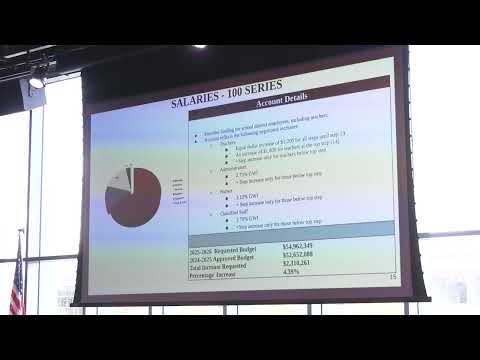
Board discussion and line‑by‑line review focused on salary and personnel costs, insurance and special education. Dan Zatoon, assistant superintendent for finance and operations, described the 100 series (salaries) as the largest portion of the operating budget, accounting for about 65% of recommended spending, and explained the district's approach to 0‑based budgeting and teacher turnover. "The way we try to adjust it and try to be good financial stewards is looking at and you'll see eventually, like, the subline. The subline is flat," Zatoon said.
Key budget drivers and changes included: - Personnel: The salary series increases reflect contractual obligations and staffing changes, including an added 2.9 certified full‑time equivalent (FTE) positions and 10.82 non‑certified FTEs. The district also budgeted step and contractual increases across multiple employee groups. - Special education: The services series and transportation were cited repeatedly as major drivers. Board members and staff described special‑education costs as volatile and rising; the board noted state reimbursement (the "excess cost" program) has fluctuated in recent years and currently fell well short of full cost, leaving districts to manage the gap. - Insurance: The board approved a recommendation from a consultant (1Digital) to move a retiree prescription drug group from self‑insured to fully insured; staff projected approximately $700,000 in claims savings in the retirees' account and reduced the health insurance line accordingly. - Facilities and maintenance: Some pandemic or one‑time reductions from 2024–25 were restored in equipment and projects; major projects and roof and building maintenance needs were discussed as an area where underfunding can create future emergency costs.
Board action: workshop approvals were taken for each page/line item (central office, principals, teachers, substitutes, paraprofessionals, benefits, transportation, utilities, building repairs, supplies and others). Most line items were approved by voice vote; the board recorded one roll‑call style exception: preliminary professional staffing (page 4) passed by a 7–1 voice vote with Board member Angela casting the lone nay. The board approved tentative budgets across the remaining pages and then voted to tentatively approve the full operating budget (page 101) at $83,240,983.
Why it matters: Board members emphasized special‑education funding uncertainty and said the state and federal policy context will affect the district's final budget picture. Several members urged continued outreach to state legislators and attendance at public hearings to press for more predictable reimbursements. Staff said they would return to the board Monday with answers to follow‑up questions and updated materials for final action.
Next steps: The board's tentative approval sends the recommended budget to the town council process; the board expects to reconvene Monday for final approval. Staff said they will supply the board with requested scenario figures (for example, how the budget would change under higher state excess‑cost reimbursement) and any updated insurance projections before that meeting.
Votes at a glance - Tentative approval, superintendent's recommended operating budget (page 101, grand total): approved (motion carried; final tentative total $83,240,983; 4.65% increase). - Preliminary professional staffing (page 4): tentatively approved; recorded vote 7–1 (Angela: nay). - Teacher salaries (page 5): tentatively approved. - Employee health insurance (pages 16–18): tentatively approved; staff reduced the retiree RX projection by $700,000 based on consultant recommendation. - Multiple line items (pages 1–100) including transportation, utilities, maintenance projects, supplies and new/replacement equipment: tentatively approved in individual motions during the workshop.
Attribution: Quotes in this article are taken from the Feb. 1 Farmington Board of Education budget workshop transcript and are attributed to speakers recorded there.