Get Full Government Meeting Transcripts, Videos, & Alerts Forever!
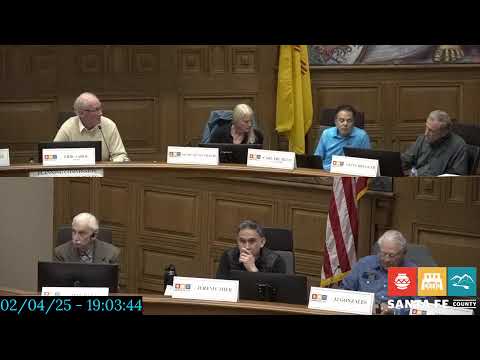
Santa Fe County planning commission approves AES Rancho Viejo solar-plus-storage conditional use permit over objections
Summary
The Santa Fe County Planning Commission voted to approve a conditional use permit for AES's Rancho Viejo 100 MW solar project paired with battery storage after a multi-day public hearing; the approval was granted with staff conditions and a 12-month permit-extension request, and it passed on a roll-call vote.
The Santa Fe County Planning Commission voted to approve a conditional use permit (CUP) for the AES Rancho Viejo solar and battery energy storage system after a multi-day public hearing and a closed-session deliberation. The commission approved the CUP with the staff-recommended conditions and added a 12-month extension to the permit timetable; the motion passed on a roll-call vote with six votes in favor and one opposed.
The vote concluded two days of hearings that included expert testimony, a county technical review, a third-party fire and hazard review, and more than three hours of public comment from residents both for and against the project. Opponents told the commission the 700-acre project, which AES describes as a utility-scale solar farm paired with battery energy storage, poses unacceptable risks to nearby neighborhoods, could strain local emergency response, and did not fully address changed permitting requirements in county code. Supporters said the facility would supply low-cost, local renewable power and generate local economic benefits.
Why it matters: The project combines large-scale solar arrays and a lithium-ion battery energy storage system (BESS). Opponents and the county's hearing officer flagged public-safety and siting concerns because homes and subdivisions sit within about a mile of the proposed site; the hearing officer's recommended order concluded the evidence supported denial, saying the project would be "detrimental to the health, safety, and general welfare of the area." The commission's approval does not itself guarantee a power purchase agreement or construction: the project will still need final technical approvals and the market and regulatory steps required to secure delivery to the grid.
Commission and staff findings - Staff concluded the environmental impact report (EIR) and application record were sufficient for moving forward with CUP consideration but identified multiple conditions that must be met before a development (vertical) permit can be issued. - The county's independent fire and hazard reviewer (ATAR) supplied a lengthy critique of the hazard mitigation analysis (HMA) and 30% design submissions, listing numerous items…
Already have an account? Log in
Subscribe to keep reading
Unlock the rest of this article — and every article on Citizen Portal.
- Unlimited articles
- AI-powered breakdowns of topics, speakers, decisions, and budgets
- Instant alerts when your location has a new meeting
- Follow topics and more locations
- 1,000 AI Insights / month, plus AI Chat