Get Full Government Meeting Transcripts, Videos, & Alerts Forever!
Get email alerts on the Energy Infrastructure topic
No spam. Unsubscribe anytime.
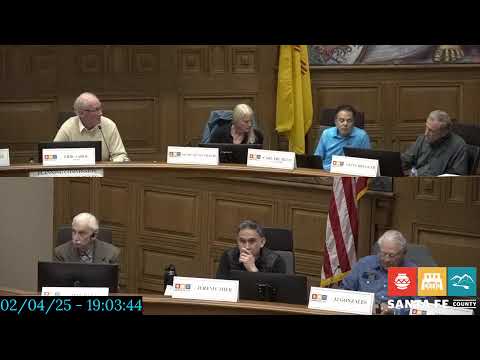
Santa Fe County planning commission approves AES Rancho Viejo solar-plus-storage conditional use permit over objections
Summary
The Santa Fe County Planning Commission voted to approve a conditional use permit for AES's Rancho Viejo 100 MW solar project paired with battery storage after a multi-day public hearing; the approval was granted with staff conditions and a 12-month permit-extension request, and it passed on a roll-call vote.
The Santa Fe County Planning Commission voted to approve a conditional use permit (CUP) for the AES Rancho Viejo solar and battery energy storage system after a multi-day public hearing and a closed-session deliberation. The commission approved the CUP with the staff-recommended conditions and added a 12-month extension to the permit timetable; the motion passed on a roll-call vote with six votes in favor and one opposed.
The vote concluded two days of hearings that included expert testimony, a county technical review, a third-party fire and hazard review, and more than three hours of public comment from residents both for and against the project. Opponents told the commission the 700-acre project, which AES describes as a utility-scale solar farm paired with battery energy storage, poses unacceptable risks to nearby neighborhoods, could strain local emergency response, and did not fully address changed permitting requirements in county code. Supporters said the facility would supply low-cost, local renewable power and generate local economic benefits.
Why it matters: The project combines large-scale solar arrays and a lithium-ion battery energy storage system (BESS). Opponents and the county's hearing officer flagged public-safety and siting concerns because homes and subdivisions sit within about a mile of the proposed site; the hearing officer's recommended order concluded the evidence supported denial, saying the project would be "detrimental to the health, safety, and general welfare of the area." The commission's approval does not itself guarantee a power purchase agreement or construction: the project will still need final technical approvals and the market and regulatory steps required to secure delivery to the grid.
Commission and staff findings - Staff concluded the environmental impact report (EIR) and application record were sufficient for moving forward with CUP consideration but identified multiple conditions that must be met before a development (vertical) permit can be issued. - The county's independent fire and hazard reviewer (ATAR) supplied a lengthy critique of the hazard mitigation analysis (HMA) and 30% design submissions, listing numerous items the county and fire marshal said must be provided before final approval; the county's fire marshal told the commission the materials were not yet at the level of detail needed for code compliance but said they could be made compliant through iterative plan review. - Hearing officer Marilyn Herbert recommended denial in her December recommended order, saying the project posed "unreasonable risk" because of its scale (AES's filings state roughly 200,000 photovoltaic panels and approximately 570,000 lithium-ion cells in packaged containers) and proximity to residential neighborhoods.
What opponents said Opponents, including neighborhood groups and dozens of residents who spoke at the hearing, raised three recurring concerns: fire risk and toxic smoke plumes from thermal runaway events in lithium-ion batteries; the project's proximity to thousands of homes (the hearing officer described the area as serving about 25,000 residents); and perceived gaps in the county's permitting and emergency-response preparedness, particularly the absence of a county hazardous materials team and a current all-hazards emergency response plan. Many speakers cited recent BESS incidents outside New Mexico, especially the January 2025 Moss Landing facility fire in California, as evidence that large BESS installations can produce multi-day fires and airborne contaminants.
"All these accidents are related and connected to AES or its subsidiaries ... they all involve harm," said Ashley Schonauer, a witness who identified herself as a retired attorney and former New Mexico Public Regulation Commission hearing examiner. "The frequency of these accidents is actually increasing, not decreasing," Schonauer said, and criticized the application for deferring final hazard mitigation and first-responder planning until after CUP approval.
Opponents also urged the commission to delay CUP decisions until the county had adopted siting standards and other requirements intended for large BESS projects; several speakers advocated a moratorium on large-scale BESS siting until countywide standards and a Development of Countywide Impact (DCI) review process were established.
What proponents and the applicant said AES and supporters argued the project would provide local renewable energy, fixed-price power for decades and local economic benefits. The applicant emphasized that modern industry standards, certifications and testing protocols (including NFPA and UL test standards) have evolved since earlier BESS incidents and that AES's design would follow those updated codes. The applicant told the commission it had performed UL 9540A-style testing and would meet NFPA 855 and other applicable standards; the applicant's representative highlighted the company's experience developing large renewable projects nationally and said the company would implement additional safety layers beyond what codes require.
"AES deploys multiple flavors of lithium-ion chemistry," a company representative said in testimony. "The variety we presented is the most cost-effective for this project," the representative added, noting the tradeoffs the developer considered among lifecycle cost, degradation and system design.
Staff, consultants and the fire marshal County staff told the commission the EIR was sufficient to consider the CUP but that the application lacked some of the project-level detail that must be provided before a development permit is issued. The county's third-party fire and hazard reviewer (ATAR) and the county fire marshal both said the HMA and design documentation were incomplete at the 30% design stage and listed many items that must be submitted in subsequent plan sets and in final HMA reports.
Santa Fe County Fire (witnessed testimony by Jeff Carroll) and ATAR said a final, site-specific HMA, thermal-runaway propagation analyses, smoke-and-gas plume modeling and a first-responder plan must be completed and reviewed before the project can be cleared for vertical construction; the fire marshal noted those documents are typically completed prior to building permits and are subject to iterative plan review.
The commission's action and next steps The commission motion approved the CUP with the staff-recommended conditions and included an extra 12-month extension request the applicant had asked for; the motion was made by Commissioner Gonzales and seconded by Commissioner Dan Pava. The motion passed on roll call (motion recorded as passing after the recorded votes: Mister Gonzales ' yes; Mister Berger ' no; Commissioner mayor ' yes; Mister Perrard ' yes; Mister Pava ' yes; Trujillo ' yes). The commission then closed the public hearing record and recessed to a later meeting date for follow-up items.
Approval does not guarantee construction or a power contract. AES said it plans to submit bids to PNM's then-current solicitation; the applicant noted May 14, 2025 as a deadline for a PNM solicitation referenced in testimony. If AES secures a PNM bid award and a power purchase agreement, the project will still require final plan reviews, the HMA and fire-safety deliverables to be reviewed and approved by the county and its fire marshal before a development (vertical) permit or building permit is issued.
Evidence and remaining questions The record contains competing technical assessments: the county consultant and fire marshal flagged missing site-specific hazard analyses and expressed concern about emergency-response capacity; the applicant supplied laboratory and UL-style demonstration testing and committed to comply with NFPA 855 and UL 9540A-level tests. The hearing officer's recommended order remains in the record and recommended denial, citing proximity to residences, the asserted scale of the hazard, and the lack of potentially required siting standards in county regulations.
The commission's approval, conditioned on the list of staff and fire marshal items and subject to iterative plan review and final HMA approvals, moves the application forward to the next regulatory and market milestones. The project will require final design compliance, applicable plan approvals from Santa Fe County and, if AES seeks a PNM contract, PNM selection and the regulatory approvals associated with a PPA before construction can begin.
Ending The commission's approval ends the county-level CUP decision on this application but begins a multi-step implementation path that will require final hazard analyses, additional plan review and regulatory approvals. Local residents and organizations said they will continue to watch the project as those technical and regulatory steps proceed.