Get Full Government Meeting Transcripts, Videos, & Alerts Forever!
Get email alerts on the Water Treatment Gac Pfas topic
No spam. Unsubscribe anytime.
Wausau Water Works reviews new GAC plant operations, PFAS funding and lead-service loan timing
Summary
Commissioners discussed initial operations and uncertain operating costs for the newly commissioned granular activated carbon (GAC) plant, steps to close DNR-backed lead service line loans, and options for containing ongoing O&M costs tied to PFAS treatment.
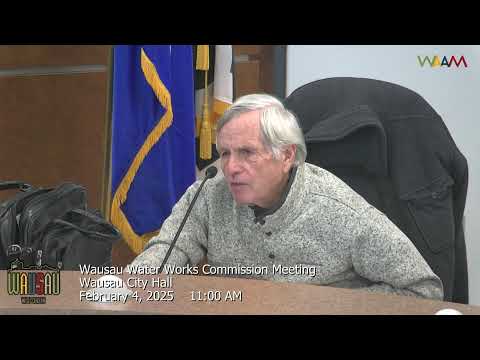
Wausau Water Works Commission members on Feb. 4 reviewed early operations at the new granular activated carbon (GAC) treatment plant, discussed state loan closings tied to the lead service line replacement program, and debated how to fund long-term operation and maintenance (O&M) costs for PFAS controls.
The Director reported that the City Council approved an amendment to the master partnership agreement with Community Infrastructure Partners as proposed by the Wisconsin Department of Natural Resources (DNR), and that once the agreement is posted to the DNR website the utility can move toward closing its 2024 loans and set a date to close 2025 loans. "Biggest major update was the Council approved the latest amendment... Once we get that uploaded to the DNR website, we should be able to move towards closing on the 2024 loans, as well as establishing a date for the 2025 loan closing as well," the Director said.
Commissioners and staff said the GAC facility has just been in operation about six weeks, so many operating expenses remain estimates. A staff memo presented at the meeting noted it is "hard to normalize a lot of these costs" at this early stage. Commissioners pressed staff to track O&M carefully and to seek assurance from state and federal policymakers that O&M costs for PFAS treatment will be eligible under any forthcoming funding streams.
"I think that we really need to track what our O and M costs are," Commissioner Robinson said, adding that the commission should press policymakers to ensure O&M is an eligible activity. Staff noted outreach and advocacy will continue as state budget and grant programs develop.
Staff also reviewed projected costs for carbon regeneration and disposal. One memo item listed a regeneration cost range described in the meeting as "from 800 to 1.4" (units were not specified in the meeting record). Staff cautioned that market availability of granular activated carbon could push costs upward, and that reusing regenerated carbon in a drinking-water facility would require DNR approval; currently the DNR has not allowed regenerated carbon for drinking water without a formal variance or pilot. Staff said regeneration pathways can reduce net disposal costs but would not automatically eliminate replacement costs without regulatory approval.
Other operational notes: Trojan-brand UV replacement parts previously sourced from Canada are reportedly being manufactured at a new Michigan facility, and staff said regular maintenance items that are returned to Canada for service remain subject to international service pathways. The commission also heard that the wastewater treatment plant will receive an "award of excellence for operations" from the Wisconsin DNR at a February government-affairs seminar; staff said they expect representatives to accept the award in Fond du Lac on Feb. 20.
The discussion closed with staff and commissioners agreeing to monitor O&M expenditures, pursue clarity from the DNR on reuse and variance pathways for carbon regeneration, and continue outreach to state policymakers about eligibility of O&M costs under PFAS-related funding programs.