Get Full Government Meeting Transcripts, Videos, & Alerts Forever!
Get email alerts on the Parking Reform topic
No spam. Unsubscribe anytime.
Wilsonville staff recommends citywide removal of parking minimums as state CFEC rules take effect
Summary
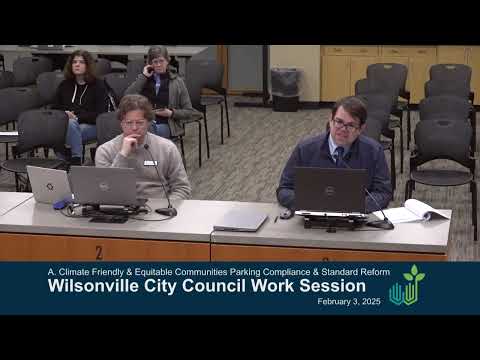
City planning staff and consultants on Feb. 3 told the Wilsonville City Council that state rules under Oregon’s Climate‑Friendly and Equitable Communities program will remove many local parking minimums and that staff and the Planning Commission are recommending Option 1 — eliminating parking minimums citywide where the state rule does not already apply.
City planning staff and consultants on Feb. 3 told the Wilsonville City Council that state rules under Oregon’s Climate‑Friendly and Equitable Communities (CFEC) program will eliminate many local parking minimums and that staff and the Planning Commission are recommending Option 1 — removing parking minimums citywide where the state rules apply.
The presentation explained why the state rules exist, how they apply locally and what choices remain for Wilsonville to manage parking, design, and related requirements such as electric‑vehicle (EV) charging infrastructure. Staff emphasized the rule known in the presentation as “parking A” (already in effect for large parts of the city because of transit proximity) and “parking B,” the remaining areas where the council must select one of three compliance approaches.
Why it matters: Oregon’s CFEC rules are land‑use regulations that supersede conflicting local parking minimums in the areas they cover. The changes will affect how future residential, commercial and industrial developments are designed across Wilsonville — particularly where the city has relied on minimums to ensure onsite parking. Councilors asked how the city can protect access to parking, maintain neighborhood livability, and avoid regressive costs for affordable housing.
Details from staff and consultants Daniel Polly, Wilsonville’s city planning manager, said the state’s CFEC rules derive from a March 2022 executive order directing agencies to reduce climate pollution and subsequent state rulemaking. Polly told the council that the state’s “transit proximity” rule removes parking minimums inside a half‑mile buffer of a frequent transit route (in Wilsonville the presentation identified SMART’s Route 4 along Wilsonville Road) and inside a three‑quarters‑mile radius of rail transit (the West Station). Polly said this transit proximity coverage already puts “much of the city” into the exempt category under “parking A.”
Consultants described the three local “parking B” choices for the remaining areas: Option 1 would remove parking minimums across the city; Option 2 would remove minimums but allow the city to adopt a short list of targeted tools (for example, “unbundled parking” and limits on residential parking requirements); Option 3 would adopt a prescriptive package of reforms and requires demonstrable parking management (metering or residential permits) in affected areas. The Planning Commission, staff and the consultant said that because the transit buffers already exempt a large share of the city, Option 1 is the simplest to administer.
City attorney and legal context Polly and the consultant reviewed litigation around the rules and told the council the Oregon Court of Appeals rejected a challenge to the CFEC rules and the Oregon Supreme Court denied review; the city attorney confirmed the council does not have a viable path to separate litigation today. The city attorney advised that because these are state land‑use regulations, a local parking minimum that conflicts with the state rules would risk reversal on appeal.
Questions and concerns from councilors Councilors pressed staff on several recurring themes: whether affordable housing and small units are exempt; who pays for EV‑ready conduit; whether underwriters and developers will still build parking if minimums are eliminated; and whether reduced requirements would produce on‑street parking pressure in older neighborhoods.
Staff said affordable housing (defined in the presentation as housing for households ≤80% of area median income) and residential units 750 square feet and smaller (including accessory dwelling units) are already exempt under the state rule and would remain exempt regardless of the local option chosen. Staff also noted that the state rule includes requirements for EV infrastructure (conduit) when parking is built, but that the cost and enforcement questions remain and that any carve‑outs or waivers must be pursued with state agencies.
Practical examples Polly and the consultant cited recent Wilsonville industrial approvals to illustrate market behavior: the Parkworks campus building was described as proposing 262 spaces versus 191 spaces that would have been required under minimums; another approval (Precision Countertops) illustrated developers providing slightly more than the minimum (61 required, 71 proposed). Staff said industrial and many commercial developments historically over‑provide parking based on underwriting and market expectations, which reduces the risk of under‑parking in industrial zones.
Next steps Staff asked the council whether it wants to direct code amendments toward Option 1, or to study Options 2 or 3 further. The Planning Commission’s position, and staff’s recommendation in the work packet, was that Option 1 makes the most sense for Wilsonville. Staff said it will return with draft development‑code amendments once the council indicates its preferred option.
Ending Councilors asked staff to continue community outreach and to identify specific tools the city can use — short‑term permit zones, one‑side parking restrictions, or other parking management measures — to address neighborhood‑level parking conflicts if minimums are removed. Staff said they will also check with state agencies about possible EV‑related exemptions for affordable housing and will return with code language and an implementation plan.