Get Full Government Meeting Transcripts, Videos, & Alerts Forever!
Get email alerts on the Homelessness Encampments topic
No spam. Unsubscribe anytime.
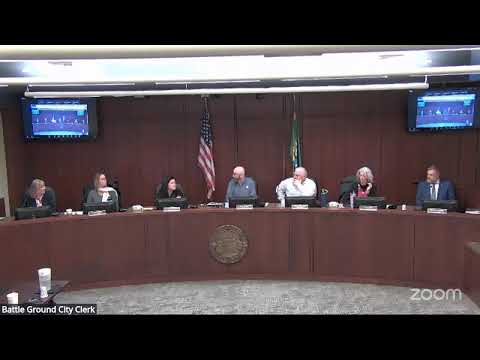
Battle Ground adopts ordinance banning camping on public property
Summary
After a public hearing, the Battle Ground City Council adopted Ordinance 2025-02, prohibiting camping on city-owned property; council voted unanimously after hearing public support and staff warnings about legal challenges elsewhere.
The Battle Ground City Council adopted Ordinance 2025-02, prohibiting camping on public property, after a public hearing and discussion at its regular meeting. The council vote was recorded as unanimous (6-0).
Staff opened the public hearing and told the council the item had been presented to them previously on Jan. 6. Resident David Terry and longtime resident Richard Lewis testified in support. “I wholeheartedly support it,” Terry said, praising the measure as “comprehensive” and saying it will “give our city the tools to limit the effects of homelessness” while acknowledging limits to enforcement such as fines. Lewis told the council he had handled an encampment on his own commercial property when he felt staff and police were constrained.
Mayor McCoy described the ordinance as “one part of a multifaceted approach to homelessness,” noting the city will continue other work on the issue. The mayor also told the council staff are aware of litigation elsewhere, saying “there’s even another lawsuit coming out to stay the current ordinance down in Grants Pass,” a point staff and the city attorney will monitor. City staff asked the council to open the hearing, take testimony, close the hearing and consider adoption as presented.
Following the hearing the council moved to adopt Ordinance 2025-02. The council’s roll was recorded as six votes in favor, none opposed. The ordinance title read on the record described the measure as prohibiting camping on public property, establishing penalties, and providing for severability and an effective date; the text of that effective date and implementation steps were not specified on the record. Staff said they would proceed with the ordinance and legal review as needed.
The ordinance is intended to give city staff enforcement tools related to unauthorized encampments; several speakers and council members emphasized the ordinance is only one part of a broader approach that includes housing, social services and outreach. The transcript records public concern that fines and dispersal do not by themselves prevent people from moving between encampments and that complementary services are required.
City staff did not state a specific effective date for the ordinance on the meeting record. The council’s vote followed the public hearing and a motion to adopt; no amendments were recorded during the meeting.