Get Full Government Meeting Transcripts, Videos, & Alerts Forever!
Get email alerts on the Interlocal Agreements topic
No spam. Unsubscribe anytime.
Council signals caution on Valley Transit interlocal: staff should require indemnity or project‑by‑project agreements
Summary
Council members advised staff to protect the city’s liability and staffing availability when partnering with Valley Transit on bus‑stop and capital work; staff and Valley Transit have discussed mutual indemnification and project‑specific requirements.
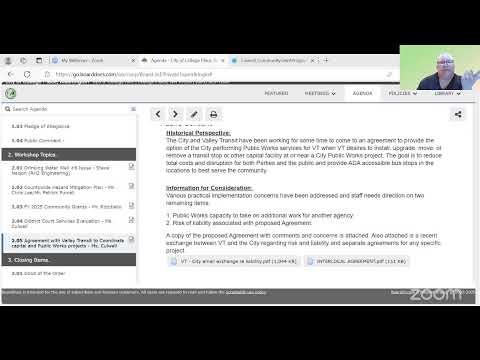
City attorney and staff briefed the council on a proposed interlocal agreement with Valley Transit that would let the transit agency ask the city to implement bus‑stop/capital improvements as part of road projects. The agreement now under review would allow Valley Transit to seek the city’s public‑works assistance on identified projects to achieve cost savings and co‑benefits.
City counsel explained the core issue: if Valley Transit brings design documents or a third‑party engineer’s product to the city and then asks City crews to implement the work, the engineer’s indemnity toward Valley Transit may not extend to the city. The city’s risk pool recommended either (a) mutual indemnification between public agencies for general projects or (b) a project‑by‑project approach requiring that the scope, insurance and indemnity protect the city when third parties are already engaged.
Several council members urged staff to protect the city by requiring indemnity that covers the city or, where necessary, to decline turnkey requests if project‑level insurance and indemnity are not provided. Council member Espinosa said mutual indemnification or requiring Valley Transit to hold the city harmless for work they request would be prudent: “Asking them to indemnify us and hold the city harmless for the work that they perform, would be a wise move,” he said.
Valley Transit board members and director Angie Peters were described as open to efficient processes; Council member Sherman (who serves on the Valley Transit board) said an email from Peters indicated she saw no problem with proposed mutual indemnification language and that Valley Transit seeks to avoid duplicative project‑level negotiations when possible. Staff said Valley Transit currently contracts some bus‑stop ADA upgrades directly with concrete contractors and that Eighth Street work has been on Valley Transit’s radar.
Council direction: staff should continue negotiating language that protects the city’s liability exposure, require project‑level insurance/indemnity when third‑party engineers or products are involved, and retain council approval discretion if staff capacity is insufficient. No formal vote was taken Tuesday.
Ending: Staff will return to Valley Transit with guidance and seek mutually acceptable contract language and project procedures.