Get Full Government Meeting Transcripts, Videos, & Alerts Forever!
Get email alerts on the Hazard Mitigation topic
No spam. Unsubscribe anytime.
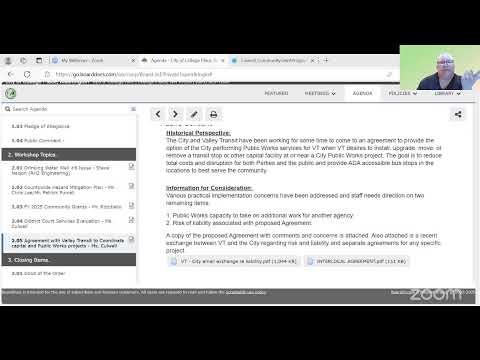
Walla Walla County emergency manager presents updated multi-jurisdiction hazard mitigation plan to College Place council
Summary
County Emergency Management director Chris Lee briefed the council on a 5‑year FEMA-required, multi-jurisdiction Hazard Mitigation Plan update, describing risk assessments, community engagement and how the plan supports grant applications for mitigation projects.
Chris Lee, director of Walla Walla County Emergency Management, told the College Place City Council the county’s 2024 Hazard Mitigation Plan update is intended to meet FEMA requirements and to keep jurisdictions eligible for mitigation funding.
Lee said the multi-jurisdiction plan — which lists Walla Walla County, the City of Walla Walla, College Place, Waitsburg, Prescott, Walla Walla Public Schools and the Conservation District as adopting jurisdictions — updates risk assessments, historical hazard inventories and mitigation actions. “A hazard mitigation plan is…required by FEMA if you were to put in for any mitigation or funding opportunities,” Lee said.
Lee described the planning process as extensive and collaborative. He said the effort included participation from local nonprofits, social service groups and facilities serving people with access and functional needs so those populations are considered in mitigation and funding strategies. He noted the plan now addresses climate-change considerations and new events (for example, the Tiger Creek fire and last November’s bomb cyclone) that were not in the last plan.
The plan breaks hazards down by jurisdiction and ranks likelihood and consequence to guide funding priorities, Lee said. He pointed the council to the plan’s risk assessment tables and to project lists (for example, seismic work on reservoirs and culvert improvements). “When FEMA is evaluating projects and people are going after money, they have a very thorough document that outlines everything to help them understand this region,” Lee said.
Lee said the plan will remain a living document; staff expect to submit the final draft to the state and FEMA and then add recent events as revisions before hazard seasons. He also described how the plan lists about 21 potential federal, state and other funding sources and that the city’s administrator has identified several projects for College Place in the plan’s appendix.
Council members asked how the plan treats schools, floodplain development and critical facilities. Lee said College Place Public Schools were invited and are referenced in the plan; schools and critical facilities are listed as such in the risk tables. On development questions Lee said the plan does not set land‑use policy but provides risk data the city and planning department can use when making land‑use decisions. He urged jurisdictions to submit project entries and details: “If you don't put it in there, you don't stand a chance to mitigate what is going on,” he said.
Ending: Council members welcomed the plan’s focus on pets, access and functional needs and on pre-event mitigation; Lee and staff said they will forward the FEMA-submission materials and will update the plan after FEMA review.