Get Full Government Meeting Transcripts, Videos, & Alerts Forever!
Get email alerts on the Education Funding topic
No spam. Unsubscribe anytime.
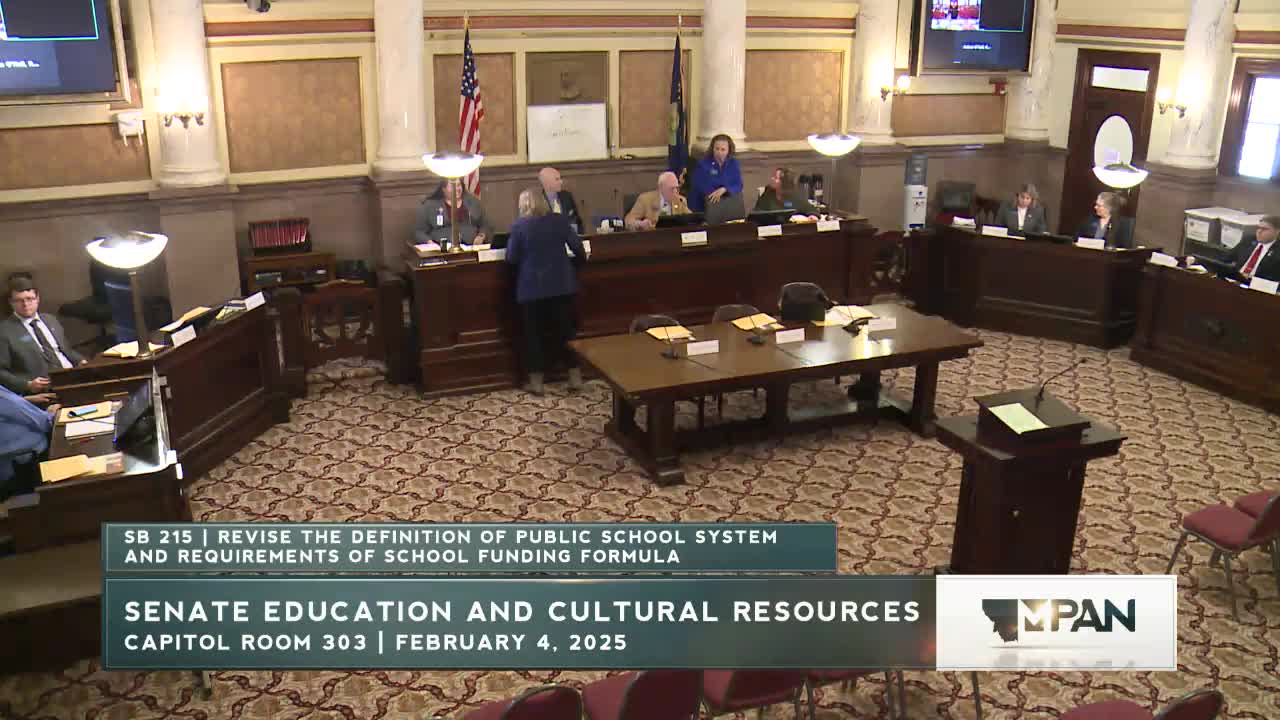
Senate hearing on SB 215 spotlights school-funding transparency and opposition from education groups
Summary
Sen. Becky Beard introduced Senate Bill 215 aiming to link inflation-adjusted funding increases to student achievement and to require clearer funding formulas. Multiple statewide education organizations testified in opposition, citing legal history, measurement problems and likely fiscal impacts; proponents were not present.
Sen. Becky Beard, sponsor of Senate Bill 215, told the Senate Education Committee that the bill would “promote the identification of educationally relevant factors while establishing funding formulae and budgets” and would require greater transparency so taxpayers can understand how K‑12 funding is allocated.
The bill drew unanimous testimony in opposition from school-district and education organizations at the Jan. 1 hearing before the Montana Senate Education Committee, which heard detailed objections about legality, measurement and costs. No proponents appeared in person or online.
The opposition’s nut graf: Several state education groups argued SB 215 would disrupt long‑standing state funding law, restate issues already scheduled for the statutorily required decennial study of school funding, and raise significant fiscal and practical concerns about tying inflationary adjustments to measures of student achievement.
Deborah Silk, associate executive director and general counsel for the Montana School Boards Association, told the committee that Title 20’s current statutory framework — including 20‑9‑309 and related provisions developed after the Columbia Falls litigation — has governed Montana school funding for two decades. Silk warned the bill’s language could invite constitutional or statutory challenges and said opponents believe the proper venue to revisit funding formulas is the decennial study. Silk also said a preliminary financial estimate discussed with the association’s staff suggested a potential state cost “about a $200,000,000 ticket” for state share increases tied to weighted factors for low‑income students and students with disabilities.
Rob Watson, executive director of School Administrators of Montana, said parts of the bill that state funding increases “should correspond to improving student achievement” do not account for fixed operating costs unrelated to achievement, such as utilities and property and liability insurance, which have risen independently. Watson said tying inflationary increases to achievement could leave districts unable to meet ordinary operating costs if achievement measures dip.
Shelly Turner, executive director of the Montana Association of School Business Officials (MASBO), expressed similar fiscal concerns and asked the committee to avoid removing local cost responsibilities without specifying who would pay for out‑of‑district students under expanded open‑enrollment language in the bill.
Witnesses from the Montana Federation of Public Employees (MFPE), the Montana Rural Education Association and the Montana Quality Education Coalition (MQEC) also opposed the bill. Kim Popham, MFPE director of public policy and research, described in detail how circumstances outside the classroom can affect student performance and said “tying inflationary adjustments to student achievement is just very difficult to do.” Doug Reisig, executive director of MQEC, said MQEC — a party to the Columbia Falls litigation referenced in testimony — was concerned the bill assumes a direct, measurable correlation between increased dollars and improved student outcomes and that the bill’s transparency requirement may be “not achievable” without clearer definitions.
Several senators questioned how “achievement” would be measured and how the bill would affect very small or rural districts that do not always produce the statewide test cohorts used for accountability. Senator Olson asked the sponsor for proponents; Sen. Beard said the bill was her own initiative and acknowledged she had not sought proponents. Senators also asked whether the bill set directives for the upcoming decennial study; Beard said the bill was intended to add “sunlight” to how funds are spent and to help taxpayers understand the return on education spending.
Mr. McCracken, a school‑finance presenter to the committee (role listed as staff member in the hearing), answered a committee question by saying educational resources such as explanatory videos could help make school funding more understandable to taxpayers, an approach several senators said they supported as a complement to any statutory change.
No formal action was taken on SB 215 during the hearing. Sen. Beard concluded by asking the committee to pass the bill so taxpayers would have greater transparency; opponents requested that the committee consider the bill’s effects as part of the decennial study and asked lawmakers to address unresolved measurement and fiscal issues first.
Ending: The committee closed the SB 215 hearing with the bill still under consideration and no vote recorded. Committee members who spoke signaled divergent views about student representation and measurement, and witnesses urged using the decennial study and other technical resources to resolve open questions before adopting the bill’s proposed changes.