Get Full Government Meeting Transcripts, Videos, & Alerts Forever!
Get email alerts on the Technology Ai Computing topic
No spam. Unsubscribe anytime.
Montana senators hear bill to establish a ‘right to compute’ and require AI infrastructure planning
Summary
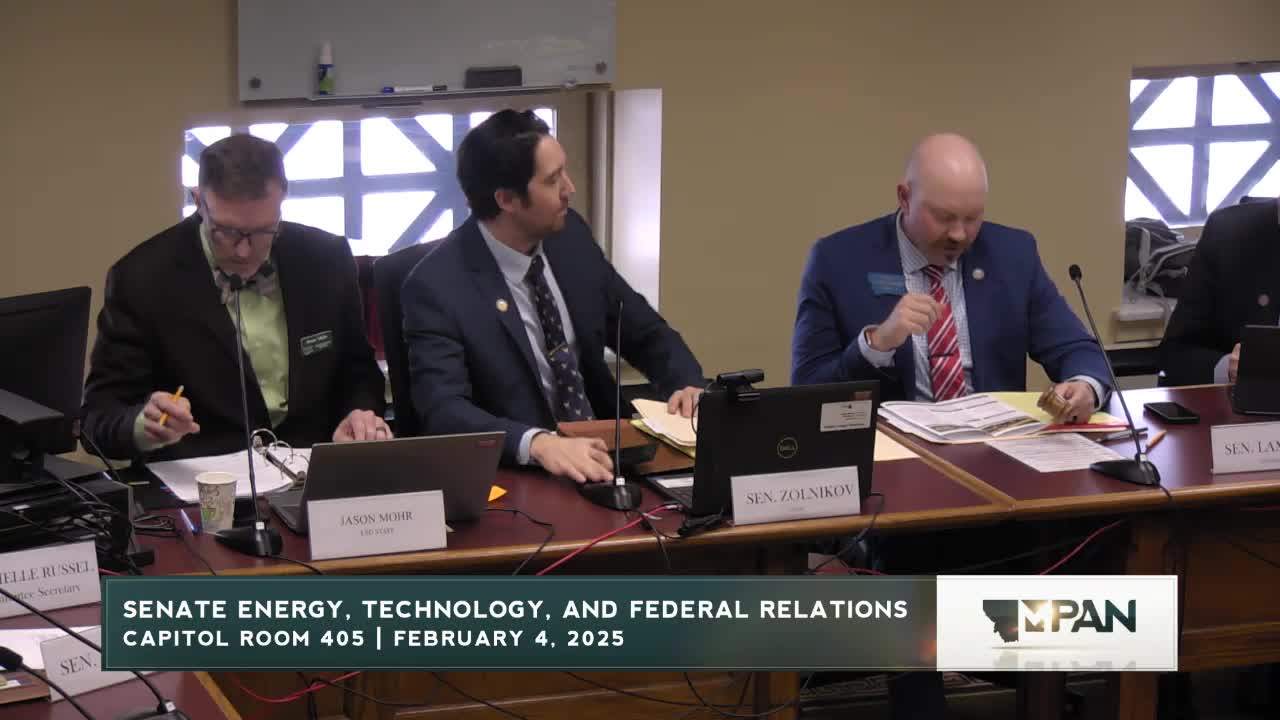
A Senate Energy Committee hearing on Senate Bill 212 centered on a proposed state “right to compute,” industry enthusiasm for data centers, and widespread concern about a provision requiring shutdown/disable capabilities for AI-controlled critical infrastructure; no formal action was taken.
Senator Daniel Zolomikov, sponsor of Senate Bill 212, told the Senate Energy Committee that the bill would establish a state policy framework recognizing a “right to compute” while carving out narrow government interests for regulation. “All AI is, is more inputs, better outputs,” Zolomikov said, urging the committee to back a law that encourages data centers and other computational investment in Montana.
Supporters told senators the bill would help position Montana to attract data center and AI investment while protecting fundamental rights. Tanner Avery, policy director at the Frontier Institute, said SB 212 “enables this by creating a new state policy framework for regulating the private use of emerging computational technologies like AI, cloud computing, and data centers” and argued the framework balances innovation and responsible governance.
Opponents focused nearly uniformly on section 4, which would require AI-controlled critical infrastructure to implement a capability to revert to human control or to disable AI systems in emergencies. Bridger Mahlum of Broadband Montana warned that the provision as written could force impractical tests of shutdown capability: “The only way for our members would to do that shutdown would be basically to unplug all the routers, which would take down the network.” Jake Lastock of CTIA, representing the wireless industry, said the approach risks creating a patchwork of state mandates that touch national-security-level infrastructure and urged federal coordination: “Critical infrastructure like wireless networks are inherently a national issue.”
Zolomikov acknowledged industry concerns and said he expects amendments aimed at replacing the term “kill switch” and the mandatory shutdown test with planning and risk-management requirements. “I think the word kill switch is a bad word,” he said, and described his goal as requiring facilities to “have a plan” so operators “have at least a plan in case something goes bad.”
Informational testimony included Kevin Gilbertson, the state chief information officer, who offered to answer technical questions about state data-center operations if needed.
The committee asked detailed questions about energy impacts, how data centers would be prioritized on the grid, and the bill’s interplay with federal standards and cybersecurity guidance. Zolomikov repeatedly said the bill is intended to be pro‑industry with limited exceptions for “compelling government interests” such as protecting critical infrastructure and preventing fraud or harm to minors. Several industry witnesses said they would work with the sponsor on language to remove or substantially rework section 4. No committee vote was taken; the hearing ended with the sponsor saying he would circulate amendments for further review.