Get Full Government Meeting Transcripts, Videos, & Alerts Forever!
Get email alerts on the State Tax Charitable Deduction topic
No spam. Unsubscribe anytime.
Committee hears proposal to create additional state charitable deduction; fiscal cost questioned
Summary
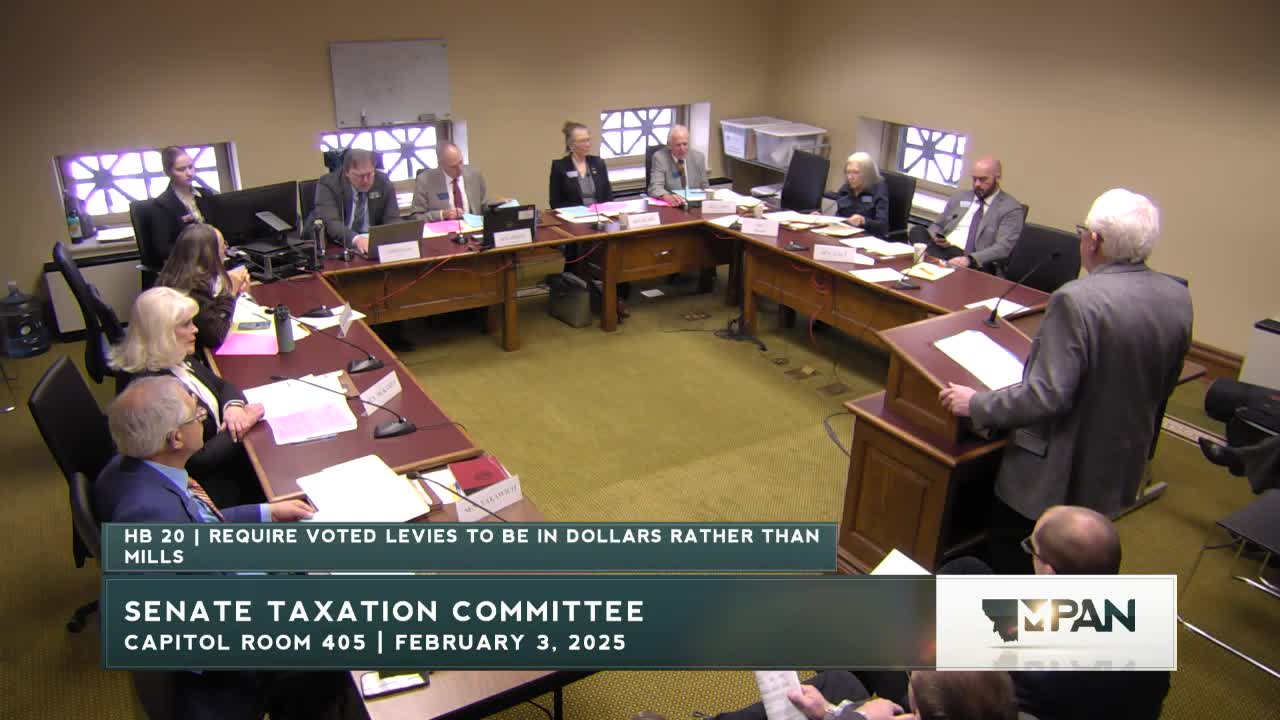
The Senate Tax Committee heard Senate Bill 157, sponsored by Senator Daniel Emerich of Great Falls, to create an additional state charitable deduction that would provide a variable benefit (described in committee as 50%) depending on a taxpayer’s federal filing choices.
The Senate Tax Committee heard Senate Bill 157, sponsored by Senator Daniel Emerich of Great Falls, which would allow an additional charitable deduction on Montana income tax returns. The bill proposes a variable deduction — described by the sponsor as a 50% benefit — that would apply differently depending on whether a taxpayer itemizes on a federal return or claims the federal standard deduction.
Senator Daniel Emerich opened the hearing by saying the bill is aimed at incentivizing philanthropy. He described the proposal as offering “a 50% tax deduction for charitable donations,” and said the additional deduction would be calculated based on the filer’s federal return treatment so that those taking the federal standard deduction would be eligible for the state deduction as framed in the bill.
The Montana Nonprofit Association supported the measure. Amy Grimales, testifying for the association of more than 700 charities, said nonprofits employ more than 12% of Montana’s workforce and that donations and the number of individual donors have been flat or declining in recent years. “For those reasons, we support this bill. We encourage a due pass,” Grimales said.
Opponents focused on the bill’s projected fiscal cost. Heather O’Loughlin of the Montana Budget and Policy Center said the Legislative Fiscal Division’s estimate projects a state revenue loss of roughly $37,000,000 per year. She noted the estimate assumes expiration of the federal Tax Cuts and Jobs Act (2017); if federal law remains in place, more taxpayers will claim the federal standard deduction and the state cost could be larger.
Alan Lloyd, representing the Montana Society of CPAs, said he and his group “reluctantly oppose” the bill because it would reintroduce complexity into the tax code just as the state recently simplified its income-tax linkage to federal taxable income.
Department of Revenue staff provided technical context. Aaron McNay said the fiscal estimate is based on the HJ 2 revenue forecast under current law; because Montana now ties its income tax to federal taxable income (Senate Bill 399, 2021), any future federal changes — in particular whether the 2017 tax provisions expire at the end of tax year 2025 or are extended — would affect how many taxpayers itemize and therefore the cost of the state deduction. “I think that it probably would have some type of impact on increasing the cost,” McNay said when discussing the scenario in which federal tax provisions remain in effect.
Committee members asked for additional analysis. Senator Fern asked whether the fiscal office could rerun estimates under the assumption that current federal provisions remain in effect; Department staff said they could provide alternative estimates but that uncertainty about federal policy makes any projection conditional.
There was no committee action at the close of the hearing. Supporters framed SB157 as a tool to boost charitable giving; opponents cited a large and uncertain fiscal impact and warned the change could complicate tax administration.