Get Full Government Meeting Transcripts, Videos, & Alerts Forever!
Get email alerts on the Housing Hoa Regulation topic
No spam. Unsubscribe anytime.
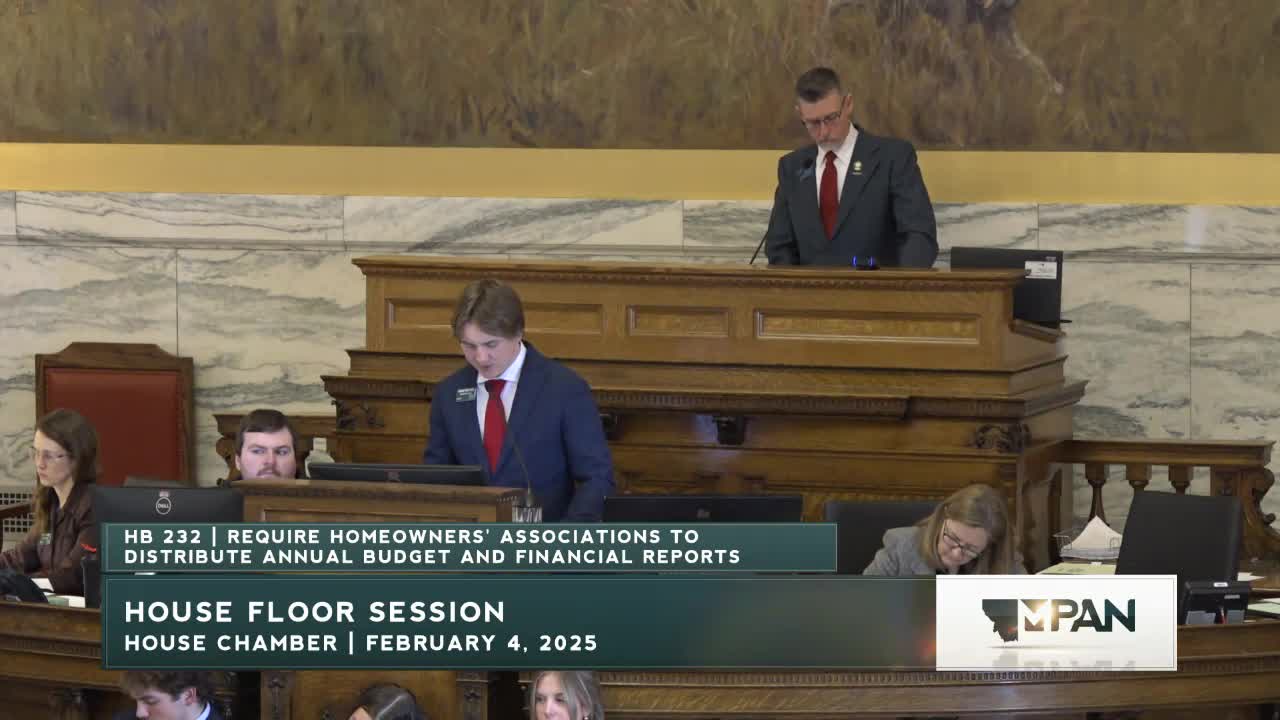
House rejects homeowners association bill after extended debate on reserves, voting and government intrusion
Summary
House Bill 232, which would have required certain homeowners associations to provide annual budgets and limit fee increases, failed second reading after prolonged floor debate over reserve funding, voting thresholds and whether the legislature should regulate private contracts.
House Bill 232, a measure to require transparency from homeowners associations and limit certain fee increases, failed second reading in the Montana House after an extended and often technical debate that split lawmakers 30-70.
Representative Falk, the bill sponsor, said the measure aims to protect homeowners from sudden fee increases and to require annual budgets and financial reports for covered associations. "I think this is a good bill for a prevention, and a homeownership affordability concern," Falk said on the floor.
Opponents, including Representative Griffith — who said he has practiced HOA law for more than 20 years — criticized provisions that they said would interfere with established reserve accounting, limit associations’ ability to levy assessments for major repairs and impose impractical voting and administrative requirements. Griffith warned the bill’s one-assessment-per-year rule would conflict with common accounting and lending practices that separate operating assessments and reserve assessments.
Supporters emphasized transparency and consumer protection. Representative Jay Hinkle described a Belgrade case where a homeowner disputed fines and the HOA threatened liens; he said requiring financial reports would help homeowners obtain information about spending decisions.
Key elements of HB232 discussed on the floor included: - A requirement for homeowners associations above a minimum size to produce annual budgets and financial reports. - A cap on fee increases of 15% (or $100, whichever is greater) absent approval by three-fifths of unit owners. - An exemption for associations with 10 or fewer parcels. - New requirements for written ballots and identification of property owners when ballots are mailed.
Critics argued the bill would intrude on private contracts, create accounting problems for condominium reserve funds and lacked carve-outs for health, safety and emergency spending. Supporters said the bill is narrow, targeted and intended to prevent sudden large increases in HOA charges.
House vote on the measure resulted in 30 ayes and 70 no, failing to advance the bill on second reading. The transcript records detailed back-and-forth about mortgage-company reserve requirements, condo assessments for limited common elements, and how ballot rules interact with existing nonprofit corporation law.