Get Full Government Meeting Transcripts, Videos, & Alerts Forever!
Get email alerts on the Wildlife Policy Wolf Reimbursements topic
No spam. Unsubscribe anytime.
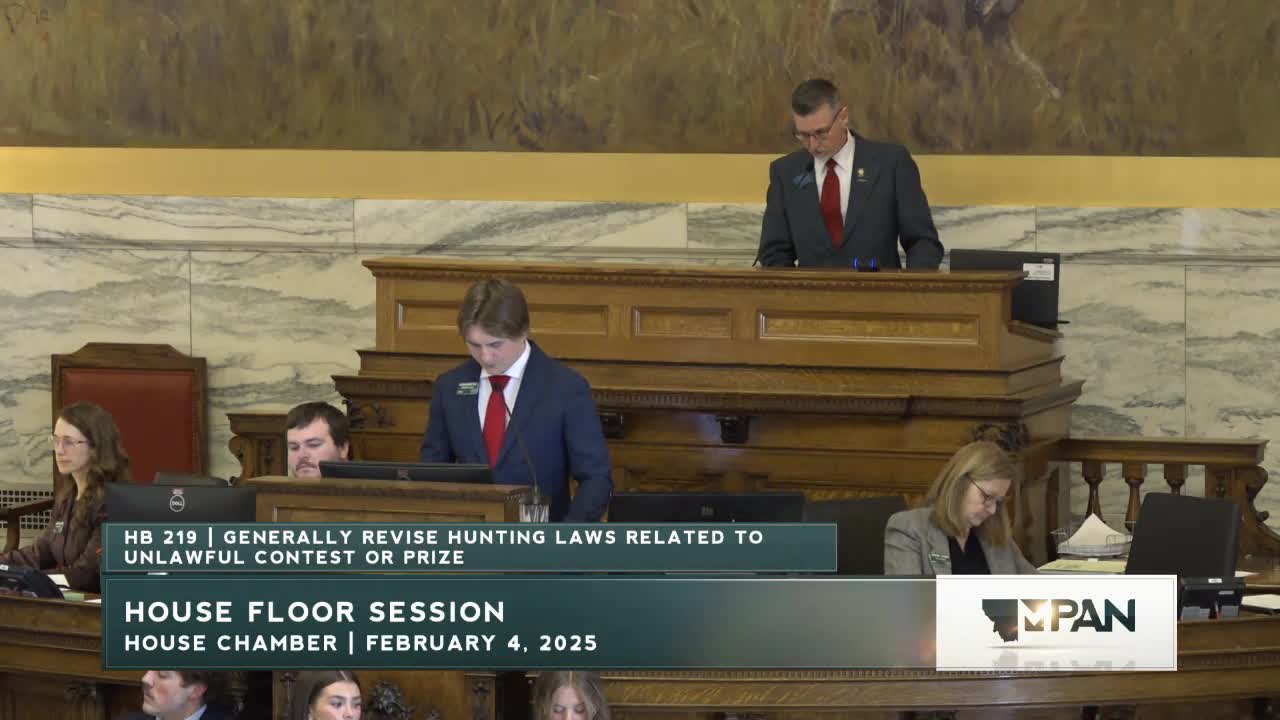
House advances bill clarifying third-party reimbursements for lawfully harvested wolves after amendment fails
Summary
House Bill 219, which clarifies eligibility for third-party reimbursements tied to lawfully harvested wolves, passed second reading after lawmakers rejected an amendment that would have required Fish, Wildlife & Parks reporting while protecting individual identities.
House Bill 219, a bill clarifying that all lawfully harvested wolves are eligible for reimbursement from third-party organizations, passed second reading in the Montana House after members rejected an amendment that would have required reporting to Fish, Wildlife & Parks about reimbursements.
Representative Schubert, the bill sponsor, described HB219 as a technical "cleanup" of 2021 legislation (Senate Bill 267) to ensure people who lawfully harvest wolves — including ranchers protecting livestock — may be reimbursed by third-party organizations that fund such payments. "This bill really is a cleanup bill," Schubert said, emphasizing that reimbursements would still come from nonprofit or third-party groups rather than the government.
Representative Konar offered an amendment to require reporting to the Department of Fish, Wildlife & Parks (FWP) on third-party reimbursements and to keep individual names and contact information confidential while allowing aggregate reporting by hunting district. Konar said the change would let the legislature monitor how reimbursement funds are used without public disclosure of personal data. "This would give us the ability as a legislature to know what groups are actually reimbursing, who is getting the reimbursement…so that we as a legislature have the information to know whether or not things are going the way that we... want them to go," Konar said.
Opponents, including Representative Schubert and Representative Jay Hinkle, argued the amendment was an unfriendly expansion that could expose hunters to harassment and that the reporting requirements warranted a separate bill and committee review. Schubert called the amendment "absolutely an unfriendly amendment" and warned it would change the bill’s intent by requiring personal information to be reported.
The House rejected the amendment by roll call, 46 ayes to 54 no. Later, HB219 passed second reading on a recorded vote of 57 ayes to 43 no.
Actions recorded in the transcript include: the adoption vote on the amendment (failed, 46-54) and the bill’s passage on second reading (passed, 57-43). The transcript shows substantial floor debate about privacy, the information FWP currently receives, and whether legislative oversight requires the proposed reporting.
The amendment text would have designated reimbursement recipient and distributor names and contact information as nonpublic to FWP while allowing aggregated district-level reporting; opponents raised concerns about whether social security numbers and addresses would be collected and stored. The floor debate did not produce a change in the bill text beyond the failed amendment, so the bill advances without a reporting requirement to Fish, Wildlife & Parks as described in the amendment.