Get Full Government Meeting Transcripts, Videos, & Alerts Forever!
Get email alerts on the Housing Board Representation topic
No spam. Unsubscribe anytime.
Montana committee hears bill to add Native American and veteran seats on Board of Housing
Summary
Sen. Susan Webber sponsored SB 219 to require at least one Native American and one veteran seat on the Montana Board of Housing. Proponents emphasized disproportionate homelessness and barriers to homeownership; staff described existing programs and appointment logistics. The committee took no formal vote at the hearing.
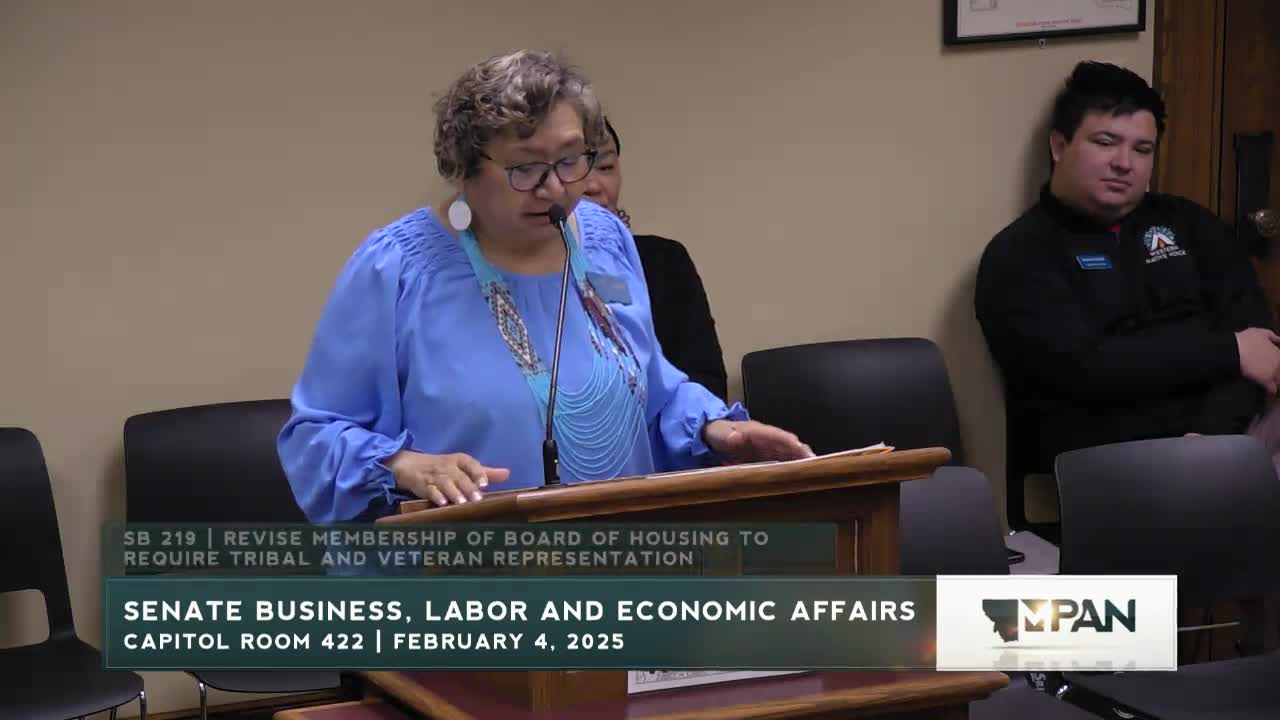
Helena — Sen. Susan Webber, sponsor of Senate Bill 219 and a member of the Blackfeet Nation, told the Senate Business, Labor and Economic Affairs Committee on Feb. 4 that the bill “is requesting a seat at the table for a Native American and a veteran on the Board of Housing.”
Why it matters: proponents and witnesses said Native Americans and veterans face higher rates of homelessness and barriers to homeownership in Montana, and that guaranteed representation on the board would bring lived experience and targeted perspective to statewide housing policy.
Webber opened the hearing by telling the committee that while the Department of Commerce had temporarily appointed a Native American member, that appointment will expire and there is currently no veteran on the board. She asked the committee for a “do pass” recommendation for SB 219.
Several proponent witnesses described the disparities they see. Lats Fourstar submitted a written letter from the Montana American Indian Caucus and told the committee that the caucus “stands in strong support to senate bill 219.” Alyssa Snow, representing the Chippewa Cree Tribe of Rocky Boy and the Blackfeet Tribe, said: “45% of Native Americans in Montana own their own homes compared to 70% of white residents. We are just under 7% of the population here in Montana, but we make up 20% of the state's homeless population.” Keaton Sunchild of Western Native Voice urged the committee to pass the bill, saying that seats for both communities would “go a long way to providing stability in reservation communities, for Native Americans off reservation, and especially for our veteran communities as well.”
Amani Kynes Coleman, a policy analyst with the Montana Budget and Policy Center and a citizen of the Crow Tribe, testified in support and cited national and state-level trends linking lack of affordable homes to increases in houselessness. Cheryl Cohen, executive director of the Montana Board of Housing (administratively attached to the Department of Commerce), appeared as an informational witness and described programs the board administers, including HUD VASH and a veterans home loan program funded from the coal trust tax fund. Cohen said, “We administer that HUD VASH program statewide.”
Committee members asked questions about existing federal and tribal programs and how the board currently functions. Senator Chris Zolnikov asked whether VA-backed home loan programs exist; Cohen confirmed the board partners with participating lenders on VA-insured mortgage products and described HUD VASH and the state’s veterans home loan revolving fund. Cohen also explained the board’s composition and workload: it has seven governor-appointed members (statute requires experience in housing, economics, or finance and at least one practicing attorney), meets monthly, and makes technical decisions on tax-credit projects and mortgage programs.
Several senators raised operational questions rather than objections: whether one appointee could fill both a Native American and veteran slot, how the governor’s appointment process works, and whether expanding the board to nine members might address attendance and expertise concerns. Webber said a candidate who meets both criteria could serve both roles; Cohen warned that adding detailed statutory requirements could make it harder to maintain a quorum because members must have technical expertise and be available to travel for monthly meetings.
No formal motion or committee vote was recorded at the close of the hearing. Webber closed by restating the bill’s intent: “this bill was just to have that voice on the board of housing.” The committee concluded the hearing and indicated potential executive actions on other bills on a later schedule.
What’s next: SB 219 remains in committee for possible future executive action; committee members and staff discussed outreach to recruit qualified applicants and the procedural steps for gubernatorial appointment and senate confirmation.