Get Full Government Meeting Transcripts, Videos, & Alerts Forever!
Get email alerts on the Legal Professions Appointments topic
No spam. Unsubscribe anytime.
Sponsor and bar groups spar over SB193 that would shift attorney-examiner appointments to governor
Summary
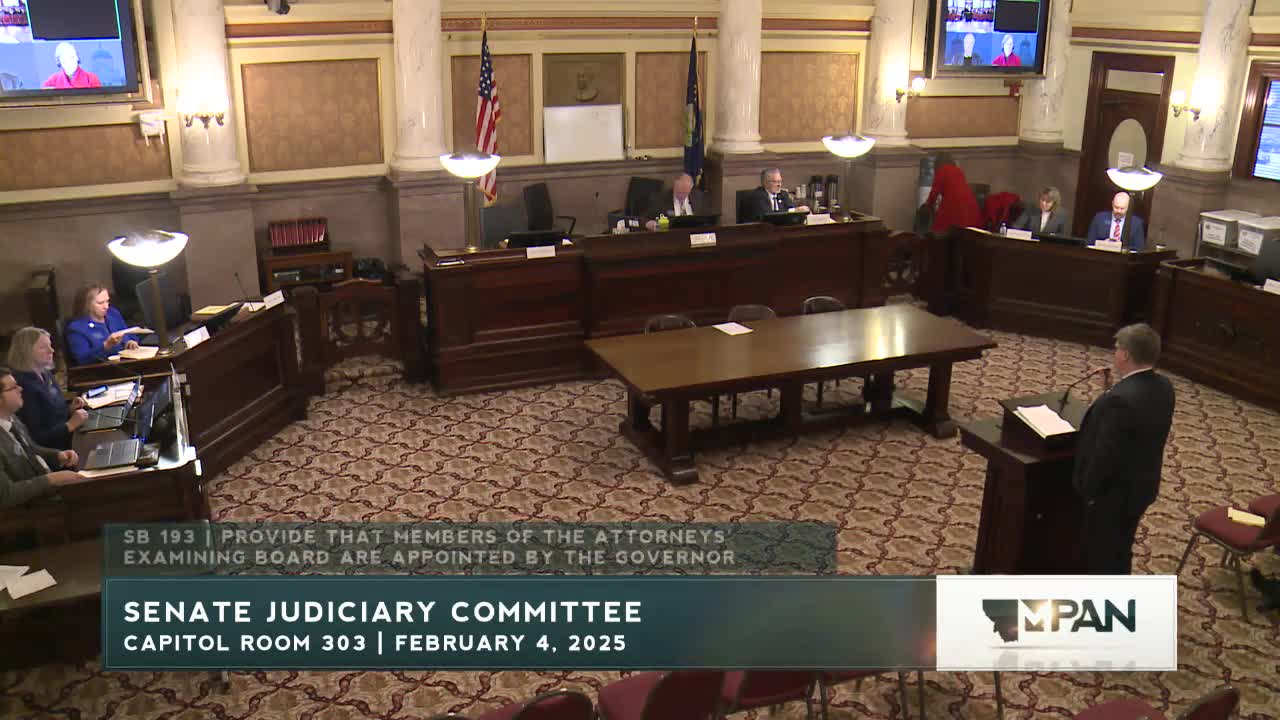
Senate Judiciary Committee Chair Greg Usher opened a hearing on Senate Bill 193, which would amend MCA 37-61-102 to shift appointing authority for the attorney's examining board from the Montana Supreme Court to the governor.
Senate Judiciary Committee Chair Greg Usher opened a hearing on Senate Bill 193, which would amend Montana Code Annotated section 37-61-102 to replace references to the Supreme Court with the governor for appointing members of the attorney's examining board.
Sponsor Sen. Jeremy Trebis of Senate District 10, Great Falls, told the committee he intends the bill to make the governor responsible for appointing members to what the draft language calls the attorney's examining board. Trebis said he is uncertain whether the change should apply to the attorney's examining board or to the Office of Disciplinary Counsel (ODC), and that he plans to work with staff on amendments. "I feel like I kinda lost my way a little bit with this bill," Trebis said in his opening remarks.
The State Bar of Montana and several attorneys who testified called the bill unconstitutional. Bruce Spencer, representing the State Bar of Montana, told the committee the Supreme Court alone regulates the practice of law under the Montana Constitution and that the statute in question predates the 1972 constitution. "You can't do this. The bill's unconstitutional. It's the court that regulates the practice of law," Spencer said, noting that the statutory examining board "is no longer in use" and that the court now relies on a Board of Bar Examiners created by court rule.
A former State Bar president who identified himself as a "concerned citizen and past president of the State Bar of Montana" echoed Spencer's view and urged the committee to table or defeat the bill. Attorney Alexander Colelli (as identified in testimony) told the committee he does not see a problem the bill fixes and said the change would conflict with separation-of-powers principles.
Committee members asked procedural and practical questions. Members noted that subsection 3 of the statute says the board "shall perform the duties and render assistance in the examinations of applicants as provided by the governor," language that would raise possible conflict with the existing Board of Bar Examiners and could require fiscal resources if the governor were to prescribe and administer examinations. Senator Smith asked whether the governor would be administering the bar exam and whether that would create a fiscal note; Trebis said he would accept amending out the exam-prescription language and would keep the core of the bill — the appointment language — if the committee wished.
The hearing produced no committee action on SB193. Trebis told the committee he would draft amendments to remove or revise the portions giving the governor authority over examinations and said he would work on whether the bill should instead reference the Office of Disciplinary Counsel. The legal note in the committee packet, and testimony from bar representatives, raised a clear separation-of-powers concern that the committee and sponsor acknowledged during questioning.
The hearing record contains questions from multiple senators about how the Office of Disciplinary Counsel is staffed and appointed (the chief disciplinary counsel is appointed by the chief justice, witnesses said) and about the historical use of the statutory board. Witnesses stated the statutory attorney's examining board has not been used for many years and that the Supreme Court now uses internally created boards and commissions to regulate the practice of law. No formal vote or motion occurred on SB193 during the hearing.
Ending: The sponsor said he will circulate amendments to address the governor-prescribed exam language and to consider whether the bill should reference the Office of Disciplinary Counsel instead of the defunct statutory board. The committee closed the hearing on SB193 and moved on to other agenda items.