Get Full Government Meeting Transcripts, Videos, & Alerts Forever!
Get email alerts on the School Consolidation topic
No spam. Unsubscribe anytime.
School board work session debates consolidation plan, Pearl Creek magnet and rural options ahead of final vote
Summary
The Fairbanks North Star Borough School District Board of Education spent its Feb. 3 work session reviewing a district recommendation that would consolidate elementary schools to address a multi-million-dollar budget shortfall and long-term enrollment decline.
The Fairbanks North Star Borough School District Board of Education spent its Feb. 3 work session reviewing a district recommendation that would consolidate elementary schools to address a multi-million-dollar budget shortfall and long-term enrollment decline. Board members and district administrators debated whether to remove any schools from the closure list, whether Pearl Creek should be kept open as a magnet school, and whether rural communities should be allowed charter or pared-down models instead of outright closures.
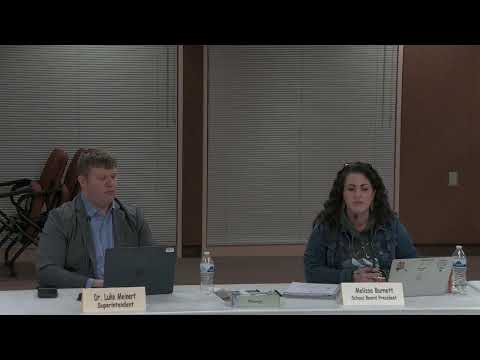
The board’s recommendation — which administration framed as necessary to right-size the district amid a roughly 20% enrollment decline and continuing fiscal uncertainty — would close a set of elementary schools and reconfigure districtwide special-education programs. Superintendent Dr. Minor and facilities staff presented the framework and told the board the package was designed to produce sustained savings and to position the district to reinvest in remaining schools. Board President Burnett said the discussion and the upcoming vote were intended to allow the district to “get through this” and move on to implementation and innovation.
Why it matters: board members said the recommended consolidations would free funds to restore services districtwide but would also carry local disruption, especially for rural communities and for Hunter Elementary, a school several members described as serving a uniquely vulnerable, walk-to population. Vice President Maple, who returned from meetings in Juneau with other district leaders, said she was considering “significantly reduced models in our rural schools” but worried about unintended impacts on remote communities. “I am struggling on principle with the concept of more schools of choice,” she said, while also noting she was not “immovable” in her position.
Major lines of debate
Pearl Creek and the magnet proposal: Several board members and community advocates have proposed converting Pearl Creek into a magnet school intended to draw students back into district enrollment. Board discussion focused on whether the district should remove Pearl Creek from the closure list and run a lottery to measure out-of-district interest before the board’s final vote. Trustees and staff agreed the district could lawfully run a magnet lottery but could not prioritize out-of-district applicants; any lottery would include in-district applicants as well. Mrs. Hardy and other board members said a successful magnet could bring significant new revenue if it drew hundreds of out-of-district students; administration noted that a full projection depends on how many would actually enroll and on whether a future state BSA (base student allocation) increase (HB 69 was discussed) passes the legislature.
Rural schools: Multiple trustees flagged 2 Rivers School and Salcha as uniquely difficult choices. Members praised local innovation — Principal Wilde and community leaders were singled out for program creativity — but noted the per-student operating cost was markedly higher for remote sites. Some trustees said they would prefer to close those schools; others urged the district to help local communities rapidly pursue charter conversions or other locally controlled models to keep buildings in community use. Mrs. Hardy recommended that, if rural schools are closed, the district expedite charter-application assistance and filing to meet state timelines (the board discussed an April 1 deadline tied to a July State Board of Education meeting).
Hunter Elementary: Hunter drew repeated, sometimes emotional defense from trustees and the Fort Wainwright Native Association (FNA) board, which voted to oppose Hunter’s closure. Board members who opposed closing Hunter cited its walk-in population south of Airport Way, the socioeconomic profile of its students, and community trust and supports that would be lost if the school were split. Mr. Burgess and others said they could not support removing Hunter from the list, while other trustees expressed concern that keeping Hunter would force larger cuts elsewhere.
Special education and program placement: Administration described a plan to colocate preschool, extended resource (ER) and intensive resource (IR) classrooms more evenly across the remaining schools rather than clustering them at a subset of campuses. The district said total counts of specialized classrooms would not drop; rather, the configuration would change so neighborhood schools host more services. Director of Special Education Ms. Hall explained that students who currently travel to specialized sites would instead receive services closer to their attendance-area schools under the reconfigured plan.
Budget context, impact aid and maintenance money: Trustees repeatedly returned to the district’s broader fiscal picture. Several members urged coordinated advocacy to state lawmakers about the state funding shortfall and the loss of federal Impact Aid, which local leaders said has withheld millions from the district in recent years. Trustees also discussed borough capital improvement project (CIP) priorities (KIPP list) and whether borough maintenance funding could alter closure recommendations; administration said Pearl Creek had been prioritized on the borough KIPP list but that borough action would be required to reallocate funds.
Process and next steps: Administration said the board can postpone action on any single school (for example, to let Pearl Creek run a lottery) but cautioned that the board’s schedule aligns with budget deadlines. Superintendent Dr. Minor and staff said closing a school and later approving a magnet or charter replacement can be administratively complicated and that, for Pearl Creek specifically, voting to close and then reopen as a magnet would raise legal and timing issues; the administration recommended that if the board intends to pursue a magnet it should not vote to close the school first. The board scheduled a formal vote for the next public meeting.
Quotes from the meeting (attributed to board members and staff):
• Vice President Maple: “I don't feel immovable… I want to move forward with closures, and I'm particularly concerned with our rural communities right now.”
• Mrs. Hardy (board member): “Charter school special education programs must operate in the same manner and with the same funding as other district programs.” (referring to state and federal law)
• Ms. Hall (Director of Special Education): “Students will be distributed to their neighborhood schools. It would allow us to put staff and resources where students would naturally be going to school.”
• Mr. Burgess (board member): “If charters cost more for the district…if that is increasing our costs…and the governor and legislators want more charter schools and more schools of choice, this is a clear message: if you want us to open more charters, pay us what it takes to run them.”
What the vote will (and will not) do: The board’s upcoming vote is the formal action point for closure decisions. Administration emphasized that a vote to close is administratively final under the district timeline; if the board wanted to keep a school open while testing a magnet or charter route, the board should postpone the closure vote on that specific campus and direct staff to return with implementation details.
Outlook and local reactions: Trustees acknowledged the emotional weight of any closures and emphasized the district’s intent to use savings to reinvest in services such as smaller class sizes, specialized programs, and K–12 literacy work the district has highlighted. Several trustees urged unified advocacy to state and federal officials for additional funding. Community members and village leaders who spoke at listening sessions appear likely to press for rapid charter or community-run solutions if closures are approved.
Ending: The board will reconvene for its public meeting and vote on the recommendation at the district’s next scheduled meeting; administration said it will prepare redistricting scenarios and more detailed financial projections dependent on the board’s direction.