Get Full Government Meeting Transcripts, Videos, & Alerts Forever!
Get email alerts on the Violence Prevention topic
No spam. Unsubscribe anytime.
Joint Office of Neighborhood Safety and Engagement outlines plan to coordinate violence‑prevention work in Memphis and Shelby County
Summary
City and county staff described a new joint office that will coordinate community-based violence intervention, create a public accountability dashboard, fund capacity building, and pursue shared data governance; commissioners and stakeholders asked about budgets, data sharing and measurable targets.
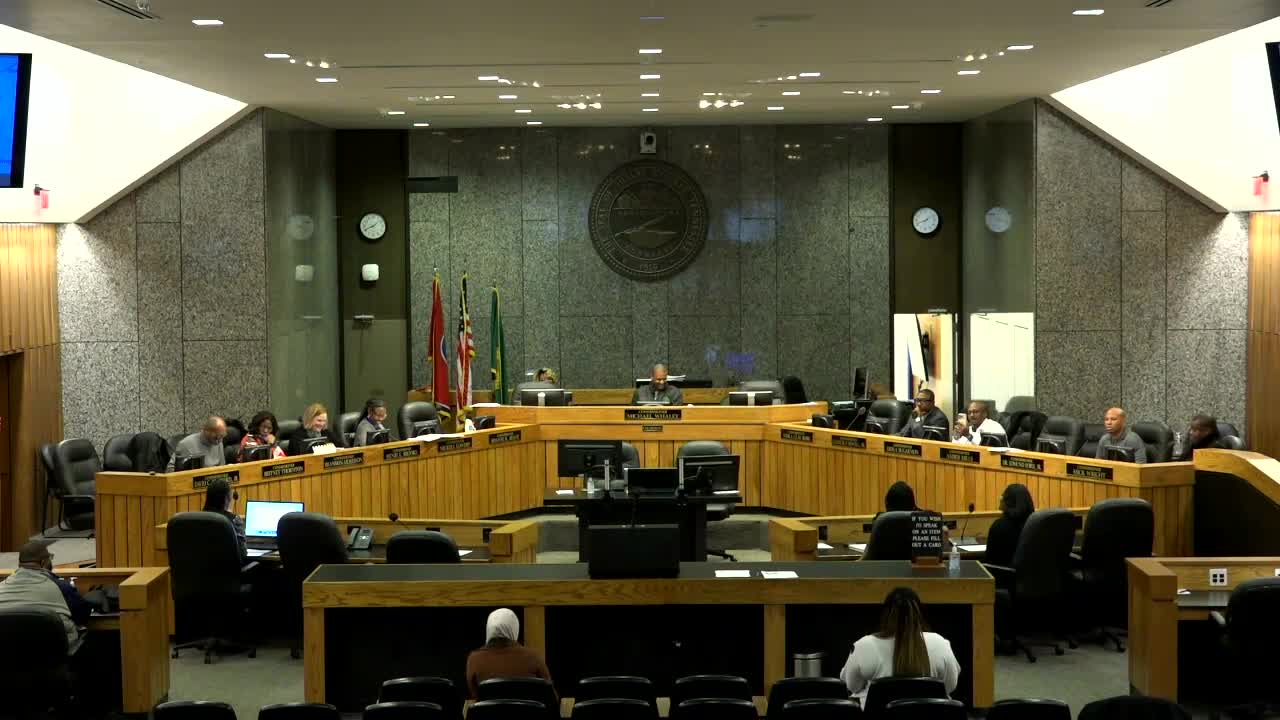
Valerie Matthews and Tamika Williams, leaders of the newly formed Joint Office of Neighborhood Safety and Engagement, briefed Shelby County commissioners and community partners on the office's strategy to coordinate violence‑prevention work across Memphis and Shelby County.
The presenters said the office — formally launched in November 2024 — will act as a backbone organization to “inform, integrate, invest and innovate,” coordinating nonprofit providers, building capacity for grant applications, and creating a public accountability dashboard that maps crime and local resources.
The office intends to adopt a public‑health approach to gun violence, the presenters said, focusing on prevention and intervention and on directing resources to neighborhoods and individuals identified as highest risk by data. The presenters said they will support community‑based violence intervention (CVI) models and make subawards to local organizations while helping those groups apply for state and federal grants.
Why it matters: Memphis and Shelby County officials said the region has a persistently high rate of gun violence that disproportionately affects Black and Brown males. The joint office aims to reduce shootings by aligning city and county efforts, improving data sharing, and strengthening local organizations so they can scale evidence‑based work.
Matthews, who serves on the Shelby County side of the office, said, “We are the first and we are the only joint office in The United States Of America,” and described the office’s role in convening partners and supporting data‑informed deployment of resources. Tamika Williams, deputy director on the City of Memphis side, summarized the office’s investment priorities: capacity building (grant writing, back‑office training and budgeting) and targeted funding for proven street outreach, hospital‑based and school prevention programs.
Presenters described four primary drivers: - Inform: build a public accountability dashboard that maps crime incidents, dispositions and local service resources so residents and partners can see both where incidents happen and where help is located. - Integrate: create a “whole of government” approach by convening city, county and nonprofit fiscal agents and holding regular community convenings such as the “courageous conversation” series. - Invest: provide subawards and capacity building so local organizations can apply for larger state and federal grants and sustain work beyond discretionary funding. - Innovate: co‑create a Community‑Based Violence Intervention and Prevention (CVIP) strategic plan with national partners and local providers.
Staff said they have started a landscape analysis with national partners (the National Offices for Violence Prevention Network and others), convened more than 40 local organizations for planning and training, and expect a midyear report on the ecosystem analysis. They cited Baltimore’s public dashboard as a model for mapping incidents and dispositions alongside service locations.
County and city officials pressed staff on practical details during a 90‑minute Q&A. Ernest Brooks, senior policy advisor at the Shelby County District Attorney’s Office, asked whether the joint office operates with separate city and county budgets and how success will be measured. Presenters replied that grant applications will be filed from whichever entity (city or county) is the registered applicant; funds will flow to that entity’s budget and then support joint initiatives. Office staff said outcome metrics will include reductions in fatal and nonfatal shootings and programmatic goals tied to the office’s drivers (for example, a fundraising target discussed during the briefing was $2,000,000 in brought‑down funding as an illustrative staff goal). Staff also said they plan measurable, co‑created goals for the CVIP plan and public dashboard use.
On data sharing, attendees asked which agencies would sign data‑sharing agreements. Valerie Matthews said an IT steering committee already exists and a governance subcommittee has been created; Sandy Bromley, Division of Community Services, said, “The IT steering committee has now officially, as of just this week, created a data governance committee to really get our own house in order.” Presenters said Memphis Police Department data has been available so far and that they have requested additional data from other agencies to heat‑map hot spots, but that data governance and written agreements are still being formalized.
Stakeholders raised operational questions about partnerships and frontline work. Presenters said the office will work with existing street outreach groups (examples named in the meeting included 901 Block Squad and Block Ministries) and with the city’s Group Violence Intervention program and police liaisons to pair enforcement with outreach and retaliation‑reduction strategies. Presenters also said faith‑based organizations are part of the broader ecosystem and will be invited to participate in prevention and support activities.
Judicial and court partners described referral opportunities. John Marshall, lead judicial commissioner, described existing court referral conditions used for community providers and encouraged continued alignment between the court system and local service providers to reduce recidivism.
On victim services, presenters said they are conducting site visits and learning what local organizations already track; they named the Women’s Advocacy Center and the Shelby County Crime Victims unit as organizations in the ecosystem and said the office will avoid prescribing data requirements until it has completed the landscape analysis.
Staff closed by asking commissioners and community leaders to “share your Rolodex” — to refer local organizations and discretionary funders so the office can vet and connect providers — and said the mayor is expected to request funding for the office in the next budget process. The office scheduled its next meeting for Feb. 27 at 1:30 p.m.
Ending: Presenters framed the joint office as a coordination hub rather than a direct service provider: staff will fund, convene and prepare local providers to draw down larger grants, build a public dashboard for transparency and pursue formal data‑sharing agreements to support targeted interventions. Commissioners and stakeholders left with follow‑up requests about formal MOUs, the dashboard timeline and measurable crime‑reduction benchmarks.