Get Full Government Meeting Transcripts, Videos, & Alerts Forever!
Get email alerts on the Student Attendance topic
No spam. Unsubscribe anytime.
Salem School officials report fewer absences and tardies after new attendance, cell-phone rules
Summary
At the Jan. 21 Salem School Board meeting, Salem High and Woodbury deans reported midyear gains after tightened attendance documentation and a tiered cell-phone policy: 981 fewer high-school absence days and roughly 1,620 fewer tardies in the first 18 weeks compared with last year; 24 electronic-device violations required dean intervention.
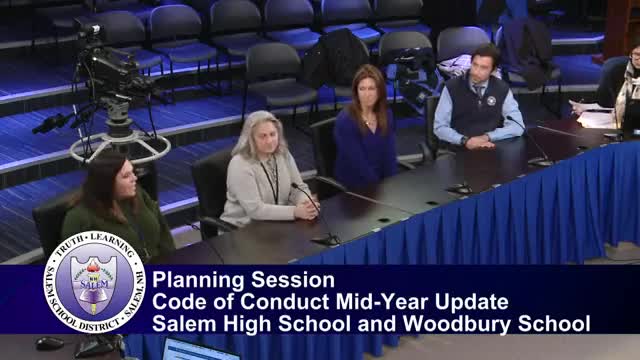
At the Jan. 21 Salem School Board meeting, Stephanie Nichols, dean at Salem High School, told the board that tightened attendance and tardy documentation and a tiered cell‑phone policy have produced measurable reductions in student absences and tardies midyear.
Nichols said, “we are down by 981 days,” meaning the high school recorded 981 fewer student absence days in the first 18 weeks of this school year compared with the same period in 2023–24. She also reported about 1,620 fewer tardies so far this year at the high school — a drop from roughly 4,300 year‑to‑date last year to about 2,700 this year. Harrison Little, dean at Woodbury School, said Woodbury recorded 367 fewer absences over a comparable span.
Board members were told the attendance changes rest on a new documentation policy: parents may call in up to five parent‑excused absences per year; after that the district requires third‑party documentation (for example, a medical note or court paperwork) for an absence to be excused. Nichols described the change as intended to allow earlier intervention with families: earlier meetings can be scheduled when a student reaches about 10 missed days rather than waiting until a much higher threshold.
Deans and assistant principals also described a tiered approach to tardies and electronic devices. For the high school, the first three tardies per semester are treated as minor (“kind of freebies”), tardies four through six result in lunch detention, and seven or more lead to after‑school detention. On cell phones, staff explained a three‑tier response: teachers first address phones in class, then ask students to use classroom caddies, and finally call a dean when a student refuses to comply. Nichols said, “At Salem High School, we've had 24 reported electronic device violations,” a figure the school records when a dean must be called to the classroom and document the incident in Infinite Campus.
Board members and staff said the changes also reduced office paperwork in some ways while increasing the intake of third‑party documentation. Assistant Superintendent Debbie Payne and Superintendent Mara Palmer emphasized that the policy is intended to help staff intervene sooner with families and connect students to supports, including counseling, when chronic absence or tardiness appears linked to mental health or medical needs.
Several board members asked about consequences for student athletes and noted that the New Hampshire Interscholastic Athletic Association (NHIAA) has rules that can affect participation on the day of an unexcused absence. Pamela Berry, vice chairman, reminded the board that athletic‑eligibility consequences are governed by NHIAA policy and not by the school’s internal attendance consequence schedule.
Administrators noted areas for continued work: hallway phone use and bathroom‑pass phone use remain higher than in‑class use, and staff continue to refine consistent classroom implementation. Both Woodbury and high‑school staff reported positive staff and student survey responses: about 75% of staff who responded said protocols were “just right,” and about 70% of student respondents said classroom phone use had decreased.
School officials said they would continue to monitor attendance, tardies, academic impact and repeat electronic‑device incidents and bring further data back to the board.
Ending: The presentation was informational; no board action was taken. Board members thanked the school team and closed public comment before moving on to other agenda items.