Get Full Government Meeting Transcripts, Videos, & Alerts Forever!
Get email alerts on the Special Education IDEA topic
No spam. Unsubscribe anytime.
Committee examines IDEA funding, reimbursement mechanics and special-education cross-subsidy
Summary
Officials described how IDEA Part B, preschool and Part C early-intervention funds are distributed, the program's entitlement obligations, and how insufficient federal funding shifts costs to states and districts; lawmakers pressed for clarity about draws and student data sent to the federal government.
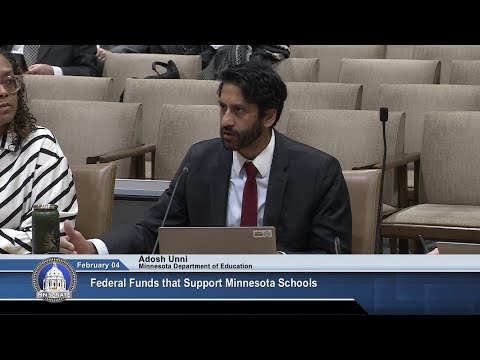
Assistant commissioners for student support and special education described the Individuals with Disabilities Education Act (IDEA) funding streams that form the largest federal special-education pots and the mechanics districts use to draw reimbursements.
"This is by far the largest pot of federal special education funding that the state receives," Darren Corte, assistant commissioner for the Office of Student Support Services, told the committee. He explained IDEA Part B (school-age special education) is a formula grant intended to pay a portion of the "excess costs" of educating students with disabilities. Minnesota law and federal requirements mean LEAs must serve children with disabilities and provide a free appropriate public education (FAPE); IDEA funding helps cover a portion of those program costs.
Officials explained several practical points the committee pressed for: (1) IDEA funds are entitlement-based and distributed via formula; (2) districts submit reimbursement claims after spending, and the state pays districts from the federal allocation on a weekly draw schedule tied to reported expenditures; (3) some formula references use historical base years (for example, a 1996 resident child count appears in federal rules cited); and (4) if federal funding does not cover costs and federal mandates remain in force, states or districts must cover the remainder (the so-called cross-subsidy).
Committee members asked whether identifiable student-level data submitted to the Department of Education are also transmitted to the federal government during monitoring and reimbursement. Officials said Minnesota submits categorical counts and performance data to federal programs but said they needed to check whether individual student identifiers are shared upward and, if so, in what programs.
Corte and other presenters also outlined related federal special-education grants: preschool special-education allocations for ages 3–5, Part C early-intervention funding for birth to age 3 (a "birth mandate" in Minnesota), the State Personnel Development Grant to improve recruitment and retention, and a small deaf-blind technical assistance project. Committee members pressed for more precise dollar figures and timelines; department staff agreed to follow up with LEA draw counts and the timing for state allocation draws.
Lawmakers said they are concerned both about long-term underfunding of special education and near-term administrative disruption that might delay reimbursements or complicate workforce planning. Department officials said they will return to the committee with further detail on outstanding draws, the flow of IDEA payments into the state payment system (described in testimony as CDRA reporting and MEGS payments), and what student-level data, if any, go to the federal level.