Get Full Government Meeting Transcripts, Videos, & Alerts Forever!
Get email alerts on the Federal Funding Overview topic
No spam. Unsubscribe anytime.
Committee hears how federal dollars flow into Minnesota schools and the risks of federal disruption
Summary
Department of Education officials told the Minnesota State Education Finance Committee that federal sources provide roughly 10 percent of the dollars spent on K–12 education in Minnesota and outlined how those funds reach local districts and charter schools.
Department of Education officials told the Minnesota State Education Finance Committee that federal sources provide roughly 10 percent of the dollars spent on K–12 education in Minnesota and outlined how those funds reach local districts and charter schools.
"Our federal funds make up 10% of our state's education budget," said the committee chair, adding that the figure is concentrated in specific programs such as Title I, special education and school nutrition. Assistant directors and commissioners from the Department of Education walked committee members through entitlement (formula) funding and discretionary (competitive) grants, reimbursement processes and emergency ESSER awards that followed the COVID-19 pandemic.
The presentation emphasized how most federal programs operate on a cost-reimbursement basis: local education agencies pay eligible costs, submit reimbursement requests to the state education agency, and the state draws federal funds to pay those claims. Departments noted that this flow creates exposure if federal payments or federal administrative capacity are delayed.
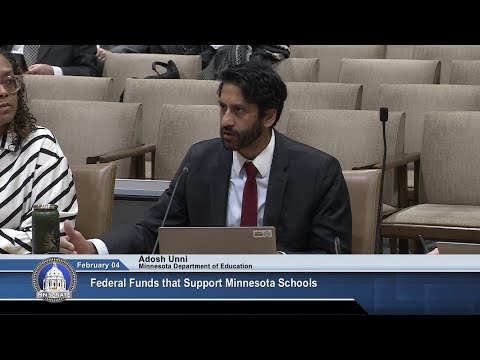
"We are grappling with the lack of clarity like everyone else," Adosh Ooni, the Department of Education’s director of government relations, told the committee when members asked how recent federal actions might affect payments and program oversight. Officials said the department is seeking clarification from federal counterparts and working with the governor’s office and state finance staff to track contingencies.
Committee members pressed officials on how executive-branch actions at the federal level could affect entitlement and discretionary streams. Department staff described two concerns: (1) whether a federal office would have the authority or capacity to pause reimbursements or to delay program monitoring; and (2) whether personnel changes at the U.S. Department of Education or mishandled access to systems could slow reviews and payments. Officials did not offer definitive legal conclusions, saying they are awaiting federal guidance.
The hearing also reviewed how one-time pandemic funds were distributed and largely expended. Officials said Minnesota received three emergency allocations (CARES, CRRSA and ARP/ESSER) totaling more than $2 billion to the state and districts; most deadlines for spending or drawing those funds have now passed. Committee members asked how much outstanding reimbursement remains at the district level; department staff said they must consult agency finance records to provide a precise figure.
Committee members from across the political spectrum voiced urgency about planning: some urged caution against "panic," while others said the state must prepare contingency budgets because districts may not post jobs or enter contracts when federal support is uncertain.
The committee asked the Department of Education to return with follow-up information on (a) the dollar amounts districts have already spent and for which federal reimbursements remain pending, (b) which federal streams are discretionary versus entitlement (as that distinction affects the likely risk of being altered administratively), and (c) what identifiable student- or program-level data are transmitted to federal agencies during reimbursement and monitoring processes. Officials agreed to provide those follow-ups to the committee.
This presentation is expected to inform the committee’s budget and policy planning as members consider state-level options to address any federal shortfalls."