Get Full Government Meeting Transcripts, Videos, & Alerts Forever!
Get email alerts on the Property Tax System topic
No spam. Unsubscribe anytime.
Senate Tax Committee hears high-level overview of Minnesota property tax system; state general levy draws historical debate
Summary
Nonpartisan staff briefed the Senate Tax Committee on Minnesota property tax mechanics — timeline, exemptions, classifications, exclusions and credits — and on the state general levy. Staff and senators discussed how exclusions shift local tax burdens and how the 2001 state general levy was redirected to the general fund.
Senate Tax Committee nonpartisan staff presented a broad overview of Minnesota’s property tax system and answered senators’ questions about exemptions, classification rules and the state general levy.
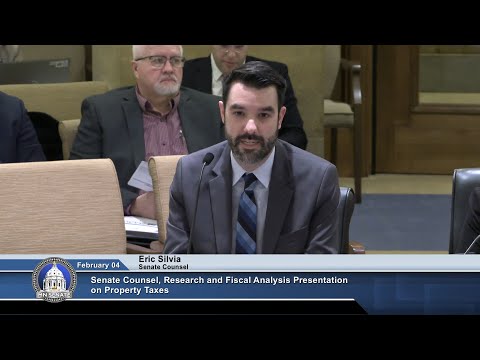
Eric Silvia, nonpartisan counsel for the Senate Tax Committee, told the panel the presentation would cover the property tax timeline, exemptions, the classification system, tax calculation, credits and the state general levy. "Taxation is the rule and exemption is the exception," Silvia said, summarizing the basic premise of Minnesota law on exemptions.
The briefing outlined why the assessment timetable matters: the assessment date is Jan. 2, valuation notices typically mail in March of the assessment year and provide the first formal opportunity to challenge values and classifications. The committee heard that property taxation functions on a two-year cycle — an assessment year followed by a taxes-payable year — and that taxes payable in a year reflect values established in the prior assessment year.
Silvia and Rachel Johnson, a nonpartisan analyst with the taxes committee in the office of Senate Counsel, explained two core measurement bases used in Minnesota: net tax capacity (NTC) levies, which account for roughly 82% of property taxes and use class rates multiplied by taxable market value; and referendum market value, used mainly for school operating levies and excluding certain property types such as agricultural seasonal recreational and student housing. Johnson said, "exclusions cause property tax shifts and credits do not," describing the technical reason exclusions change a taxing jurisdiction’s tax base while credits are applied after gross tax is calculated.
Why it matters: the committee was shown numerical examples and recent legislative changes that affect taxpayers across the state. Johnson said the Homestead Market Value Exclusion was expanded in 2023 and will take effect for taxes payable in 2025. She described the expansion’s mechanics: for homesteads valued at $75,000 or less the exclusion is 40% of market value; the exclusion phases and ends at higher values with a maximum exclusion amount that peaks near $38,000 under the new schedule. Johnson told the committee that about 1,123,000 homesteads received the exclusion in 2024 and that the number is expected to rise to about 1,320,000 when the 2025 changes take effect.
The briefing listed commonly referenced credits and recent 2024 spending levels: the agricultural homestead market value credit (about $37,000,000 in pay 2024), the school building bond agricultural credit (about $109,000,000 in pay 2024), the disparity reduction credit (about $13,000,000 in pay 2024) and taconite-related homestead credits (about $17,000,000 in pay 2024). Johnson cited Minnesota Statutes section 273.1393 as the statutory ordering for credits.
Committee members pressed on the state general levy, created during a broad 2001 property tax reform. The presentation noted the state general levy was established in 2001 and applies two separate dollar amounts: one on commercial-industrial (CI) property and public utility property and a smaller levy on seasonal recreational (cabin) property. Johnson gave approximate levy totals used in the presentation: roughly $717 million for CI property and about $42 million for seasonal recreational property. Several senators recounted the political history: Senator Sandra Rest said the 2001 reform initially directed levy revenue to schools but that subsequent action shifted the revenue to the general fund. "It was actually a very exciting reform, but it hardly lasted a single year before support for the schools was gone," Rest said.
Committee members debated the equity of the general levy and whether commercial and seasonal-recreation property should be taxed through a statewide levy that feeds the general fund. Senators described lingering regional tensions over how that revenue is distributed and how it affects local school budgets.
The presentation also reviewed property tax exemptions and their legal sources. Silvia read the constitution’s exemptions enumerated in Article X, Section 1 (public schoolhouses, hospitals, colleges, churches and other categories) and noted the much larger set of statutory exemptions in Minnesota Statutes section 272.02 (about 105 subdivisions authorizing exemptions). He explained most statutory exemptions are ongoing unless the legislature writes a sunset. Silvia and Johnson described examples of parcel‑specific exemptions enacted in recent years and explained the statutory deadlines governing when an acquisition or change-of-use can qualify a property for exemption in an assessment year.
No formal action or vote occurred during the briefing. Committee members were advised to contact staff for follow-up materials and to request further detail on specific credits or the historic policy decisions that created the state general levy.
Ending: The committee paused this overview to hear additional testifiers later in the hearing; staff indicated they would provide supplemental materials on specific credits and statutory citations on request.