Get Full Government Meeting Transcripts, Videos, & Alerts Forever!
Get email alerts on the Education Funding topic
No spam. Unsubscribe anytime.
Minnesota legislators warn dismantling U.S. Department of Education would put billions and students at risk
Summary
Minnesota senators at an education finance press conference said proposed federal actions, including executive orders and data access changes, could freeze reimbursements and cut about 10% of school funding, jeopardizing meals, special education and staffing.
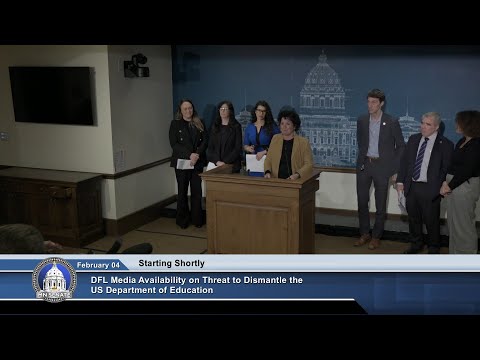
At a press conference after an Education Finance Committee hearing, Minnesota lawmakers warned that recent federal actions and proposed executive orders could effectively dismantle the U.S. Department of Education and jeopardize billions in education funding that Minnesota schools rely on.
Senators who spoke said the federal funding mechanism for much of K‑12 education is reimbursement-based, meaning districts already have spent money and rely on federal payments. "They'll be left holding the bag if the federal government doesn't fulfill those commitments," said Senator (Education Finance Committee member), summarizing testimony from the day's committee hearing.
Why it matters: Legislators said federal funds support roughly 870,000 students statewide — across more than 2,000 schools and about 325 school districts — and that an abrupt cut or freeze could disrupt school meals, special education reimbursements, transportation and other core services. "Imagine if we have billions of dollars frozen at the federal level," the senator said.
Context and specifics: Speakers cited a recent loss of about $400 million in ESSER pandemic relief funding as an example of how federal changes have already affected Minnesota schools. They also discussed figures shown to the committee indicating federal dollars account for roughly 10% of Minnesota's K‑12 education budget; presenters referenced a federal share ranging from about $1.4 billion (one presentation line) to a higher aggregation the senators described as roughly $2.2 billion when additional grants are included.
Several senators warned about potential program cuts and the reimbursement mechanism. "They're not getting reimbursed for school lunches, school breakfasts, they're not getting reimbursed for special ed services," said Senator (Education Finance Committee member) describing the committee's testimony. Lawmakers repeatedly named Title I, special education funding and the national school lunch program as at‑risk areas; they tied those programs to the potential 10% reduction discussed in committee.
Data and governance concerns: Senator Erin May Quaid said private individuals recently gained access to federal financial and student data through actions at the Department of the Treasury and the Department of Education and called that a security and governance risk. "Who's going to reimburse them if Elon Musk controls the payment system?" she asked, expressing concern about student privacy and the capacity to run federal reimbursement formulas.
Political and planning effects: Several senators characterized the federal actions as destabilizing, saying schools cannot plan two‑year budgets when federal funding is uncertain. "Schools can't plan for a future when unstable leaders treat critical funding like it's a bargaining chip," said Senator Gustafson, who urged constituents to contact federal representatives.
No formal state action was taken at the press conference. Lawmakers said they will continue to press for protections at the state level but acknowledged that a Republican‑controlled U.S. House, Senate and Supreme Court limit what state officials can accomplish federally.
Ending: Speakers closed by urging public attention and legislative coordination to protect funding streams that directly support students, meals, special education and staffing stability.