Get Full Government Meeting Transcripts, Videos, & Alerts Forever!
Get email alerts on the Tax Policy topic
No spam. Unsubscribe anytime.
Board recommends opposing petition to impose local tax‑cap language; petition draws legal and timing questions
Summary
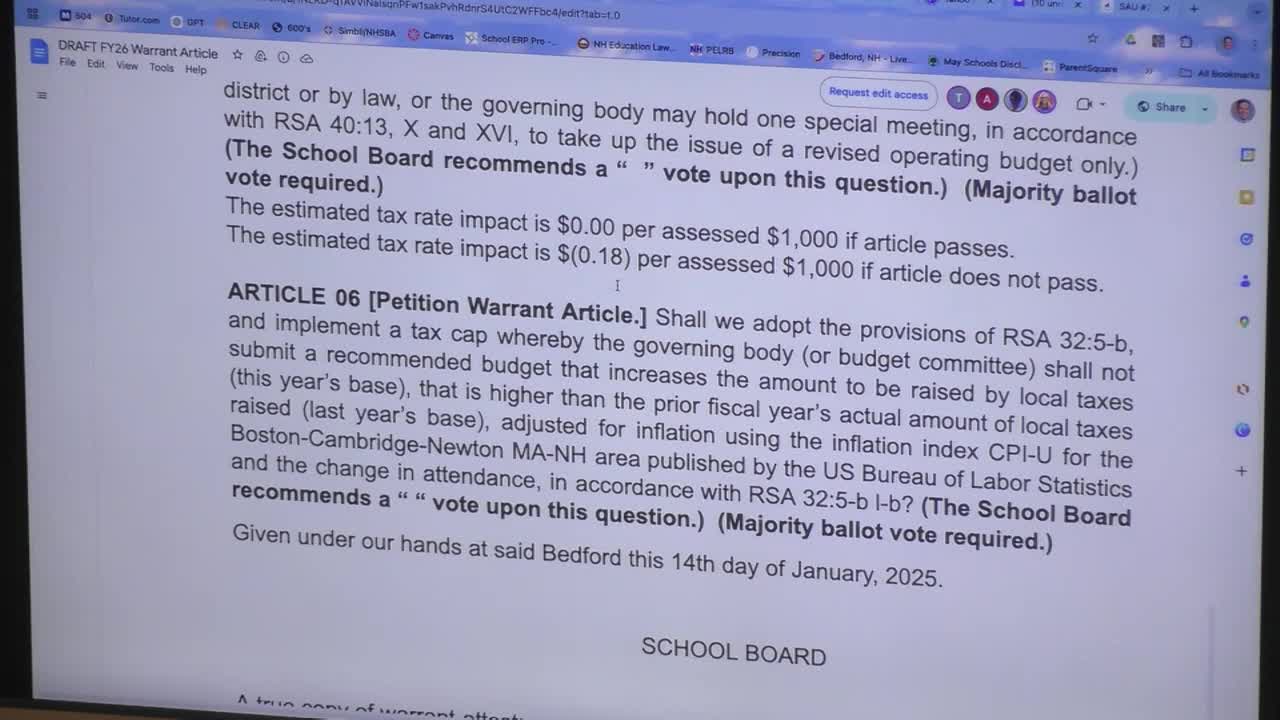
A petition warrant article proposing a tax cap under RSA 32:5‑b was presented to the Bedford School Board the same day as the hearing; board members questioned its timing, legal clarity and potential effects and the board voted to recommend a no vote on the petition warrant article.
The Bedford School Board held a public hearing on a petition warrant article (Article 6) submitted to the district office the afternoon of Jan. 14 that would, if approved, implement a local tax cap under RSA 32:5‑b.
Business Administrator Lisa Ambrosio and members clarified the process and the statute: the district received the petition just before the hearing and the board said the first obligation was to hold a public hearing. Ambrosio said the petition language invokes RSA 32:5‑b and references use of the CPI‑U (Boston‑Cambridge‑Newton, MA‑NH) and average daily membership adjustments; she also noted the statute requires a three‑fifths vote to adopt such a cap. Ambrosio told the board she had contacted the supervisor of the checklist and the town clerk to begin verifying signatures and planned to consult the district attorney and the state Department of Revenue Administration (DRA) about the final form and legal sufficiency of the warrant language.
Resident Edward Kamisky, who was present, asked several procedural questions about amendment at deliberative session and the petition’s intent. Ambrosio said petition language can be amended at deliberative session if it does not change the petitioners’ underlying intent, and that many technical items (which CPI month is used; how attendance is calculated) will need legal clarification. She cautioned that the petition was received late and had not yet been certified by the town clerk at the time of the hearing.
Several board members expressed concern about the timing and the lack of prior public engagement with petition sponsors. Multiple board members said they had worked since November to produce a fiscally conservative operating budget with a net 0¢ tax impact and described receiving the petition the same day as “disingenuous” and procedurally disruptive. Board members also raised policy concerns: corollary obligations such as special‑education costs and rising health insurance could make a rigid tax cap difficult to implement without reducing services or staff.
At the conclusion of the hearing the board voted on whether to recommend the petition to voters. A board member moved and another seconded a motion that the board recommend a “no” vote on Article 6; the motion passed by voice vote with at least one abstention noted in the meeting record. The petition will appear on the warrant regardless of the board’s recommendation; Ambrosio said the board will receive legal advice at deliberative session and that additional details (signature certification and statutory calculations) would be provided to the board and the public once verified.
Board action: the board voted to recommend opposing the petition warrant article (Article 6) at the Jan. 14 meeting. The petition’s legal sufficiency, the precise CPI and attendance adjustments to apply, and whether the petition would affect town taxes as well as school taxes were all listed as outstanding questions for counsel and the DRA ahead of the deliberative session.