Get Full Government Meeting Transcripts, Videos, & Alerts Forever!
Get email alerts on the Capital Asset Preservation topic
No spam. Unsubscribe anytime.
Administration urges large bonding allocation for deferred maintenance, emergency CAPRA funds and Capitol security upgrades
Summary
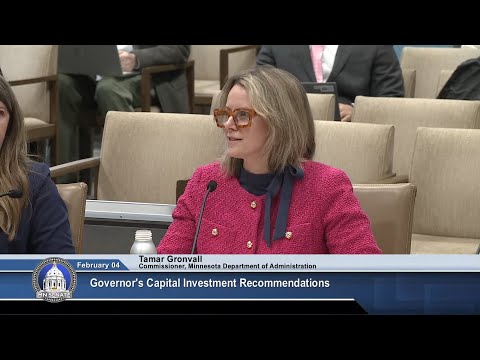
ST. PAUL, Minn. — The Minnesota Department of Administration presented the governor’s capital priorities to the Senate Capital Investment Committee on Jan. 28, urging a significant bonding allocation to address the state’s deferred maintenance, replenish emergency repair funds and fund remaining Capitol Complex security upgrades.
ST. PAUL, Minn. — The Minnesota Department of Administration presented the governor’s capital priorities to the Senate Capital Investment Committee on Jan. 28, urging a significant bonding allocation to address the state’s deferred maintenance, replenish emergency repair funds and fund remaining Capitol Complex security upgrades.
Why it matters: Admin said the state’s portfolio of buildings is large, old and costly to maintain; lawmakers were asked to prioritize asset preservation to prevent higher repair costs, avoid diverting operating dollars and protect public safety and energy savings across agency facilities.
At the hearing, Commissioner Tamara Grondahl told senators that “Minnesota owns over 4,800 buildings spread across 19 state agencies” totaling “more than 34,000,000 square feet,” and that Admin estimates the deferred-maintenance backlog at roughly $2.2 billion. She described asset preservation as cheaper over time than emergency repairs and said modern, properly operating buildings reduce energy use and greenhouse gases.
Grondahl highlighted the Capital Asset Preservation and Replacement Account, known as CAPRA, as a critical reserve for emergency repairs and hazardous-material abatement. She said CAPRA paid for flood response, roof and water-main work in 2024 and that “very little CAPRA funds are currently available” and a few weather events could deplete the fund. Committee members asked for the account balance; Grondahl said roughly $1.9 million remained in the CAPRA account after recent spending.
Committee discussion focused on how to size CAPRA. Grondahl said Admin uses a mix of recent spending patterns, deferred-maintenance projections and likely emergency events to estimate need, adding that the account has historically ranged from about $300,000 to $5 million in annual appropriations but that extraordinary events can cost far more.
On Capitol Complex security, Grondahl described recommendations from the Advisory Committee on Capital Area Security (ACAS), noting work began after a 2014 physical-security study and a 2022 update. She said some improvements already funded from earlier appropriations — including turnstiles and security kiosks — have been implemented, but “over half of the capital complex population and building square footage has not received the security upgrades necessary.” She told the committee that remaining vulnerabilities could risk life, assets and government operations and asked lawmakers to include funding for the next phase.
Grondahl also described a governor’s proposal for a budget-neutral State Building Renewable Energy Storage and Electric Vehicle Account that would let Admin accept federal rebates and accelerate renewable energy and EV fleet upgrades at state facilities.
In response to senators’ questions, Grondahl declined to give operational-level security details in public but listed a sample of completed work — bollards, projectile-resistant glass, card readers and kiosks — and said more specific information could be provided offline. On CAPRA spending history, she said the account had seen larger draws in 2023 and 2024 and that Admin can provide a year-by-year breakdown on request.
The presentation closed with Admin reiterating that timely asset preservation reduces long-term costs, improves safety and keeps state facilities operational for agency missions.
Looking ahead: Admin asked the committee to consider CAPRA replenishment in the bonding package and to fund the remaining Capitol Complex security projects identified by ACAS, while authorizing the renewable-energy account to access federal rebates for future projects.