Get Full Government Meeting Transcripts, Videos, & Alerts Forever!
Get email alerts on the Education Kindergarten topic
No spam. Unsubscribe anytime.
Bedford School Board backs special warrant to fund full‑day kindergarten
Summary
After multiple community sessions and a district survey, the Bedford School Board voted to recommend a special warrant article that would fund full‑day kindergarten at the district’s three elementary schools; if approved by voters it would raise $885,100 in gross costs with a state start‑up offset.
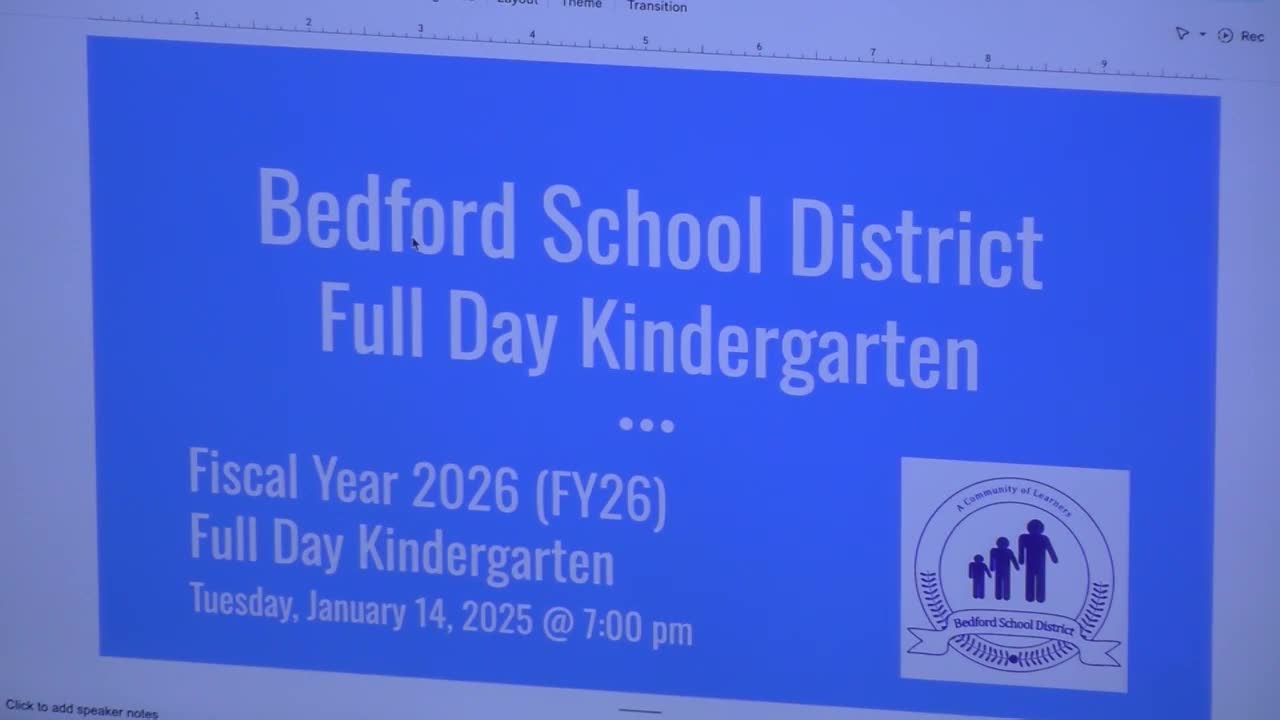
The Bedford School Board voted to recommend a special warrant article to implement full‑day public kindergarten for fiscal year 2026 at Peter Woodbury, Memorial and Riddle Brook elementary schools.
Board members and district staff told a public hearing the proposal follows multiple school listening sessions and a community survey; the board previously voted 4–1 to place the item on the warrant. Superintendent Mike Coroner presented the proposal and said, “for fiscal year '26, the Bedford School District, is at this juncture, moving forward the proposal for full day kindergarten.”
The nut of the proposal: the warrant asks voters to “raise and appropriate the sum of $885,100 for a gross budget to implement full day public kindergarten” and to qualify the district to receive a state start‑up grant equal to half of base adequacy funding, a grant the presentation lists at $520,408. Coroner and Business Administrator Lisa Ambrosio laid out the district’s estimate that net new local appropriation would be $364,692 after the grant and other offsets, and the presentation estimated an approximate tax impact of 6¢ per $1,000 of assessed valuation if the grant is received (13¢ per $1,000 without the grant). The district’s kindergarten enrollment for next year was estimated at about 78 students; staff said the budget was conservatively prepared and that many kindergarten families currently use the district’s K‑Plus program.
Administrators said the district’s rationale is primarily instructional: teachers reported limited time in a half‑day schedule to meet state standards and to provide required services (occupational therapy, physical therapy and speech) without eroding instructional time. Coroner said teachers were a principal driver of the change, noting classroom scheduling and service delivery constraints in a 2½‑ to 3‑hour day. School staff also flagged start‑up expenses including furniture ($25,000), classroom supplies (about $59,727), technology ($50,000) and a roughly $5,000 summer curriculum/technology institute for teacher planning.
At the close of the public hearing the board took procedural action: a board member moved and another seconded a recommendation that the district endorse Article 2 (the full‑day kindergarten warrant). The motion was approved by voice vote with no roll‑call taken; the board’s recommendation will appear on the warrant materials to voters.
If voters approve the article, district presenters said the line will remain in future budgets (the grant offsets would continue as state adequacy is applied), and any unexpended funds raised for this special article must be returned to taxpayers for the purpose specified in the warrant. Coroner and Ambrosio emphasized that the state adequacy/start‑up grant is applied specifically to kindergarten students and is intended as an ongoing offset in subsequent years.
Formal school board recommendation: the board voted to recommend approval of Article 2 at the meeting; the ballot decision by voters occurs at the district’s official session.
Looking ahead: the item will appear on the district warrant for the March vote alongside the operating budget and other warrants. The district will include the detailed budget and the MS‑26 forms with the warrant packet posted before the deliberative session.