Get Full Government Meeting Transcripts, Videos, & Alerts Forever!
Get email alerts on the State Government Transparency topic
No spam. Unsubscribe anytime.
Government Oversight Committee hears bill to implement CREATES report; debate centers on P-Card digitization and separation-of-powers concerns
Summary
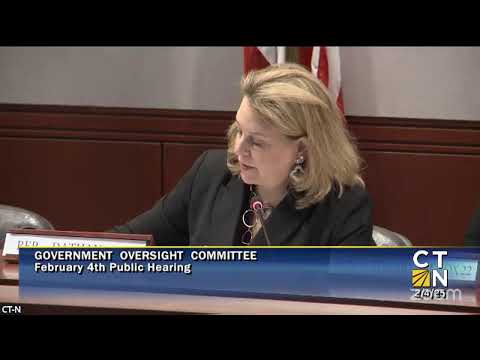
The Government Oversight Committee held its inaugural public hearing on Feb. 4, 2025, on House Bill 5574, a one-sentence bill to "implement the recommendations of the CREATES project report." Representative Vincent Candelora, the House minority leader, testified in favor of reviving the 2021 CREATES report, citing potential efficiencies and greater transparency; Logan Place, an attorney and co-coordinator for the State Employees Bargaining Agent Coalition (CBAC), testified in opposition, saying the bill as written would improperly delegate legislative authority to the executive branch.
The Government Oversight Committee held its inaugural public hearing on Feb. 4, 2025, on House Bill 5574, a one-sentence bill to "implement the recommendations of the CREATES project report." Representative Vincent Candelora, the House minority leader, testified in favor of reviving the 2021 CREATES report, citing potential efficiencies and greater transparency; Logan Place, an attorney and co-coordinator for the State Employees Bargaining Agent Coalition (CBAC), testified in opposition, saying the bill as written would improperly delegate legislative authority to the executive branch.
The bill matters because committee members said it could identify cost savings and administrative efficiencies as the state enters a difficult budget cycle. Candelora pointed to parts of the CREATES report that discuss digitization, P-Card transparency and common platforms across agencies and cited an estimate in the report of potential savings "between $190 million and $300 million" from broader digitization and shared systems. "I'd like to resurrect it," Candelora said during his testimony, arguing some recommendations could be implemented now and that digitizing purchasing cards used in higher education could reduce misuse.
Logan Place told the committee CBAC opposes HB 5574 in its current, vague form because it delegates broad authority to the executive branch without specified legislative direction. "It is the legislature's job to set the policy by enacting the law and the executive branch's job to carry out those laws," Place said, citing State v. Stoddard and arguing the bill should be narrowed into specific statutory proposals. Place also said collective-bargaining agreements constrain changes such as deferred retirement options for police and that any pension changes would have to be negotiated under the existing CBAC contract.
Committee members pressed on areas where the CREATES report might yield immediate action. Several lawmakers identified digitizing the P-Card system for the state university and other agencies as a finite, actionable step. Representative Carney and Senator Sampson described the P-Card issue as a practical place to start; they and others said higher-education P-Card transactions remain under audit and that making card transactions visible online would assist oversight. Candelora said auditors had identified roughly 700,000 higher-education P-Card transactions and urged an online P-Card platform similar to other state agency disclosures.
The hearing also touched on other CREATES recommendations described in testimony: exploring deferred-retirement options for police, civilianizing some law-enforcement support tasks such as fingerprinting, reviewing workerscompensation and overtime (particularly in corrections), and rationalizing state assets. Candelora said the state spent about $2,000,000 on the CREATES study in 2021 and that certain corrections overtime costs had contributed to budget pressure; he noted the state previously had an approximately $400 million surplus that was partly reduced by overtime spending in the Department of Correction. Place and others cautioned that the report contains many options and contradictions and that specific proposals would require individual statutory language and bargaining where applicable.
Committee members signaled they intend to consider a narrower, piecemeal legislative approach rather than a single sweeping delegation. Several members asked staff at the Office of Legislative Counsel (OLC/LCO) to draft more specific statutory language focused on limited items, with P-Card digitization repeatedly mentioned as "low-hanging fruit." No formal votes were taken at the hearing; members closed the public-comment portion after additional testimony was declined and moved to a short break before committee business.
The hearing record shows a clear split: proponents who say the CREATES recommendations contain implementable steps to save money and improve transparency, and union representatives who say the proposed bill is unconstitutionally broad and that many changes would require bargaining or precise statutory language. The committee will consider next steps, including targeted bill language and further testimony from agencies and stakeholders.