Get Full Government Meeting Transcripts, Videos, & Alerts Forever!
Get email alerts on the Energy Data topic
No spam. Unsubscribe anytime.
Advocates push ‘Energy Data Bill of Rights’ to make building, vehicle and generation data searchable and machine‑readable
Summary
A bipartisan concept — the Connecticut Energy Data Access Bill of Rights — drew support from environmental groups, municipal leaders and nonprofits, who said publicly available, machine‑readable energy data would help towns, researchers and planners track progress and design local decarbonization programs.
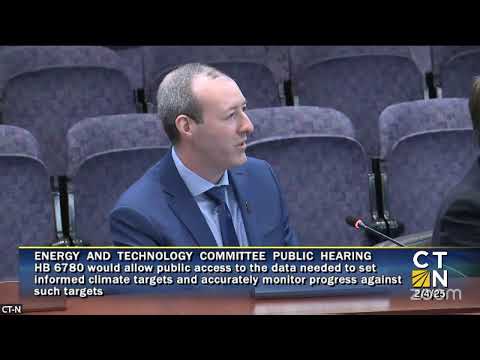
A proposal to make energy‑relevant datasets available in standardized, machine‑readable form — dubbed an Energy Data Access Bill of Rights (HB 6780) — won broad support in testimony from environmental groups, municipal officials and clean‑energy advocates.
What the bill would do: Supporters say the bill would guarantee public access to key datasets needed for planning and monitoring: building characteristics, state‑owned building usage, numbers and types of cars registered by town, distributed generation and renewable procurement records, and residential electric usage (with privacy protections).
Supporters’ case: Carrie Lynch of The Nature Conservancy said accurate, timely data is essential for setting and monitoring climate targets and that the state lacks an easy, single source of truth. Mark Scully of PACE and Barry Kresch of the Electric Vehicle Club argued that municipal planning and decarbonization models (for EV charging, heat‑pump adoption and rooftop solar) would be far more effective with standardized data available to towns, researchers and non‑profits. Kresch urged replacing slow FOIA workflows with regular public feeds.
Privacy and scope: Witnesses recognized the need for privacy protections and for excluding nomadic or app‑based services from regulatory reporting. The Nature Conservancy and others emphasized aggregated, non‑identifying outputs and strict controls on personally identifiable data.
Why it matters: Drafting national and state decarbonization plans requires accurate local signals — e.g., where heat pumps are installed, which neighborhoods still rely on delivered fuels, and where demand spikes may emerge as EVs and building electrification expand.
Follow up: Supporters offered to help design a state data inventory and recommended building on existing sources such as OPM assessor data and Energize CT datasets. Committee members asked supporters to propose a prioritized dataset list and any necessary statutory changes to allow sharing while preserving privacy.