Get Full Government Meeting Transcripts, Videos, & Alerts Forever!
Get email alerts on the Child Protection And State Of The Child Report topic
No spam. Unsubscribe anytime.
Second Look Commission: report finds gaps in services, recommends DCS policy changes
Summary
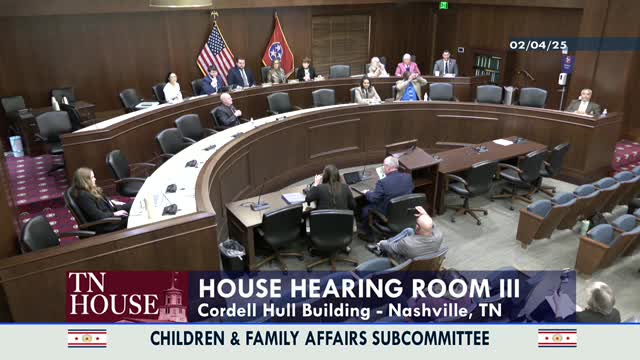
Kylie Graves, director of data, policy and communication for the Tennessee Commission on Children and Youth and director of the Second Look Commission, presented the Second Look Commission’s 2024 annual report to the Children and Family Affairs Subcommittee in February 2025.
Kylie Graves, director of data, policy and communication for the Tennessee Commission on Children and Youth and director of the Second Look Commission, presented the Second Look Commission’s 2024 annual report to the Children and Family Affairs Subcommittee in February 2025.
The commission reviewed cases that closed in fiscal 2023 and found 623 unduplicated victims of a second or subsequent severe abuse—about 600 individual children each year. Graves told the committee the commission samples cases from Department of Children’s Services (DCS) case closures, pulls each child’s history with DCS, the courts and law enforcement, and looks for “areas where things went well” and “things that may have fallen through the cracks.”
The report identified the largest share of second-instance severe abuse as sexual abuse (64 percent of second-instance severe cases), followed by drug-exposed cases (22 percent), physical abuse (5 percent) and other categories such as lack of supervision (9 percent). Graves said the commission always reviews abuse-death cases regardless of sampling and noted autopsy delays cause timing lags in review; she reported the commission reviewed six abuse-death cases in the current year that spanned fiscal years 2021–2024.
Why it matters: the commission’s findings are intended to highlight system failures and direct policy or operational changes by DCS, the courts and other agencies that serve children. Richard Kennedy, executive director of the Tennessee Commission on Children and Youth, told the committee the commission’s work supports policy briefs, data products and resource mapping intended to inform legislators and state leaders.
Key findings and recommendations
- Services and workforce gaps: Commissioners repeatedly flagged delays and shortages in timely, appropriate mental-health services for children. The report recommends continued state investment in mental-health services and workforce expansion and that Tennessee evaluate providers who accept TennCare for appropriateness of modality (in-person vs. telehealth) and acuity.
- Transition homes and supervision: The report found documentation gaps and safety concerns at transition homes. Members recommended consistent enforcement of the department’s 3-to-1 staffing ratio, clearer policy on steps to take when an incoming child would create a staffing ratio breach, daily child logs for transition homes, and stronger background-check compliance for adults working in those facilities.
- Immediate protection agreements (IPAs): The commission recommended more consistent implementation of DCS policy limiting IPAs’ duration and requiring a juvenile-court petition within 10 days when DCS has determined to file, to avoid use of IPAs as a long-term permanency tool.
- Case management and data access: The commission advised that DCS’s replacement of TFAX (the current case management system) should include features to display all services a child receives (including services not billed through DCS) and to retain referent information when a hotline report is screened out. Graves said this change would make services and referral histories easier to find at a glance.
- Multidisciplinary review triggers: Second Look recommended DCS establish a policy that when a case has a certain number of referrals or overlapping investigations, a mandatory multidisciplinary team meeting be convened to consider third-party review (for example, centers of excellence) and to prevent duplication or gaps in investigations.
- Courts and prosecution coordination: The report reiterated a statutory requirement that within 15 days of a district attorney general’s investigation completion, the district attorney general advise DCS and the child-protective investigative team whether prosecution is appropriate; the commission recommended more consistent compliance and training for court staff on newly developed pro se dependent-and-neglect petition forms.
Mental health and youth suicide data
The commission’s State of the Child materials also highlighted child and adolescent mental-health indicators. Graves summarized the Youth Risk Behavior Survey results, reporting that nearly one in four Tennessee high school students in 2023 said they had considered or attempted suicide in the previous 12 months; nearly one in five reported making a plan; and more than one in seven reported an attempt in the prior year. Graves said the survey is administered in partnership with the Department of Education and undergoes validation and weighting before publication. She also reported 146 suicide deaths among youths ages 9–17 in Tennessee during 2019–2022 and an increase in emergency-room visits for suicide attempts that track the survey trends.
Committee discussion and follow-up requests
Representative Bufel asked about survey methods and the source of the suicide figures; Graves pointed to the Youth Risk Behavior Survey administered through the Department of Education and to corresponding trends in suicide deaths and ER visits. Representative Townes and other members asked what state programs target suicide prevention; Graves listed cross-agency efforts including the 988 crisis line, school-based mental-health services, the Child Behavioral Health Safety Net and child psychiatry support (CAPES), and emphasized that in-school access and a sense that at least one caring adult reduces risk.
Richard Kennedy noted the commission’s broader role in data, collaboration and policy and invited legislators to request targeted briefings or additional data from the commission’s new public dashboard.
No formal committee action or vote on legislation occurred during the presentation; the committee received the report and members asked questions and discussed recommendations for DCS, the courts and other agencies.
Ending
Graves said she will be on leave after the meeting and that staff member Jordan Wally will serve as a contact while she is away. Chairlady Mary Littleton and members praised the commission’s work and the committee adjourned after questions and comments.