Get Full Government Meeting Transcripts, Videos, & Alerts Forever!
Get email alerts on the Innovation Economic Development topic
No spam. Unsubscribe anytime.
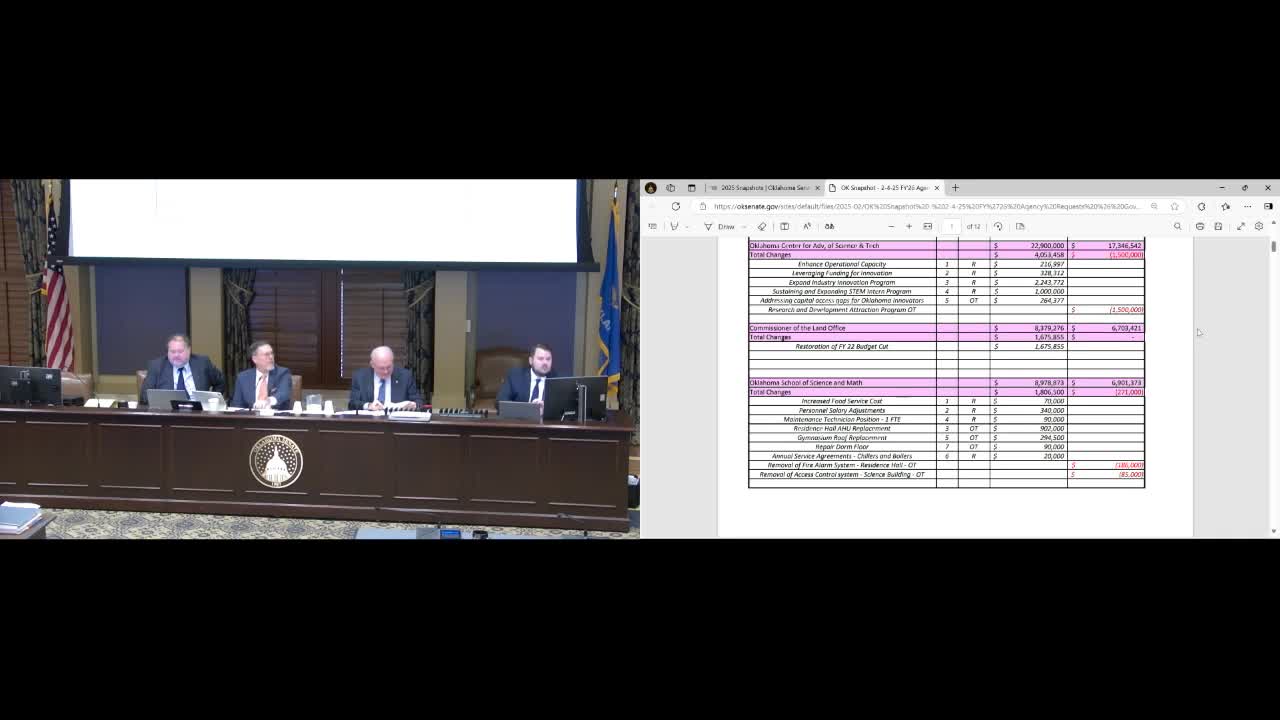
OCAST requests funding to expand industry innovation, capital access and a STEM internship program
Summary
The Oklahoma Center for the Advancement of Science and Technology (OCAST) requested recurring and one‑time funds to expand its industry innovation program, to sustain a STEM internships initiative and to leverage federal and foundation matches for innovation projects.
Oklahoma’s innovation agency, OCAST, told the Senate Appropriations Committee on Feb. 4 it seeks modest recurring operational increases and larger investments to expand its industry innovation grants and a STEM internship program.
Why it matters: OCAST programs are intended to spur technology commercialization, small business growth and workforce development in science and tech fields; funding choices affect statewide economic development and federal match capacity.
Senator Seifried presented OCAST’s requests and Director McGrail, appearing before the committee, described three programmatic priorities: expanding the Industry Innovation Program (the agency received 70 applications last year and funded 16), sustaining and expanding a STEM internship program, and addressing capital access gaps for Oklahoma innovators. OCAST requested $2,200,000 to expand its Industry Innovation Program (allowing multiple cohorts and increased awards), $1,000,000 to sustain and broaden a STEM internship program, and $264,377 one‑time to address capital access gaps. The agency also requested smaller recurring operational increases to support grant‑seeking and program administration.
McGrail and committee members discussed how OCAST’s grant programs require dollar‑for‑dollar matches and leverage federal and foundation funding. McGrail told senators that the Industry Innovation Program left “missed opportunities” last year because demand exceeded available awards; she said unfunded applicants represented potential job retention and creation, and cited program impact numbers — including average job wages for funded projects — as justification for expanded state support.
On the STEM internship program, OCAST said it served a modest number of companies (the director said OCAST supported about 19 companies last year with roughly 27 interns) using existing operations and deobligated funds and now seeks a $1,000,000 appropriation to expand reach and formalize matching and contracting practices.
What’s next: OCAST leadership told senators the agency is tracking sustainability risks tied to federal grants and ARPA‑era funds but said it is managing a portfolio of programs and will not deploy awards until matches and funds are secured. The committee asked for additional detail on program metrics and sustainability planning.
Ending: OCAST requested targeted funding to scale innovation grants and a STEM internship program; senators requested additional performance and match details before committing recurring state dollars.