Get Full Government Meeting Transcripts, Videos, & Alerts Forever!
Get email alerts on the Career Tech Budget topic
No spam. Unsubscribe anytime.
CareerTech requests $19 million increase to cut waitlists, expand training and prison reentry programs
Summary
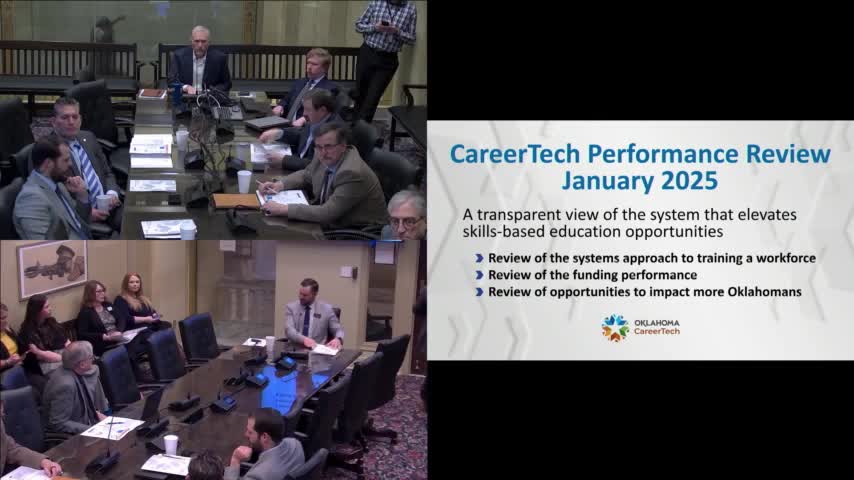
Director Hakan, head of CareerTech, told the Appropriations and Budget Subcommittee that the agency is asking for a $19 million recurring increase to expand training, K‑12 program support and transition services for incarcerated individuals.
Director Hakan, head of CareerTech, told the Appropriations and Budget Subcommittee that the agency is asking the Legislature for a $19 million recurring increase to its state appropriations to expand full‑time technology center training, K‑12 program support and transition services for incarcerated individuals.
Hakan said CareerTech used a one‑time appropriation approved last year, about $28 million of a larger request, to raise instructor pay, add programs and reduce waitlists. "Our purpose is to provide workforce training for individuals that wanna go into technical trades," he said, and described how recent dollars were applied to apprenticeships, new districts and inmate transition services.
The increase, Hakan told the committee, would restore remaining items from the agency’s multi‑year request, not fund wholly new initiatives. He said the agency added about 2,500 students after last year’s appropriation but still faces a large waitlist — he cited about a 7,400‑student waiting list for technology center programs — and noted a 40% increase in demand for full‑time programs in technology centers.
Hakan outlined how the recent state funds were spent: $1.5 million in state funds to support an apprenticeship program that CareerTech took over from a federal Department of Labor/Commerce grant; $500,000 paid to help Beaver County join a technology center district before local ad valorem collections began there; $450,000 for skill‑center transition services for incarcerated people; and $25 million directed to technology center program funding, which CareerTech says added roughly 2,500 students.
He described the incarcerated‑individual training network as a major element of CareerTech’s work: the agency offers programs at 16 sites that together produced about 1,350 program completers, with a stated 94% placement rate and about 6% returning to prison. Hakan said the Department of Corrections pays CareerTech about $1.3 million under contract for some education services, and that CareerTech has been stepping in to fund programs when DOC budget cuts reduced DOC‑funded education slots.
CareerTech’s delivery model, Hakan said, consists of five arms: technology centers (full‑time postsecondary programs and adult training), comprehensive K‑12 programs (CTE classes and program support), adult education/family literacy (high school equivalency and preparatory classes), business/industry customized training, and skill centers inside correctional facilities. He emphasized that technology centers are postsecondary, clock‑hour institutions that train many licensed and credentialed workers (for example, CareerTech trains the majority of the state’s licensed practical nurses, a figure Hakan cited as 72%).
Hakan explained funding shares between CareerTech and K‑12 districts: local districts employ and pay teachers on standard contracts; CareerTech provides salary supplements for some CTE teachers (for example, additional months for 12‑month positions) and program assistance funds. He said program assistance varies by program — he gave ag education as an example that receives roughly $13,000 in program assistance — and that districts commonly contribute additional funds or seek grants for equipment.
Committee members asked for more detail on several topics. Representative Lowe asked about an $8 million line for "additional pathways" listed in the agency request; Hakan said that amount covers 37 different program areas the agency could not fully fund last year and offered to provide the full list. Representative Johns asked which correctional sites host programs; Hakan listed examples including Helena‑Goltry, Veneta and Lexington and said CareerTech aims to reach 20 sites by year end. Hakan also said CareerTech is building a new welding facility in Veneta and plans a facility in Boley.
Hakan framed CareerTech’s economic impact statistics for the committee: he said technology center activity produced nearly $1 billion in economic impact statewide last year, including $456 million in wages, and that the agency measures an economic output multiplier of approximately $9.39 for each state dollar invested. He also cited average lifetime earnings gains for completers — about $14,000 more for secondary students and roughly $16,000 more for adult completers — figures he attributed to CareerTech program completion.
The presentation also outlined CareerTech’s work with employers: about 9,000 businesses received direct training last year (Hakan said the total will exceed 10,000 next year), and CareerTech offers customized training for manufacturers, energy firms (including wind‑energy tower technicians) and employers recruiting displaced workers (Hakan referenced Michelin employees in Ardmore who received retraining).
Hakan closed by summarizing the request as primarily recurring funding to continue programs added or begun with last year’s appropriation (instructor pay, health careers, construction trades and manufacturing being priorities) and to extend K‑12 program support and district start‑up grants to additional communities showing local interest.
The committee chair told members they will be assigned agencies to review in advance of next week’s bill hearings; the chair said members would receive emails assigning at least two members to each agency and asked for input during the budget process. No formal committee votes or motions were recorded during the presentation.