Get Full Government Meeting Transcripts, Videos, & Alerts Forever!
Get email alerts on the Election Infrastructure topic
No spam. Unsubscribe anytime.
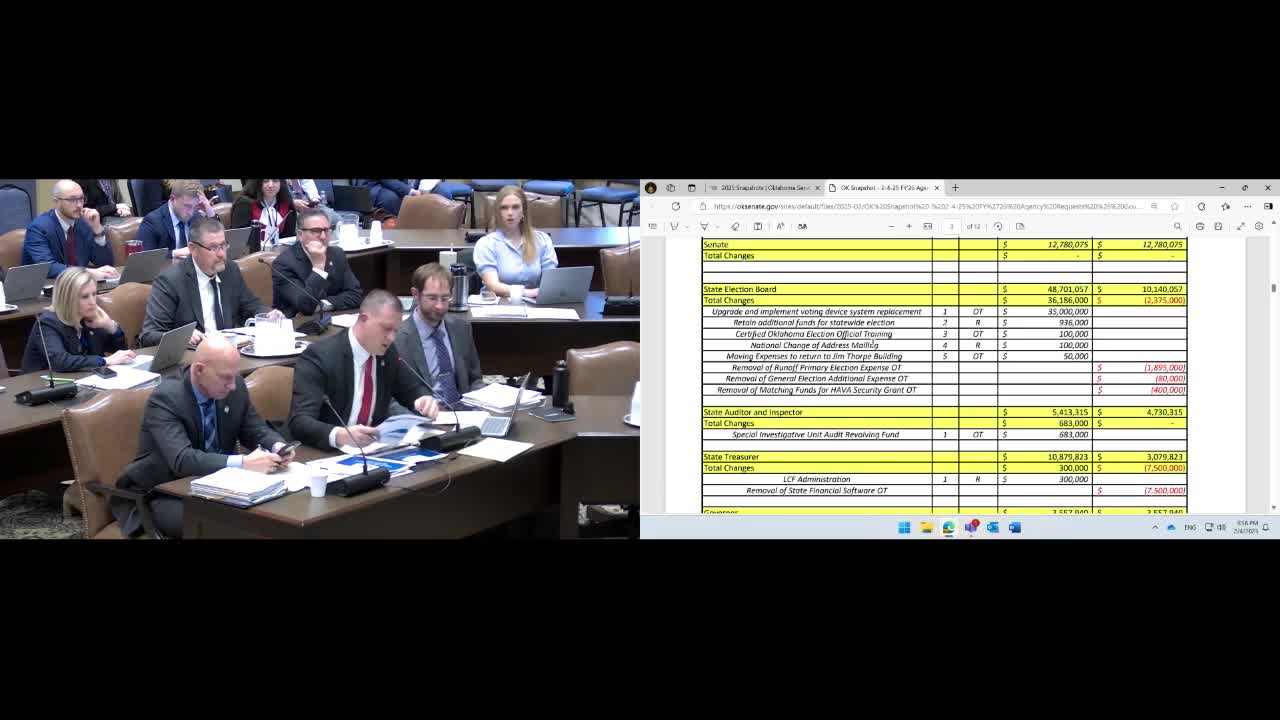
State election board presses for $35 million to replace decade‑old voting equipment
Summary
The State Election Board asked the subcommittee for $35 million in one‑time funds to replace an election system first used in 2012, citing updated voluntary federal voting system guidelines and limited spare‑part availability for existing machines.
The State Election Board asked the Senate subcommittee for a $35 million one‑time appropriation to replace the state's voting equipment, which the board said was first deployed for Oklahoma elections in 2012.
Board representatives and a state official told the committee the existing scanners and related components are built on older-generation technology and that spare parts and vendor support will become more difficult to obtain over time. The board said it must continue to use paper ballots and optical scanners, consistent with state law, but that newer systems would bring improved security features and other operational advances.
Committee members asked about procurement, compatibility and cost timing. The board said a procurement and deployment timeline would likely include issuing a request for proposals and conducting vendor selection; the board's goal would be to go to bid in 2026, install and train in 2027, and be in use in time for major elections in 2028.
Senators and the board also discussed operational costs tied to returning to space in the Jim Thorpe Building and cover limited recurring requests for training and voter notification mailings. The larger $35 million request was presented as a one‑time capital expense to update statewide election infrastructure.
The subcommittee did not take action during the hearing and requested additional planning detail, including procurement timelines and vendor qualification standards.