Get Full Government Meeting Transcripts, Videos, & Alerts Forever!
Get email alerts on the Local Food And Property Rights topic
No spam. Unsubscribe anytime.
Committee advances bill to protect Oklahomans' right to grow food with limits for health, safety and local rules
Summary
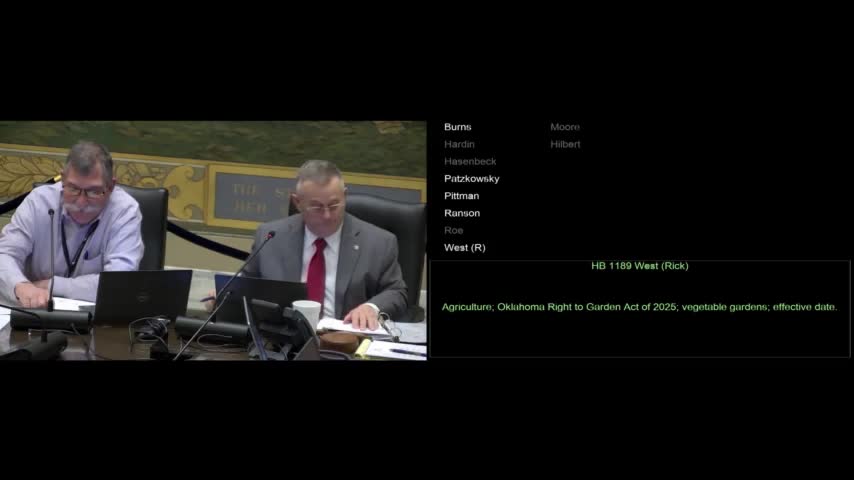
HB 1189 would affirm a right for Oklahomans to grow food on private property while preserving municipalities’ authority to adopt content-neutral limits for safety, water use and pest control; the committee advanced the bill 5–2.
House Bill 1189, a recurring bill the sponsor has brought in prior sessions, passed the Agriculture Committee and would affirm a right for residents to grow gardens and raise certain food products on private property.
Representative West, the bill’s sponsor, said the measure "guarantees Oklahomans the right to grow a garden and grow their own food." He told members he has run the bill in past sessions and that he modified language after discussions with municipal officials so local governments can still adopt content-neutral ordinances limiting garden size or proximity to roadways for health and safety reasons.
Members raised questions about the interaction between the bill and homeowners associations (HOAs). Representative Rowe asked whether HOA rules would be superseded; West said he believes state statute would override HOA restrictions but acknowledged municipalities and HOA agreements could affect implementation. The bill’s language, as described in committee, includes a provision that the statute “should not prohibit any municipality, city or town from enacting content-neutral ordinances limiting the size and proximity of gardens to roadways that impact health and safety.”
Members also asked about water use, drought response, fertilizer and invasive species controls. Representative Burns asked why the bill would allow municipalities to regulate water use, pesticide or fertilizer application and invasive species; the sponsor and other members said municipalities requested those carve-outs and that such limits are intended to protect health, water conservation during drought, and pest control.
The committee voted 5–2 to advance the bill.