Get Full Government Meeting Transcripts, Videos, & Alerts Forever!
Get email alerts on the Education Budget topic
No spam. Unsubscribe anytime.
Oklahoma Department of Education seeks $88.6M FBA increase, $3M recurring Bible program and other budget requests
Summary
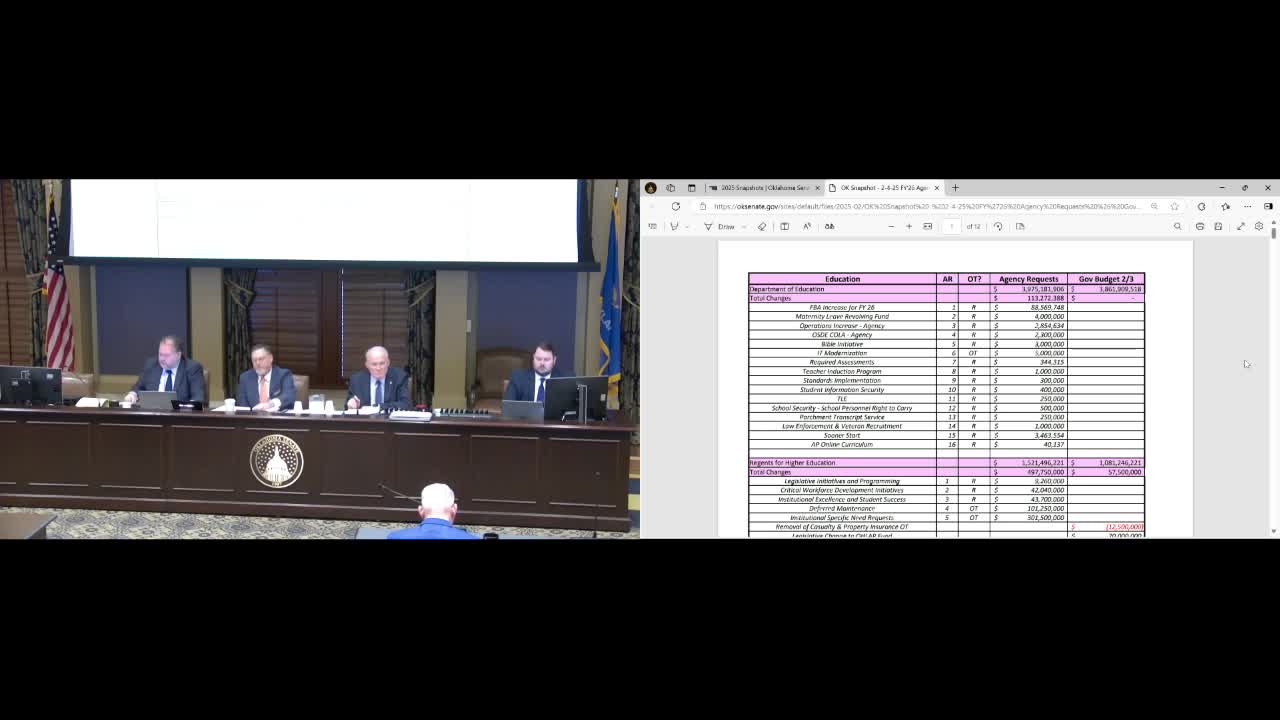
The Oklahoma State Department of Education asked the Senate Appropriations Committee on Feb. 4 for a package of budget increases that included an $88,569,748 recurring request for the Foundation Block Aid increase, a 6% cost‑of‑living adjustment for department employees and a $3,000,000 recurring line for a state program to place King James Bibles in classrooms.
The Oklahoma State Department of Education asked the Senate Appropriations Committee on Feb. 4 for a package of budget increases that included an $88,569,748 recurring request for the Foundation Block Aid increase, a 6% cost‑of‑living adjustment for department employees and a $3,000,000 recurring line for a state program to place King James Bibles in classrooms.
Why it matters: The requests affect K‑12 funding and operations across the state, including classroom materials, teacher benefits and school security. Committee members pressed officials on funding details, program scope and whether some items are one‑time needs or should be recurring in future budgets.
At the committee meeting, Senator Seifried, vice chair of the education subcommittee, summarized the department’s requests and turned to department representatives for details. On the largest line item, Seifried said the department requested $88,569,748 recurring “for the FBA increase. This includes certified and support personnel.” The department also proposed a 6% COLA for State Department of Education employees and a $2,854,634 operations increase that the presentation said would cover personnel, IT, facilities, maintenance and professional development.
Superintendent Walters confirmed that the department is proposing a $3,000,000 recurring “Bible initiative” to provide King James Version Bibles to grades 5–12. Walters said the department has already purchased 500 Bibles for Advanced Placement government courses “for just south of $25,000” and that the $3 million request is intended to fund about 55,000 classroom copies to place “one Bible in every classroom.” Walters said the department plans to issue a request for proposals and that vendors could bid at lower prices. Asked about durability and recurring costs, Walters said the recurring line is intended to allow replacement over time depending on classroom wear and demand: “After this first year, we'd like to be able to come back to you all and say what the return rate is, how much of a need there is in the future.”
The Bible initiative drew sustained questioning from several senators about cost, instructional purpose and sourcing. Senator Stanley asked about the reading level of the King James Version; Walters replied, “The reading level of a King James Bible is gonna be pretty high. It would be higher than twelfth grade.” Walters framed the request as providing primary source material in historical context and stated, “This is not to evangelize the kids. This is for its historical significance as it relates to the history curriculum.”
Committee members also examined other education requests. Seifried said the department is seeking an additional maternity leave revolving fund allocation; the hearing record contains inconsistent figures. Early in the presentation Seifried said the fund had been funded at $2,500,000 historically and that the department was asking for an additional $1,500,000 to bring the total to $4,000,000 recurring. Later in the hearing Superintendent Walters said the department’s intent was to increase the fund to $6,500,000, describing it as a net request that would reflect participation by additional districts such as Tulsa Public Schools. Walters told the committee the department exhausted the prior year’s funds even without Tulsa participating and that awareness and program take‑up have grown.
Other specific items presented included a one‑time $5,000,000 request for IT modernization, a $344,315 request tied to virtual proctoring for assessments (the department said a statute requires virtual proctoring), a new $1,000,000 teacher induction program to support new teachers through mentors and professional development, and a $400,000 request for student information security (described as multi‑factor/"Zscaler"‑style protections). Seifried noted a separate $21,800,000 supplemental request to fund FBA for fiscal 2025 that the presentation said would be reflected on the committee’s live worksheet.
School security funding drew questions about scope and implementation. The department requested $500,000 “for school personnel right to carry,” described by Seifried and Walters as training funds for teachers or school staff in districts that choose to permit carrying and for signage noting personnel may be armed. Walters said participation would be a local district decision and characterized the funding as a pilot to meet demand primarily in smaller, rural districts that have limited on‑site law enforcement. He said the department estimated the $500,000 would allow roughly 50 districts to pilot the program and that the funds would be complementary to earlier school safety grants focused on facilities.
Committee members repeatedly asked for more detail on several line items, including how many Bibles would be supplied at different price points, how long Bibles would remain usable in classrooms, and whether districts or private groups might provide Bibles at low or no cost. Walters answered that the department had received outreach from groups willing to participate in distribution and that the department planned an RFP to allow competitive bids.
What’s next: Seifried said there would be subsequent subcommittee recommendations and that appropriations members would have further opportunities to vet, amend and prioritize these requests during the committee’s meetings this week. No formal appropriations votes or recommendations were made during the Feb. 4 presentation; the hearing consisted of agency requests and member questions.
Ending: The State Department of Education’s presentation covered several recurring and one‑time items that senators said they would continue to examine in subcommittee and full committee deliberations, particularly the Bible initiative, the maternity leave revolving fund level and the FBA supplemental request.