Get Full Government Meeting Transcripts, Videos, & Alerts Forever!
Get email alerts on the Budget And Operations topic
No spam. Unsubscribe anytime.
OMES officials defend flat operating request while lawmakers press for clearer accounting of rents, purchasing and deferred maintenance
Summary
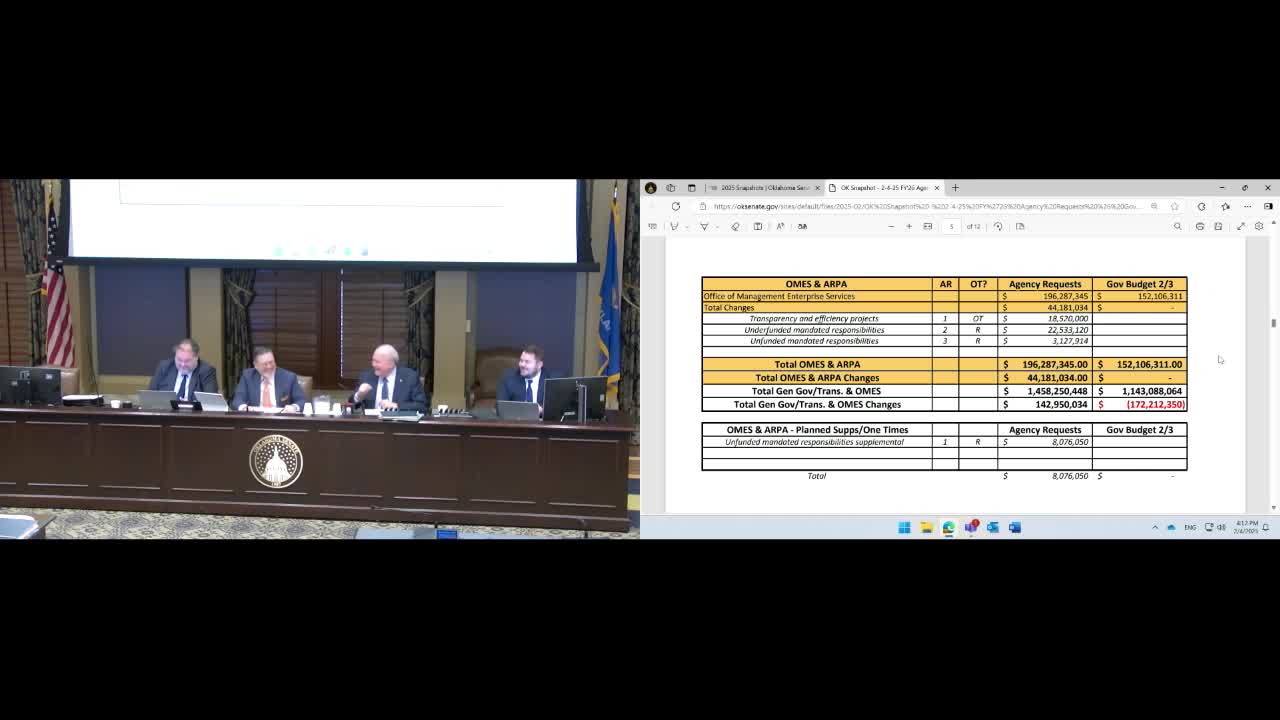
Officials from the Office of Management and Enterprise Services told the Senate subcommittee they are requesting limited new operating funds but face scrutiny from members over rent calculations, procurement practices and deferred maintenance of state buildings.
OMES officials told the Senate subcommittee that their 2026 operating request includes limited recurring increases but does not yet include a large, new capital ask for deferred maintenance.
The exchange centered on how OMES calculates rent charged to state agencies, whether central purchasing is saving money, and how deferred maintenance should be prioritized and funded.
Director Rose told senators the office is working to bring more transparency to charges for rent, shared services and statewide purchasing. “If we're not utilizing [state purchasing power] properly or if we are somehow profiting off the agencies, we are doing it wrong,” Rose said. OMES staff also said rent is meant to cover utilities and building upkeep but does not fully pay all maintenance costs.
Senators pressed OMES for detail on how rent rates are calculated and whether the agency passes savings from central buying to individual state agencies. Nathan Wald, OMES CAM administrator, said rent is based on the real operating costs for each building and that OMES sets rates below typical commercial market levels (he estimated roughly $9.60 per square foot on average and about $10 per square foot for the Jim Thorpe Building) to cover utilities and maintenance. He said OMES does not treat rent as a profit center.
On procurement and statewide contracts, OMES officials said the state’s central buying power is intended to lower costs and increase oversight. Rose described a new review process that uses software to examine purchases in real time; she said that tool is flagging incorrect codes and helping OMES follow up with agency purchasing staff. “If OMES cannot save money on that for the taxpayers, then we should not be doing it,” Rose said.
Members also raised specific procurement issues discussed earlier this year, including allegations that some agencies paid third-party vendors more than necessary for services and questions about vehicle leasing costs. OMES said a March study showed the OMES lease cost for vehicles was lower than private vendors in examples reviewed, and officials agreed to provide the committee with contracts and supporting comparisons on request.
Lawmakers repeatedly returned to deferred maintenance for state facilities. OMES acknowledged the long-range capital planning commission had placed a large dollar figure on statewide needs but said the office has not yet submitted a consolidated new capital request for all deferred projects. Rose said OMES will provide the committee with more detailed proposals and cost breakdowns to inform future appropriations.
Senators asked OMES to produce agency-level billing and an itemized list of building costs, and Rose agreed to deliver the requested data and follow up on specific items, including vehicle-contract details and the basis for any administrative fees tied to services provided by OMES. That material, lawmakers said, will be used to evaluate whether shared services should continue as structured or be adjusted.
The subcommittee did not take a vote on OMES proposals during the hearing. The director said OMES would continue to refine cost estimates and work with appropriations chairs to identify priorities for any future capital requests.