Get Full Government Meeting Transcripts, Videos, & Alerts Forever!
Get email alerts on the Administrative Rules Oversight topic
No spam. Unsubscribe anytime.
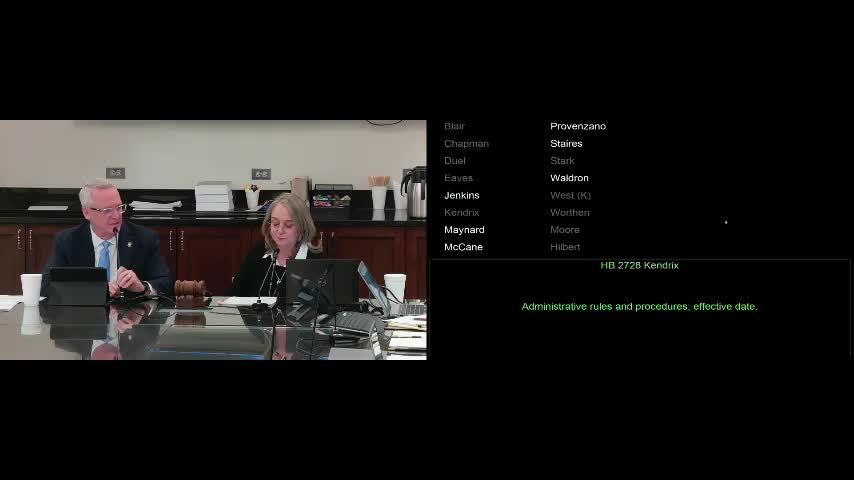
House panel approves bill to route costly administrative rules to Legislature, creates economic review unit
Summary
The House Administrative Rules Committee approved House Bill 2728 to require administrative rules with estimated first‑five‑year costs above $1 million to be treated as legislation and to create a Legislative Economic Analysis Unit (LEAU) inside LOFT to review agency cost valuations.
The House Administrative Rules Committee voted to approve House Bill 2728, a proposal that would require administrative rules with estimated first‑five‑year costs above $1 million to be processed as bills by the Legislature and establish a Legislative Economic Analysis Unit to review agency cost estimates.
Representative Kendrick, chairman of the Administrative Rules Committee, said HB 2728 — which he referred to as the RAINs bill ("Regulations in Need of Scrutiny") — would "set a cap on the administrative rules that are promulgated by agencies" so that any rule expected to "exceed a million dollar cost to citizens either in compliance or implementation costs in the first 5 years" would have to be filed and debated as legislation. Kendrick also said the bill creates the Legislative Economic Analysis Unit (LEAU), a unit located inside LOFT that will "assist the legislature, assist the administrative rules committee in reviewing the valuations put on those rules."
The LEAU, Kendrick said, will review the fiscal cost statements agencies file with proposed rules and examine the methodology agencies use to reach those estimates. "Once they've done that, the process then will come back to the administrative rules committee and we will use that information in determining whether or not that rule can be approved through administrative rule process or whether that has to go through the legislative process," Kendrick said.
Representative Waldron asked about LEAU membership and partisanship: "Question number 1 is, who serves on the legislative, economic, assessment unit? ... And will there be Democrats?" Kendrick replied that the LEAU will be a unit inside LOFT and described LOFT as a nonpolitical office; the unit's role is to provide an objective assessment of agency valuations and methodologies.
Representative Provenzano summarized the workflow the bill would create: "So all the packets from all the years are first gonna go through this unit within LOFT and run for checks and balances, chief among which if they cost a lot of money. And then once they've been bedded through that unit within LOFT, then some will go and then turn into legislation. Others will then come to this committee, thereby reducing the workload of this committee." Kendrick emphasized that the committee retains final authority: the LEAU "are to assess" valuations, while the Administrative Rules Committee makes the ultimate decision about how to address a rule.
Representative McCain, who said she had received constituent questions on rulemaking, sought confirmation that the measure would not change the "straight to the governor's desk" outcome unless the committee failed to act. Kendrick said the bill's intent is to push agencies to produce clearer, better‑supported cost estimates and to give the legislature tools to enforce oversight.
Committee members also discussed capacity and subject‑matter expertise. Several members raised whether an economically focused unit could adequately account for public‑safety or scientific considerations embedded in rules. Kendrick said the LEAU's focus is fiscal valuation and that the committee would consult agencies, counties, municipalities and school boards when appropriate; the Administrative Rules Committee would also consider whether agencies had explicit statutory authority for a rule.
The committee approved HB 2728 by a roll call vote of 12 yeas and 1 nay. The committee adopted the bill's proposed committee substitute (PCS 2) as the working draft before debate. Committee discussion emphasized that the LEAU is intended to provide evidence about valuations and that the committee would retain final judgment about whether a rule should proceed administratively or be converted into legislation.
Kendrick said the bill would require the LEAU to provide an annual report summarizing valuations and their quantified impact; he cited Florida's experience, saying that after a similar change in 2010 Florida saw a 51% decrease in rules proposed through the administrative process.