Get Full Government Meeting Transcripts, Videos, & Alerts Forever!
Get email alerts on the State Legislation topic
No spam. Unsubscribe anytime.
Wyoming House introduces dozens of bills, debates cultivated meat and spending policy; several bills pass
Summary
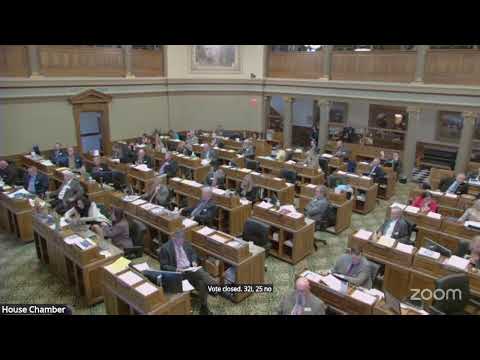
CHEYENNE, Wyo. — The Wyoming House of Representatives met Feb. 3, 2025, and introduced a wide slate of bills before taking votes on a consent package and several measures after debate on select subjects including cultivated meat regulation, the state's permanent trust spending policy and protections for medical prescribing.
CHEYENNE, Wyo. — The Wyoming House of Representatives met Feb. 3, 2025, and introduced a wide slate of bills before taking votes on a consent package and several measures after debate on select subjects including cultivated meat regulation, the state's permanent trust spending policy and protections for medical prescribing.
The session, presided over by Speaker Chip Nyman, began with roll call and ceremonial remarks and then moved to introduction, reading and referral of bills. The list of introductions included criminal-justice and election measures, tax and revenue proposals, and multiple education and public-health items. Notable introductions included House Bill 111 (hit-and-run penalties), House Bill 329 (Office of Homeland Security amendments), House Bill 291 (financial institution discrimination), House Bill 336 (waiver of parental rights, financial responsibility), and House Bill 328 (residential real property taxable-value changes). Each bill was assigned to committees by the speaker during the introductions.
Why it matters: Lawmakers used the day to place bills into committee for the remainder of session while debating several policy items on the floor that drew extended comment and roll-call votes. Lawmakers flagged the timing: this was the last day bills could be introduced in a house of origin.
Cultivated-meat debate
House Bill 168, described in the reading as a prohibition on "cultivating meat," drew extended floor debate and a floor amendment offered by Representative David Johnson (Representative Johnson moved the amendment). Johnson's amendment would have required that cultivated meat be authorized as safe for human consumption by the U.S. Food and Drug Administration before any use was allowed in Wyoming.
Representative Eklund, the sponsor, opposed the amendment, saying it would "cancel out" the bill's purpose of protecting Wyoming residents and schoolchildren and that the bill's intent was to regulate the product locally rather than defer to federal approval. Representative Johnson argued the amendment was a modest safety backstop to protect the public from a new technology. Representatives Yen and Strauch also spoke: Yen noted existing state labeling limits for "cultivated meat" and urged caution about broad prohibitions, while Strauch framed the issue as protecting children from chemicals he said were not "food." The amendment failed on voice vote and the bill was ordered to third reading.
Debate on state spending policy and trust funds
Two bills that would change the permanent trust spending policy and the common school spending policy (House Bills 270 and 271) were debated with competing amendments. Representative Harshman and others argued against quick reductions in the spending policy, saying market and commodity volatility (oil, coal) could force deep cuts if the state constrained spending too quickly. Representative Behr and others argued the state should restrain future spending and direct more into savings now. A proposed amendment to phase down the spending-policy percentage (an amendment that would have moved the policy to 4.75 percent over several years) failed on a recorded count 23-33.
Medical prescribing and off-label protections
House Bill 164, described in reading as addressing "medical prescriptions, off-label purposes," drew multiple amendments and debate about the role of federal agencies and medical boards in disciplining prescribers. Representative Presley Campbell offered an amendment that would remove redundant language and preserve providers' ability to use certain medicines for incomplete or spontaneous pregnancy loss; Campbell said leaving the restrictive language in place could endanger patients who need off-label medications to complete a miscarriage. Representative Singh offered a separate amendment addressing state versus federal scheduling of controlled substances; Singh said the amendment was intended to preserve Wyoming's authority if federal agencies moved to restrict medicines.
A later amendment (third reading amendment number 3) struck the word "employer" from a clause that otherwise would have limited adverse action by licensing boards; that amendment was adopted to preserve private employer-employee contract rights, supporters said. The bill passed final third reading on a recorded vote, 42-15 with 5 excused.
Fishing outfitters advisory board change
House Bill 5, relating to fishing outfitters and guides, was amended on third reading to require two advisory-board seats be held by small-business outfitters; supporters said that change would protect small operators on busy float sections of state rivers. The amendment was adopted and the bill passed final third reading, 35-22 with 5 excused.
Federal-review standing committee
House Bill 177, creating a statutory standing committee to review federal actions for intrusions on state sovereignty, drew debate over scope and practicality. Supporters said the panel would be a tool to resist federal overreach; opponents raised concerns about duplicating the Supreme Court's constitutional role and about creating a standing statutory committee rather than handling such reviews in rule or via targeted measures. The bill passed final passage, 32-25 with 5 excused.
Votes at a glance (final recorded counts taken from the floor): - Consent-package bills (passed): House Bill 31 (school safety and security) — 56 aye, 6 excused; House Bill 60 (student eligibility and sports) — 51 aye, 6 no, 5 excused; House Bill 86 (public property and buildings) — 57 aye, 5 excused; House Bill 133 ("sanctuary" prohibition) — 51 aye, 6 no, 5 excused; House Bill 137 (reviser's bill) — 57 aye, 5 excused; House Bill 206 (elections, acceptable identification) — 49 aye, 8 no, 5 excused; House Bill 221 (domestic sheep relocation repeal) — 55 aye, 2 no, 5 excused. - House Bill 5 (fishing outfitters/advisory board amendment adopted): passed 35 aye, 22 no, 5 excused. - House Bill 164 (medical prescribing/off-label): passed 42 aye, 15 no, 5 excused. - House Bill 177 (federal-review committee): passed 32 aye, 25 no, 5 excused.
What happened next
After the votes the House took a recess. Many bills introduced during the morning were referred to committees for hearings. Lawmakers repeatedly reminded members that this was the last day to introduce bills in the House of origin and that second-reading amendment deadlines for the budget bill were imminent.
Reporting detail and limits
This report summarizes on-floor introductions, debate and final passage counts recorded during the Feb. 3, 2025 House session. Quotations and attributions are taken from the on-the-record floor transcript; where a specific vote tally or procedural outcome was not recorded on the transcript excerpt, the report labels that item "not specified."