Get Full Government Meeting Transcripts, Videos, & Alerts Forever!
Get email alerts on the Criminal Procedure topic
No spam. Unsubscribe anytime.
Appeals court hears challenge to evidence from traffic stop in Commonwealth v. Mitchell
Summary
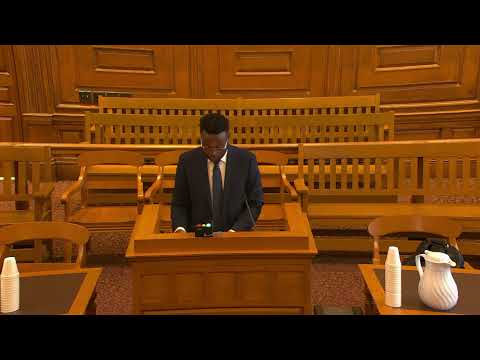
Catherine Essington, arguing for appellant Marcus Mitchell, told the Massachusetts Appeals Court on Feb. 4 that officers lacked reasonable suspicion to detain Mitchell during a parking-lot encounter and that the trial judge wrongly denied a renewed motion to suppress and a Long racial-profiling claim.
Catherine Essington, arguing for appellant Marcus Mitchell, told the Massachusetts Appeals Court on Feb. 4 that the trial judge erred in denying a renewed motion to suppress and in finding there was reasonable suspicion to detain Mitchell during a parking-lot encounter. She said the Commonwealth failed to identify a specific crime that would have justified the officers’ seizure and that many of the officers’ observations — scanning a parking lot, presence of two cell phones, or nervousness — are ordinary behavior and not grounds for detention.
“Article 14 . . . provides more protection in terms of defining the moment of seizure,” Essington told the three-judge panel (Justices Ditkoff, Hand and Walsh), and she urged the court to view the detention as occurring at the officers’ approach to the vehicle rather than later. She also asked the court to remand for a hearing on a Long racial-profiling motion, arguing that prior counsel did not have the legal framework to raise profiling claims and that the trial judge never considered the Long factors in a fresh hearing.
Nathaniel Beaudoin, for the Commonwealth, countered that the motion was waived and that the motion judge properly found insufficient proof of racial profiling under Long. Beaudoin said the trial judge made specific factual findings supporting reasonable suspicion and also defended the sufficiency of the evidence on the ammunition-possession count, arguing a jury could permissibly infer facts from the record in the light most favorable to the Commonwealth.
The panel questioned both sides about timing and consequence. Justices pressed defense counsel on why the Long motion was not filed earlier and asked the Commonwealth to identify precisely what additional facts officers observed before the detention. The attorneys also debated whether evidence discovered after Mitchell’s flight was attenuated from the alleged unlawful stop and whether a magazine or other items were discovered before flight.
Essington acknowledged some gaps in the record — including the trial judge’s sparse findings about the timing of the detention — and told the court that if it found the Long claim should have been considered, it should remand for a specific hearing. The Commonwealth said Judge Ritter had concluded that “substantial justice” did not require reopening the motion and that the judge found insufficient showing of racial profiling.
The court heard argument without reaching a decision at the session’s close.