Get Full Government Meeting Transcripts, Videos, & Alerts Forever!
Get email alerts on the Ways And Means Hearing Roundup topic
No spam. Unsubscribe anytime.
Ways and Means Committee holds hearings on housing preservation, election transparency, curbside voting, split-rate taxes, transfer tax and deepfakes
Summary
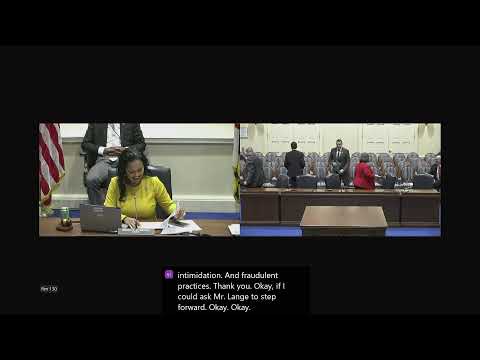
An Annapolis hearing of the House Ways and Means Committee on February (date not specified) drew panels of advocates, local officials and industry groups for a series of bill presentations and public testimonies on housing preservation, election administration, property tax tools and technology‑driven election fraud.
An Annapolis hearing of the House Ways and Means Committee on February (date not specified) drew panels of advocates, local officials and industry groups for a series of bill presentations and public testimonies on housing preservation, election administration, property tax tools and technology-driven election fraud.
Delegate Kirill (Korman) presented House Bill 390, the Affordable Housing Payment in Lieu of Taxes Expansion Act, saying the measure would allow counties to use PILOT (payment‑in‑lieu‑of‑taxes) agreements to preserve “naturally occurring affordable housing” as well as newly built or substantially rehabilitated properties. “We cannot afford to lose that housing stock,” Robert Goldman, president of Montgomery Housing Partnership, told the committee in support. The sponsor said the bill as filed sets a 50% affordability threshold but that he planned an amendment to lower the standard to 30% while allowing counties to set higher thresholds locally.
Supporters including Melissa Bonde, senior director for Enterprise Community Partners, and county officials said the change is intended to give local governments a tool to acquire or support at‑risk properties that don’t require immediate large‑scale rehabilitation but are vulnerable to market conversion. Kevin Canally of the Maryland Association of Counties told the committee the bill “closes a loophole” and asked for a favorable report.
The committee also heard House Bill 412, the Local Board of Elections Transparency Act. Sponsor testimony described requirements to post meeting agendas and written materials 48 hours before meetings, livestream open meetings and maintain an archive of recordings for five years, and to require live streams for canvass meetings during elections. Morgan Drayton of Common Cause Maryland, Rebecca Snyder of the Maryland‑Delaware‑D.C. Press Association and Nancy Soering of the League of Women Voters all testified in favor, saying the change would expand public access to local election processes. Representatives of county government and the Maryland Association of Counties supported the bill with requests for technical clarifications about hosting streams (for example, allowing YouTube links) and to mitigate potential fiscal impacts for boards that canvass in multiple buildings or lack broadband in some locations.
On election administration, Delegate Greg Williams presented House Bill 322 to authorize the State Administrator of Elections to enter memoranda of understanding with municipalities that request state assistance running municipal contests, and to shorten the deadline for municipalities to request to appear on the state ballot from 18 months to nine months before the candidate filing deadline. Jared DeMarinis, the State Administrator of Elections, told the committee the change reflects existing practice in assisting municipal all‑mail elections and that the shorter 9‑month notice is sufficient to implement changes in the voter‑management systems without fiscal impact.
Delegate Nicole Williams and disability‑rights advocates presented House Bill 317, a curbside voting pilot. The bill would authorize a pilot in three jurisdictions (one each designated as small, medium and large) for the primary and general elections to permit voters who cannot reasonably enter a polling place to request curbside in‑person voting. Supporters, including AARP Maryland and local advocates, said curbside voting is already used in many jurisdictions and would increase access for older adults and voters with mobility limitations. State Board of Elections staff and several witnesses discussed equipment logistics: the board is conducting a procurement for lighter, more portable voting equipment aimed at future elections, and officials indicated new equipment is expected under the board’s RFP cycle (discussed as a target for procurement by 2028) — a factor that influenced sponsor decisions to propose a pilot rather than immediate statewide implementation.
Delegate Von Stewart introduced House Bill 330 to allow counties to adopt a split‑rate property tax (a higher rate on land value and a lower rate on improvements) for parcels within one mile of specified rail transit stations, with a sponsor amendment to send a small share of any added revenue (5%) to the State Transportation Trust Fund. Proponents, including transit and labor representatives, said the split‑rate approach (also called land‑value taxation) has been used in Pennsylvania and Northern Virginia to incentivize development near rail and reduce vacancy. Municipal and county groups asked for revenue‑sharing language changes and raised concerns about the precedent of diverting local property tax revenue to the state; the Maryland Municipal League advocated keeping local revenues local.
House Bill 342, proposing a graduated real estate transfer tax that would charge higher rates on higher‑priced transactions, drew opposition from real estate groups and multifamily housing representatives, who argued higher transfer taxes would hinder sales activity and investment at a time when transactions and multifamily sales have slowed. Testimony included data cited by the Maryland Multi‑Housing Association showing declines in multifamily sale prices and volumes and objections that higher transaction costs are not financeable and would chill mobility in the housing market.
Child care stability measures were presented in House Bill 389, which would broaden and raise county authority to offer property‑tax credit incentives for child care providers and for businesses that provide on‑site child care. Sponsors and advocates said the change would expand an existing local option that only four counties currently use and help struggling child care providers whose margins are very narrow. The Maryland State Child Care Association and the Maryland Association of Counties supported the bill as an enabling tool for local governments.
Finally, Delegate Jessica Feldmark presented House Bill 525 to add fraud to the statutory list of prohibited means of influencing a voter’s choice and to specify that fraud can include synthetic media or “deepfakes.” Legal and election‑security witnesses including Ben Yellen (University of Maryland Center for Health and Homeland Security), Craig Holman (Public Citizen), and representatives of the Maryland Association of Counties supported the measure as a tool to address AI‑generated deceptive media. Tech industry representatives asked for narrowly tailored exemptions for platforms and cybersecurity responses; committee members sought clarifications and said they would work on definitions and carve‑outs to protect satire, authorized candidate uses of synthetic media and to define enforcement pathways (complaints to the State Board of Elections and potential referral to state prosecutors under Title 16 provisions were discussed).
The committee did not record any final floor motions or votes in the hearing transcript; most presenters and advocates urged a “favorable report” and committee members requested draft amendment language and additional technical clarifications on several bills. Several sponsors indicated they would file technical sponsor amendments following feedback at the hearing.
Ending: The Ways and Means Committee closed the session after a full day of bill hearings and testimony; committee members asked sponsors and stakeholders to submit amendment language and technical fixes and signaled follow‑up discussions on procurement timelines for election equipment, fiscal‑impact mitigation for local election boards, and tightened statutory definitions for deepfakes before advancing any bill to a committee report.