Get Full Government Meeting Transcripts, Videos, & Alerts Forever!
Get email alerts on the Education Project Based Learning topic
No spam. Unsubscribe anytime.
Moharimet fourth-graders show renewable-energy projects to Oyster River school board
Summary
Fourth-graders from Moharimet Elementary told the school board about a yearlong integrated, project-based unit on hydro, solar and wind energy that included hands-on experiments, community experts and student coding and design work.
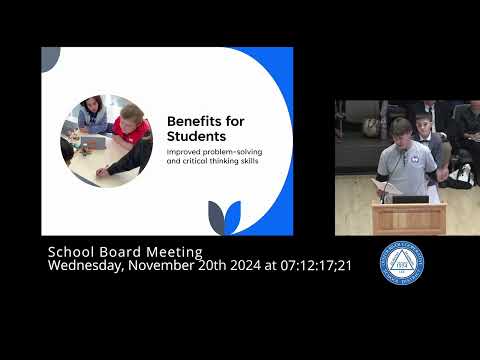
Moharimet Elementary fourth-graders and their teachers presented an integrated, project-based unit on renewable energy to the Oyster River Cooperative School District School Board at the Nov. 20 meeting.
The presentation, introduced by teacher David Goldsmith, described a multi-week unit in which students investigated hydro, solar and wind power using voltmeters, small turbines and coded motors. Sarah Curtin, Moharimet’s digital learning specialist, said the work is part of a continuing, iterative program: "Integrated learning focuses on building connections across disciplines," she said, adding that her planned spring sabbatical will study integrated project-based learning to inform district practice.
Nut graf: The classroom demonstration highlighted how multiple teachers and specialists — including math and science, library media and art staff — collaborated so students could research, build models and test devices. Presenters said the unit emphasizes hands-on problem solving and teamwork and culminates in a public share-out Friday, Nov. 22.
Students described the work in their own words. Chloe, a fourth-grader, said, "I think the energy project was interesting because we saw how we were actually able to make energy from wind." Classmate Corey described the hands-on building: "When we made it with the dam, we put a little hole in it, and then we put an upside down motor to spin a turbine... I had to try over and over to get this 1 motor to go on the spot I wanted it to go." Librarian Chris Hall said the unit "maximizes student learning time" by weaving research, coding and writing into one project.
Teachers and students described specific activities: measuring power with voltmeters while changing one variable at a time (panel angle, turbine blade count, water head), building LEGO dams with coded motors, creating Canvas slides for presentations, using a Chalk Talk activity to record research thinking, and practicing team agreements ("team alliances") and conflict scripts using "I" statements. Students named Spike Essential, LEGO Spike kits and coding as tools they learned during the unit.
The presenters said community partners visited classrooms and that the fourth-grade team invited local renewable-energy professionals from Revision Energy and Great River Hydro to give feedback. Emily Randall, a fourth-grade teacher, said teachers have refined the unit over four years and added new elements after summer training on project-based learning.
The students invited the public to a share session at the Moharimet Library Learning Commons from 9:15 to 10:15 a.m. Friday, Nov. 22. Board members asked about timeline and challenges; students said the unit spanned weeks starting earlier in the school year and cited collaboration, staying on task and learning new coding tools as the main challenges.
Ending: Board members thanked the students and staff for the presentation and for continuing the multi-year project that staff said supports the district’s graduate profile and 21st-century learning expectations.