Get Full Government Meeting Transcripts, Videos, & Alerts Forever!
Get email alerts on the State Legislative Session topic
No spam. Unsubscribe anytime.
Seattle OIR briefs council as 1,442 bills vie for action in 2025 state session
Summary
Office of Intergovernmental Relations Director Mina Hashemi told the Seattle City Council on Feb. 3 that the 2025 Washington legislative session had entered its fourth week and that “1,442 bills have been introduced and legislative business is moving quickly.”
Office of Intergovernmental Relations Director Mina Hashemi told the Seattle City Council on Feb. 3 that the 2025 Washington legislative session had entered its fourth week and that “1,442 bills have been introduced and legislative business is moving quickly.”
Why it matters: Several measures now moving in Olympia could affect Seattle budgets, public safety operations, housing policy, utility planning and child-care funding. The city’s OIR team outlined which bills align with the council’s legislative priorities and which items the city is monitoring or has formally supported.
OIR’s presentation, given by Hashemi and Anna Johnson, grouped bills under the council’s priorities. Johnson said the briefing would “first give you an update on all of our Seattle priorities,” then summarize major committee action from the first three weeks of session. She emphasized OIR selected bills for the briefing because they either “have a big impact on the city of Seattle” or have become high-profile in Olympia.
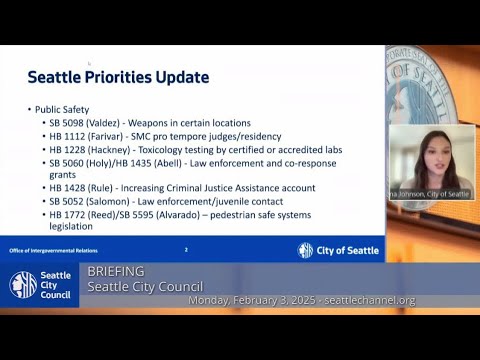
Public safety and criminal justice were among the first policy areas OIR raised. Hashemi and Johnson flagged Senate Bill 5098, described as restricting weapons in certain locations including parks and community centers, and House Bill 1228, which would allow Seattle to send DUI toxicology samples to accredited private labs in addition to the Washington State Patrol lab. Johnson said HB 1228 had a committee hearing and was awaiting executive action; OIR later confirmed the city “signed in pro” on that bill and that the city attorney testified on the issue.
OIR also called out Senate Bill 5060, a proposed $100 million grant program to fund law-enforcement co-response, behavioral-health response and peer response programs for local governments. Hashemi and Johnson said OIR had signed in in support of several bills tied directly to the city’s adopted priorities, and that dozens of other bills were being tracked without a formal city position.
On behavioral-health and schools, OIR mentioned bills to expand youth mental-health networks and workforce training (Senate Bills 5126 and 5369) and the governor’s universal free school meals proposals (House Bill 1404 and Senate Bill 5352). In energy and climate, OIR noted recycling reform (House Bill 1150; Senate Bill 5284) and legislation to let consumer-owned utilities pursue joint energy projects (House Bill 1253). On housing and land use, the team discussed bills ranging from condo-liability reform (House Bill 1403) to measures affecting lot splitting, density near transit, and a statutory process for submitting some housing-element materials to the state for review.
Council members pressed OIR for clarity about who “the city” represents when staff say the city “signed in pro” on a bill. Anna Johnson and Sameer Janayjo said OIR typically coordinates with departments, the mayor’s office and council offices before signing in; when OIR listed a bill under the council priorities briefing, the team said it had either filed pro-comments or testified for the city. If OIR did not report a formal position in the briefing, Johnson said the city had not taken action on that measure and was monitoring it.
Several council members raised bill-specific questions during the briefing. A council member asked whether House Bill 1228 is on record as supported by the city; OIR answered affirmatively and added that the city attorney had testified in support. Another council member asked about SB 5052, juvenile-contact and youth-counsel provisions; OIR said it had testified in support in committee and that the bill had been scheduled for executive action.
Hashemi and the OIR team repeatedly urged council members to flag bills that matter to them individually or to their committees so the office could target testimony and coordinate with departments and the mayor’s office. OIR staff said the pace of session work sometimes forces quick decisions and that they welcome council feedback between briefings.
What didn’t change at the briefing: OIR did not report that the council had taken new formal votes on the bills discussed; most measures remain in committee or are awaiting executive action in the Legislature. OIR’s update was a status report, not a council policy decision.
Context and next steps: Hashemi said OIR will continue to track bills tied to the council’s legislative agenda and will return with updates as measures move through committees and to the floor. Council members asked OIR to provide faster notice when a measure that concerns their committee is moving, and OIR agreed to increase outreach to council offices when timing permits.
Votes at this briefing: The only formal action recorded in the briefing minutes was adoption of the January 2025 minutes by general consent; OIR’s policy update did not include council votes on the state bills it described.