Get Full Government Meeting Transcripts, Videos, & Alerts Forever!
Get email alerts on the School Safety Sro Programs topic
No spam. Unsubscribe anytime.
Pearland SRO at PACE expands role with mentoring classes, drills and streamlined juvenile directives
Summary
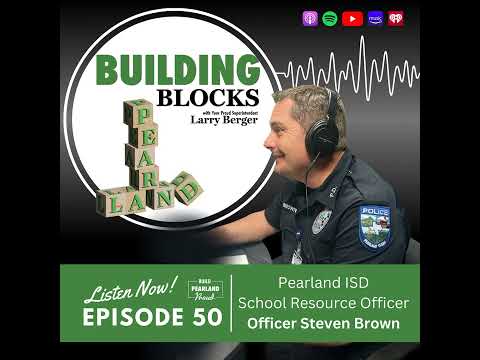
Officer Stephen Brown, a School Resource Officer with the Pearland Police Department assigned to the PACE Center, described a mix of traditional security work and expanded mentorship duties — including a program called COPS LEAD, classroom visits and procedural changes to juvenile directives — during a Pearland ISD "Building Blocks" podcast.
Officer Stephen Brown, a school resource officer with the Pearland Police Department assigned to the PACE Center, described on the Pearland ISD "Building Blocks" podcast how his work combines campus safety duties with mentorship programs aimed at preventing student misconduct.
"I wanna come to work and be bored. I don't actually wanna do the law enforcement side of my job at work," Brown said. "I wanna come to work and walk the hallways and sit in on classes." The remark summarized his goal to reduce arrests by building relationships and offering students alternatives to punitive responses.
Superintendent Mr. Berger, host of the podcast, framed the SRO program as a formal partnership between the district and the city: "We have a partnership in MOU," he said, referencing the memorandum of understanding that places city police officers on district campuses. Brown and Berger said SROs perform both security tasks — drills, door audits and incident response — and broader campus roles such as attending administrative team (AT) meetings and delivering classroom content.
Brown, who described nearly 17 years with the Pearland Police Department after military service in the Marine Corps, said he has written and taught classes under a program he calls COPS LEAD (Campus Officers Preparing Students to Learn, Engage, Achieve and Develop). The classes began as a drug-awareness curriculum and expanded to include anger management and a module Brown called "Facing Down Your Devil," addressing substance abuse, abusive relationships and other personal challenges.
Brown said he pilots those lessons with campus leaders before teaching them to students. "I presented the class to [Dr.] Darden Rayburn, a couple of the teachers and Mr. Palumbo came by," he said, adding that he trimmed graphic material so lessons would not unduly alarm students.
He also described an operational change in handling juvenile directives that previously required multiple trips to a Brazoria County judge and interagency travel to process detentions. "We were still driving directives to apprehend down to Brazoria County, finding a judge to sign it, driving it back to Pearland to pick up whomever was being detained, drive back to Angleton to drop the kid off, and then turn back around," Brown said. He said the department now emails typed directives to judges and receives signed responses electronically, which he said shortens processing time.
Brown emphasized relationship-building as central to prevention. He described walking hallways and attending classes to learn students' baseline behavior so staff and SROs can spot sudden changes: "If you see them first period and you kinda notice that something's off about them, you can head that off at the pass." He contrasted that with enforcement settings such as traffic stops, where officers typically meet a person only once.
Brown recounted a COPS LEAD class with 13 students in which only one student knew about Columbine, a reference Brown used to argue students may not understand the historical reasons for taking drills seriously. He said the lessons explain why drills matter and how law enforcement responses to school violence have evolved.
District staff and Brown framed SROs as contributing to both hardening and supportive functions on campus. "Those are not as effective" without relationship-building, Berger said, referring to locking doors and drills.
Brown said the SRO role at PACE has led him to participate in administrative planning and student support activities not always found in SRO job descriptions. He described the position as "the hidden gem" of policing work and said he wants to prevent students from reaching the point where arrests are necessary.
The podcast episode did not include formal votes, policy changes, funding details or a public comment period; it was an interview highlighting the SRO role, programs created by Brown and operational practices at one Pearland ISD campus.
Brown and district leaders repeatedly separated discussion from formal authority: Brown described department practices and classroom programs; Berger described the MOU partnership; neither announced a new district policy or budget commitment during the interview.
The episode closed with Berger urging students to view SROs as supports rather than adversaries: "Students, if you have any issues, they are not the enemy. They are support and a friend," he said.