Get Full Government Meeting Transcripts, Videos, & Alerts Forever!
Get email alerts on the Healthcare Entity Registry topic
No spam. Unsubscribe anytime.
Panel backs idea of healthcare entity registry to map ownership and consolidation trends
Summary
Senate Bill 5,561 would create a registry requiring healthcare entities to report ownership, affiliations and provider details to the Department of Health; supporters said the data gap hinders planning while providers urged narrowing scope and protecting provider privacy.
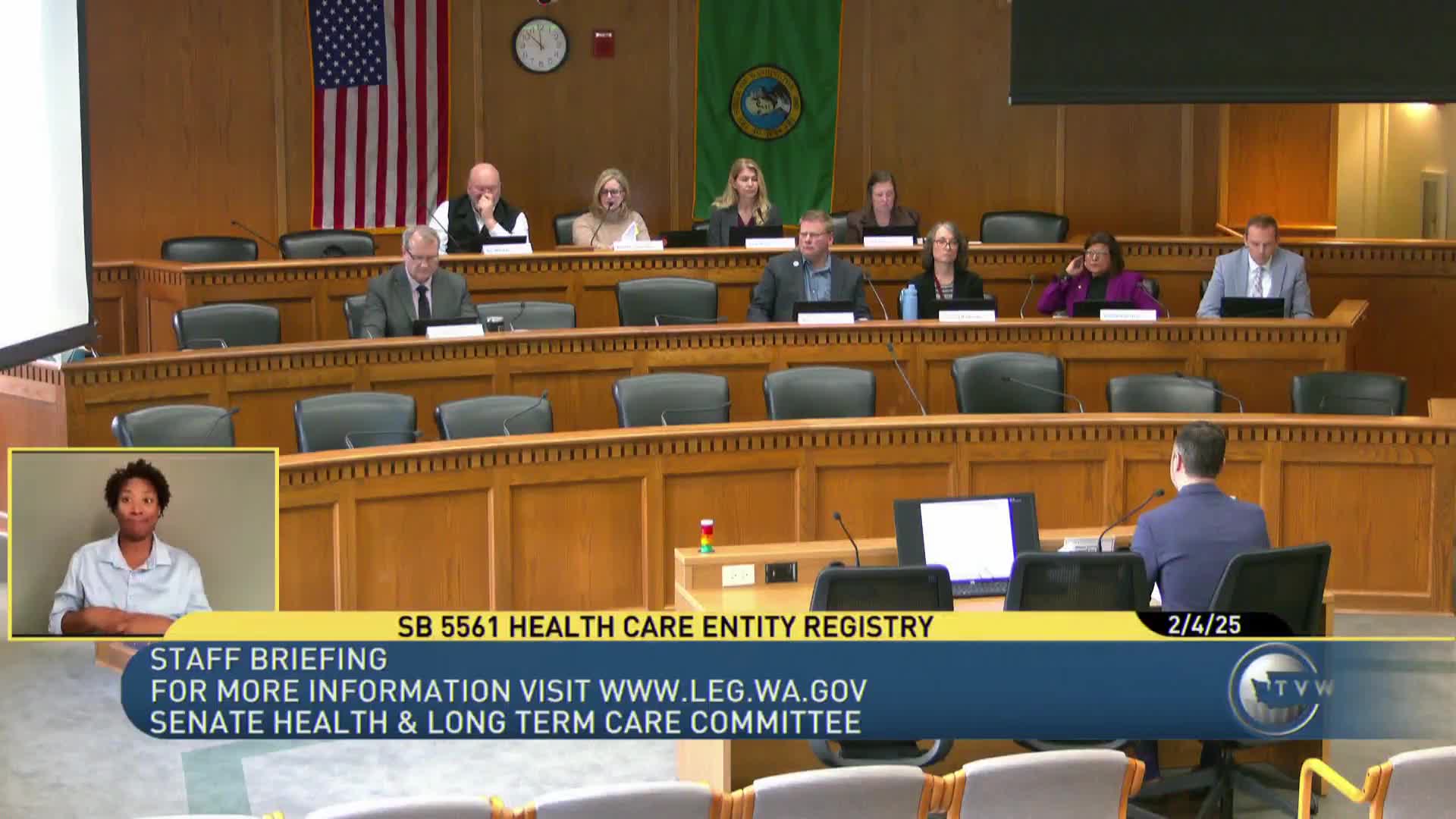
Lawmakers considered Senate Bill 5,561, a proposal to create a statewide registry that would require healthcare entities to annually report corporate ownership, organizational charts, providers practicing at locations, and selected financial information to the Washington State Department of Health.
Committee staff explained the bill would extend reporting to entities not currently licensed in a way that captures ownership, affiliated management service organizations and board composition; social security numbers would remain confidential but most other information would be publicly available through an interactive DOH tool slated for development by 2028. The bill would also direct DOH to analyze consolidation trends and permit audits and enforcement for noncompliance.
Supporters — including the Office of the Insurance Commissioner, the Department of Health, the Washington State Medical Association, public‑interest groups and employer purchasers — told the committee a consolidated registry is necessary to identify gaps in provider availability, monitor market concentration and inform policy responses to consolidation and affordability. "We would love it if there were language in the bill that clearly allowed information transfer between OIC and DOH," testified Jane Beyer of the Office of the Insurance Commissioner, noting Massachusetts has an established hospital ownership registry used to track private equity ownership.
Opponents cautioned the bill's definitions and reporting granularity were too broad. Hospital representatives and provider groups said the scope of required reporting — down to names, license types and ID numbers of every provider at an entity — could create substantial reporting burdens, privacy concerns for clinicians and very large data volumes. "For 1 of our hospitals, that would be nearly 72,000 physicians and nurses alone for their system," warned a hospital association representative, urging the committee to align reporting requirements with the specific public‑facing dashboard requirements and to rely on existing reporting where possible.
The committee did not take a vote; supporters, including nursing groups, employer purchasers and public health advocates, asked lawmakers to refine the draft to reduce burdens while preserving the registry's transparency and planning value.
Ending: Sponsors and agencies said a centralized, searchable registry would help state agencies and purchasers track consolidation and provider availability, but stakeholders asked for scoped reporting, privacy safeguards and the use of existing reporting where possible.