Get Full Government Meeting Transcripts, Videos, & Alerts Forever!
Get email alerts on the Obesity Treatment Coverage topic
No spam. Unsubscribe anytime.
Senate committee hears bill to require insurance coverage for obesity treatments after briefing on GLP‑1 drugs
Summary
Lawmakers received a work‑session briefing on anti‑obesity medications and heard testimony supporting the Diabetes Prevention and Obesity Treatment Act (SB 5,353), which would require coverage for a broad set of obesity treatments and ask Medicaid to pursue federal matching funds.
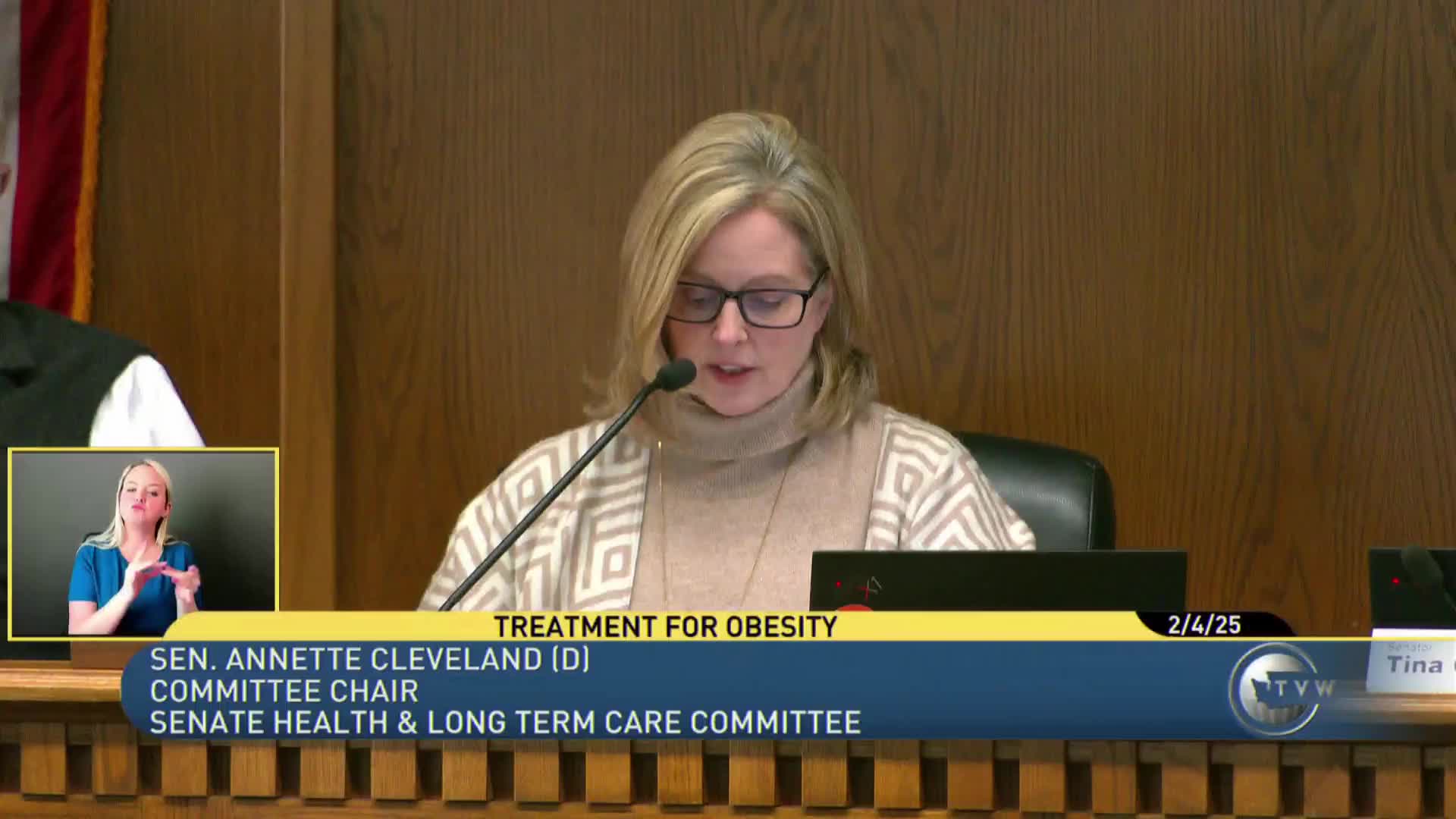
The Senate Health and Long Term Care Committee held a work session on anti‑obesity treatments and then opened a public hearing on Senate Bill 5,353, the Diabetes Prevention and Obesity Treatment Act. The bill, sponsored by Sen. Cleveland, would require many health plans to cover diagnosis and treatment for obesity beginning Jan. 1, 2026 and direct the Health Care Authority to seek federal matching funds for Medicaid coverage.
Dr. Judy Zerzan, chief medical officer at the Washington State Health Care Authority, briefed the committee on a legislative report about coverage options for glucagon‑like peptide‑1 receptor agonists (GLP‑1s) and other obesity treatments. Dr. Zerzan said the report recommends coverage be tied to individualized prior authorization that follows FDA labeling and ensures clinical effectiveness and tolerability. "These drugs are not effective for everyone," she said. The agency's fiscal modeling assumes between 5% and 10% uptake among some public plan members, producing modeled increases in employer medical contributions of roughly 3% to 6% depending on uptake assumptions, Dr. Zerzan said.
Dr. Jitanjali Srivastava, a Vanderbilt obesity medicine specialist, told the committee obesity is a complex, multifactorial disease and that new drug competition and expected generics will likely reduce costs over time. "When you have a cancer diagnosis, there is a moment where the team comes together," Dr. Srivastava said, drawing an analogy to multidisciplinary obesity care.
Sen. Cleveland described SB 5,353 as an effort to treat obesity as a chronic disease across a full spectrum of care — intensive behavioral therapy, FDA‑approved medications, and metabolic and bariatric surgery. Committee staff summarized the bill's key deadlines: by Nov. 1, 2025 the Health Care Authority must apply to CMS to request federal matching funds so that, if approved, the Medicaid program would begin covering the services in 2026. Staff also noted carriers and the Health Care Authority may apply utilization management to determine medical necessity.
Scores of witnesses — clinicians, patient advocates and people with lived experience — testified in support. Testifiers included the American Diabetes Association, physicians in obesity and endocrinology, public health and patient advocates who urged covering the full range of evidence‑based options. Testimony highlighted equity concerns: speakers described higher obesity prevalence in lower‑income groups and among Black, Hispanic, American Indian and Alaska Native populations and urged insurance coverage to reduce barriers to care.
No committee action on SB 5,353 was recorded; the hearing closed after public testimony. Sponsors said they plan to route the bill to state agencies for additional analysis during the 2‑year review period and revisit the legislation with updated cost and utilization data.
Ending: Committee members indicated they will use the agency reviews and HTCC (Health Technology Clinical Committee) reports to inform future decisions; no vote or motion on SB 5,353 was recorded in the transcript.