Get Full Government Meeting Transcripts, Videos, & Alerts Forever!
Get email alerts on the School Bonds Threshold topic
No spam. Unsubscribe anytime.
State hearing spotlights push to lower school bond threshold to simple majority
Summary
A Washington state House committee heard hours of public testimony in favor of reducing the voter approval threshold for school construction bonds from 60% to 50%, with witnesses citing overcrowded classrooms, aging facilities and uneven access to state matching funds; no committee vote was recorded.
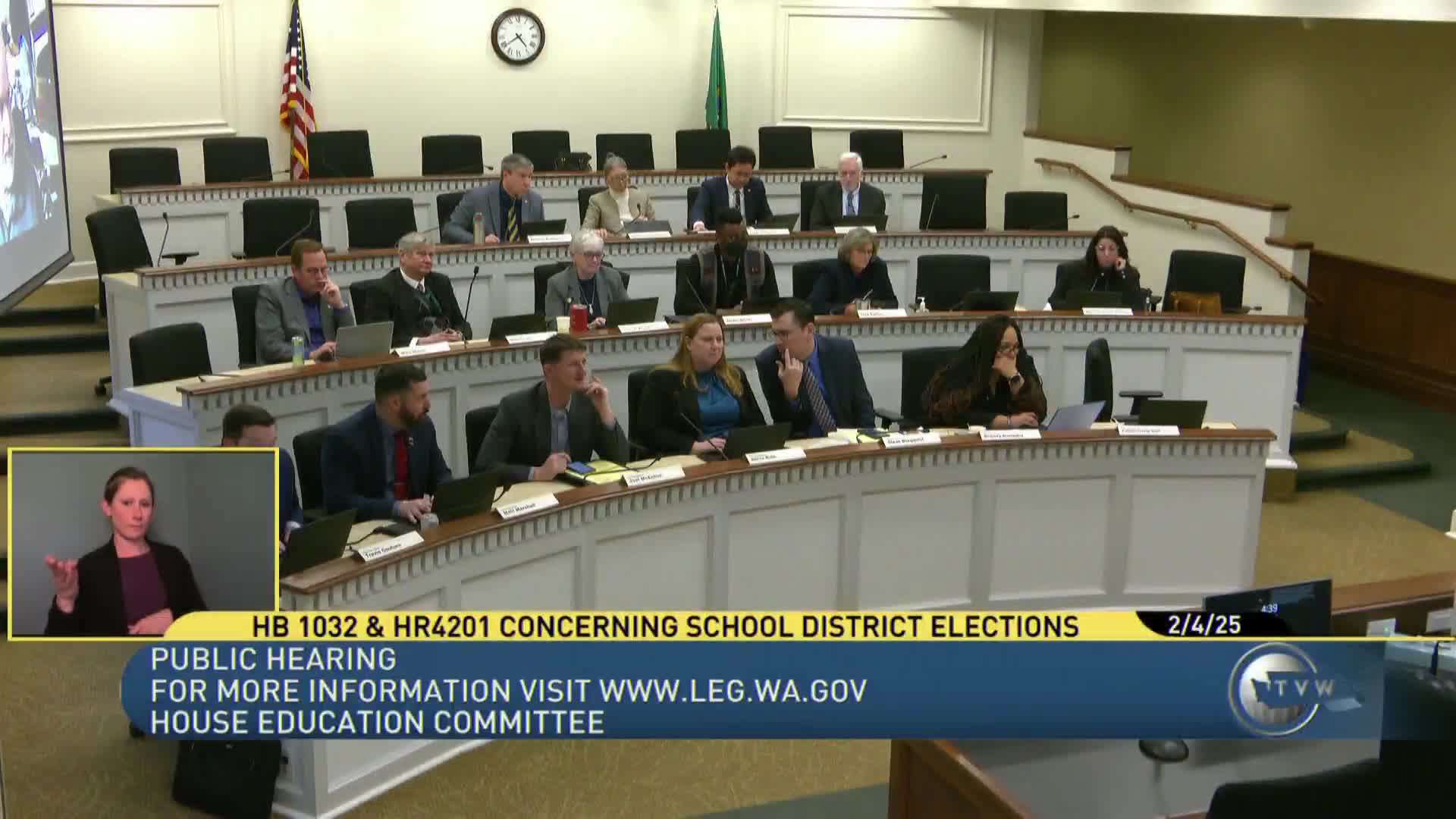
A Washington state House committee heard public testimony supporting House Bill 1032 and House Joint Resolution 4201, measures that would reduce the voter approval threshold for local school construction bonds from 60% to a simple majority.
Supporters said the change would allow more school districts to pass bonds for building repairs and expansion. "A 50% threshold would align with the standard used for levies and match the threshold used by 37 other states in the country," said Martin Turney, chief of finance and operations for the Issaquah School District. Turney told the committee his district recently had a bond that received "over 50% voter approval" but failed under the 60% rule.
Why this matters: Proponents argued the current supermajority requirement leaves districts unable to address overcrowding, seismic and infrastructure problems, and can block access to state matching funds that hinge on approved local bonds. Several witnesses described classrooms in portable buildings, overflowing courses and aging systems that present safety and accessibility concerns.
Architect and planner Benjamin Fields said statewide bond passage rates have dropped in recent years, and that the decline has left some districts without the resources to modernize facilities. "Between 2015 and 2020, the average passage rate for school bonds in Washington state was 48.2%. However, from 2022 to present, the rate has plummeted to just 19.4," Fields told the committee, arguing a lower threshold would restore earlier passage levels.
Student and teacher testimony underscored those effects at the classroom level. Rachel Kelly, a 17-year-old senior at Lake Washington High School, said her school opened a new wing but that both new and old classrooms are full; she cited an AP calculus class with 37 students and said shifting to a six-period day will increase class sizes. Jessica Justice, a public school teacher, said many bonds in recent years received majority support yet still failed under the 60% rule: "Between 2017 and 2020, 115 of the 130 school bond measures, 88%, had more than 50% support but failed to reach the threshold," she said.
Not all testimony supported lowering the threshold. Jeff Heggethorn, who identified himself as an advocate for fair and transparent elections, argued that voters lack accurate cost information about bonds and said, "School bonds should be eliminated," citing vandalism of political signs and alleged misinformation in taxpayer-funded mailers.
Committee business: Vice Chair Shavers read into the record lists of signees for and against the measures. For HB 1032, the record showed 1,430 pro, 733 con and 2 other. For HJR 4201, the record showed 2,041 pro, 852 con and 4 other. The public hearing on both measures was closed with no committee vote recorded at that time.
Discussion topics raised by witnesses included: disparities between urban and rural districts in relying on levies and property tax bases; safety concerns including seismic vulnerability and outdated ventilation; the effect of bond failures on access to state matching funds; and claims that some districts underestimate bond costs or produce biased voter materials. Several witnesses urged the bills to be advanced so districts could more readily fund capital projects.
The hearing concluded after public testimony and the record of signees was entered; the committee did not take a formal vote on either bill during the session.
Future steps: Neither bill was voted on during the hearing. Any committee action, amendment or floor action would be recorded in subsequent committee minutes and legislative filings.