Get Full Government Meeting Transcripts, Videos, & Alerts Forever!
Get email alerts on the Corrections Transgender Search Policy topic
No spam. Unsubscribe anytime.
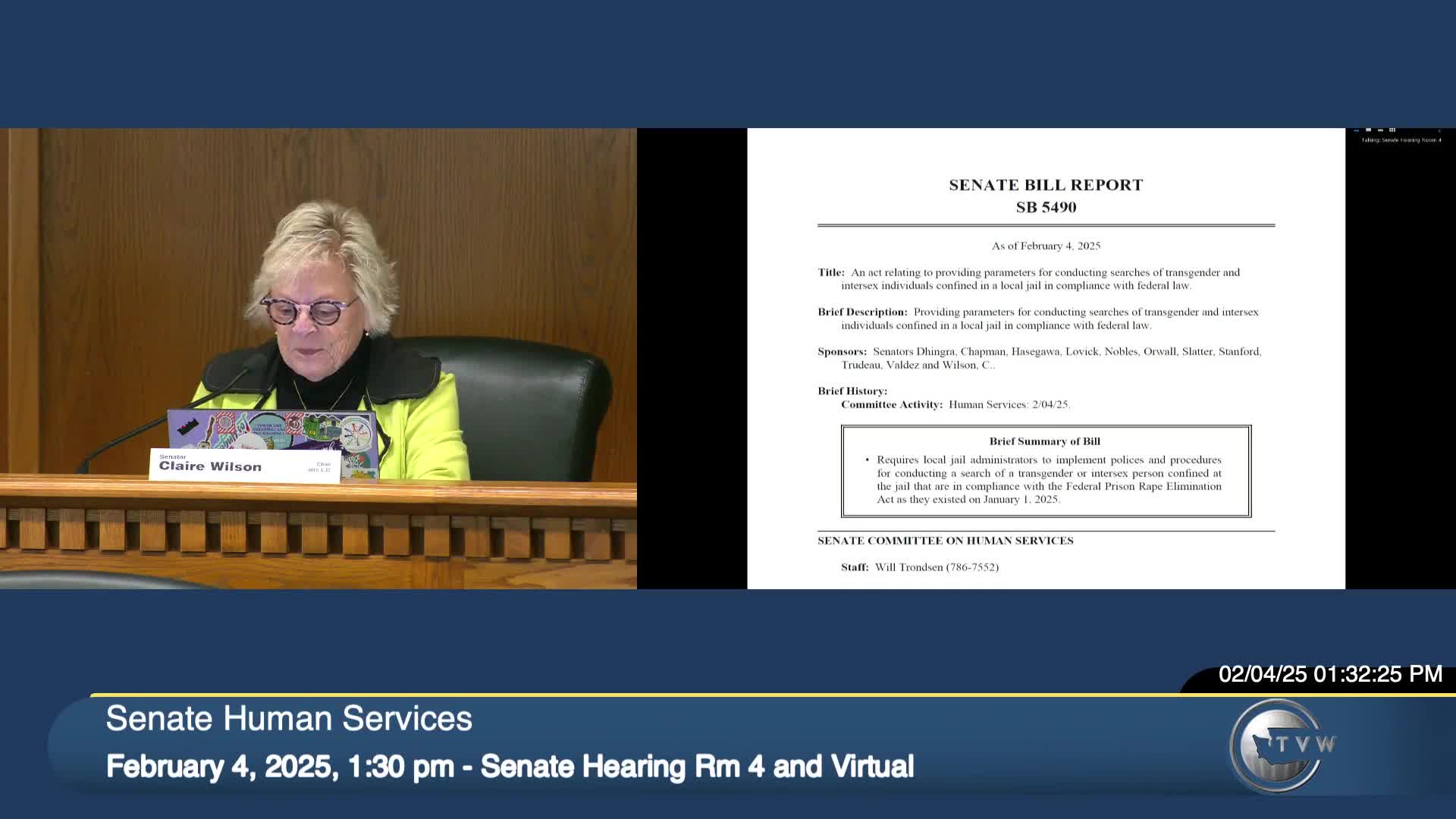
Senate committee hears bill to align jail search rules for transgender and intersex people with PREA
Summary
Senate Bill 5,490 would require local jails to adopt search policies for transgender and intersex people that comply with the federal Prison Rape Elimination Act and to limit opposite‑gender viewing for showers and changing.
Senators on the Washington State Senate Human Services Committee heard testimony on Senate Bill 5,490 on Feb. 4, a measure sponsored by Senator Manka Dhingra to require local jails to adopt search policies for transgender and intersex people that at minimum comply with the federal Prison Rape Elimination Act (PREA) as of Jan. 1 of this year.
The bill would require that a search of a transgender or intersex person be done in one of these ways: by the individual's chosen gender of staff; only by a medical professional; by female staff only when an adult is searched by female staff; or in accordance with the individual's stated gender identity. The draft also requires policies that enable people in custody to shower, perform bodily functions and change clothing without non‑medical staff of the opposite gender viewing them, with narrow exceptions for exigent circumstances or incidental viewing during routine cell checks. The bill explicitly states that a jail’s inability to make a female correctional staff available for searches is not an exigent circumstance. The bill’s effective date is Sept. 1 of this year, and a fiscal note indicates costs to local governments.
Why it matters: Supporters said aligning state law with PREA fills a gap that leaves transgender, gender‑nonconforming and intersex people at elevated risk while in custody and gives correctional staff clear procedures to follow. Will Tronson, committee staff, told members the measure is intended to bring state law into step with existing federal standards. Senator Dhingra said the change was requested by the City of Kirkland and described the bill as a “simple” update to preserve rights and prevent regression in standards.
Supporters who testified included Penny Sweet, a Kirkland city council member, who said the city requested the legislation and that existing statutes from the 1980s do not adequately address the needs of transgender and intersex people. Danny Askingi, executive director of Gender Justice League, urged the committee to adopt the bill to reduce risk and humiliation for incarcerated transgender people. Ethan Frenchman of Columbia Legal Services and Jenna Comstock of the Q Law Association also testified in support, describing the disproportionate risk of sexual assault and humiliating treatment for transgender people in custody.
Law‑enforcement groups and jail associations also testified. James McMahon, policy director for the Association of Sheriffs and Police Chiefs, said his group had worked with sponsors and provided suggested language to strengthen the bill. McMahon asked the committee to clarify distinctions between pat‑downs and strip searches and recommended statutory language to allow people in custody to choose the gender of the searcher when feasible, and to shield all people from view while showering or changing. He and others also proposed language to protect corrections personnel from being required to disclose their gender identity or to perform searches inconsistent with their own gender identity.
Concerns and open points: Testimony included a mix of support and requests for additional clarifications. Law‑enforcement witnesses asked for clearer statutory distinctions (for example, explicitly excluding body‑cavity searches from the corrections officer role and reserving those to medical personnel), and for operational flexibility to locate and train staff able to perform searches. Sponsors and advocates stressed that the bill is intended to provide minimum state standards that allow jails to implement PREA‑aligned, trauma‑informed practices.
The committee recorded public sign‑in counts at the end of the SB 5,490 hearing as 43 pro, 72 con and 1 other. The committee did not take a final vote during the Feb. 4 hearing.
The bill remains pending in the Senate Human Services Committee; sponsors and multiple stakeholders requested follow‑up conversations on implementation details and suggested amendments to address staff training, staffing availability and privacy protections.