Get Full Government Meeting Transcripts, Videos, & Alerts Forever!
Get email alerts on the Unemployment Wage Replacement Excluded Workers topic
No spam. Unsubscribe anytime.
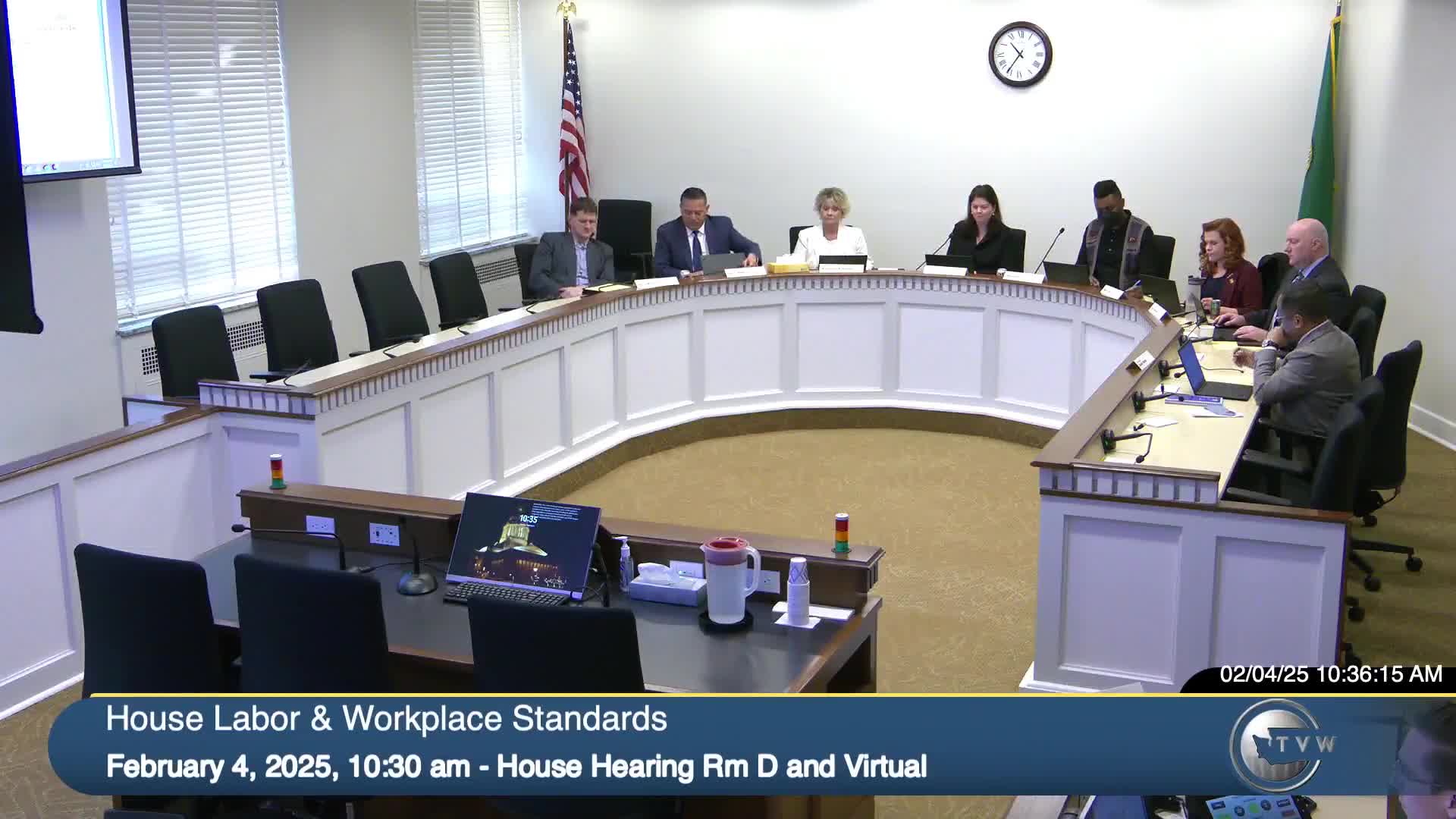
Committee hears bill to create wage-replacement program for workers excluded from unemployment insurance
Summary
House Bill 17-73 would establish a third‑party administered wage‑replacement program for workers ineligible for regular unemployment insurance, funded by a new surcharge on employer payroll taxes and other adjustments to UI-related employer contributions.
House Bill 17-73 would create a new wage-replacement program for workers who are currently excluded from regular unemployment insurance coverage. The bill directs the Employment Security Department (ESD) to select a third-party administrator to run the program, allows benefit applications beginning 01/01/2027, and requires claimants to show they worked at least 680 hours in the base year and meet other eligibility and residency criteria.
Staff explained that eligibility mirrors many unemployment insurance (UI) rules — for example, a claimant must demonstrate they were unemployed through no fault of their own, have worked 680 hours in the base year and complete a one-week waiting period. The staff briefing emphasized privacy and record limits: the bill would prohibit collecting certain demographic or immigration-status information for claimants, require destruction of verification records within 15 days after a claimant leaves the program, and make most program records confidential and exempt from the Public Records Act with specified exceptions.
Representative Julio Cortez (D), prime sponsor, framed the bill as extending a safety net to workers who have contributed payroll taxes but are barred from UI because of immigration status. "All Washingtonians deserve, a safety net if they experience a job loss through no fault of their own," Cortez said. He told the committee the proposal would cover "approximately or over 4,500 Washington families currently excluded from the unemployment system" and use a diversion method to fund the program without new general-fund costs.
Labor and immigrant-advocacy groups, including April Sims of the Washington State Labor Council and Sasha Wasserstrom of the Washington Immigrant Solidarity Network, testified in support, arguing the program would use existing employer contributions and protect workers' privacy while providing benefits. Sims said, "Undocumented workers keep our economy strong, contribute to our communities, and care for our families." Wasserstrom said the program "does not incur new costs to the employer or the state" and would be administered to maintain claimant privacy.
Business groups — including the Association of Washington Businesses and the Washington Food Industry Association — said they were neutral on the policy but opposed the bill's funding mechanism. Lindsay Huer (AWB) said the proposed shift "will place increased pressure on ESD's existing revenue sources and push additional pressures for state UI increases in the future." Carolyn Logue (Washington Food Industry Association) said employers worry using UI-related funds in this way could blunt the experience-rating penalty employers face when they lay off covered workers.
ESD staff said the department had engaged with the U.S. Department of Labor on conformity and believes the funding mechanism could meet federal requirements. Josh Dye, interim government relations director for ESD, said the department "believes it is, it would meet conformity requirements" in discussions with USDOL.
The committee heard emotional personal testimony from workers who said they lacked access to UI during the COVID-19 pandemic. Irvin Enriquez described being undocumented for more than two decades and said the proposed program would provide critical support for families.
No vote was taken; the committee left the measure open for further consideration and stakeholder work on the funding language and implementation details.