Get Full Government Meeting Transcripts, Videos, & Alerts Forever!
Get email alerts on the Hhsc Budget Article 2 topic
No spam. Unsubscribe anytime.
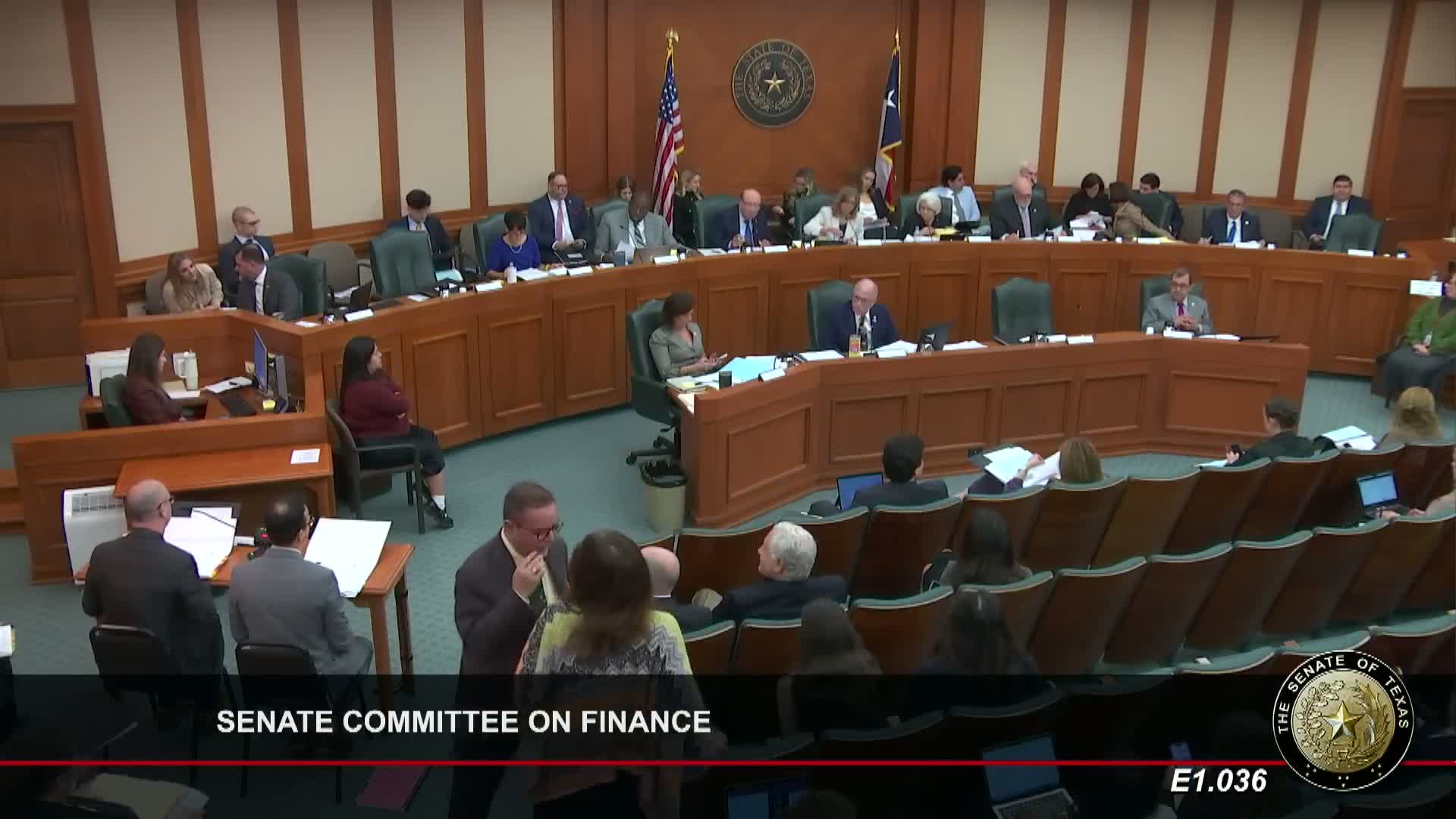
Senate Finance hears LBB and agency summary of HHSC Article 2 budget; members press on Medicaid forecasts and staffing
Summary
The Senate Finance Committee reviewed LBB and HHSC Article 2 budget recommendations, including a $94 billion all‑funds HHSC pattern with $74.4 billion for Medicaid client services; members pressed the agencies for more detail on rate changes, caseload forecasts and staffing for eligibility redetermination and state hospitals.
The Senate Finance Committee received a Legislative Budget Board summary of Article 2 (Health and Human Services) funding and a follow‑up presentation from the Health and Human Services Commission and agency staff. The discussion covered Medicaid and CHIP forecasts, provider rate increases, new state hospital capacity, community attendant wages, and staffing needs for eligibility and state hospital operations.
Eric Schroeder of the Legislative Budget Board summarized the LBB introduced recommendations for the 2026‑27 biennium: "Recommendations for the 2026‑27 biennium include $94,000,000,000 from all funds," he told the committee, noting the package is a 2.1% increase from the current adjusted base. LBB highlighted that recommended increases include $74.4 billion for Medicaid client services, a $4.3 billion rise driven largely by forecasted caseload growth and rate changes.
Key LBB numbers cited to the committee included a $2.0 billion allowance for forecasted Medicaid caseload growth and previously approved rate increases, and $1.8 billion to raise the base wage for community attendant services (often described in testimony as the proposed move to a $12 hourly base). Schroeder told senators the Medicaid client services recommendation totals $74,400,000,000 in all funds and called out a $547.6 million set of increases targeted to nursing facilities and maternal‑fetal radiology services.
Health and Human Services Commissioner Cecily Young thanked the panel for the preliminary funding pattern and described the agency’s priorities, including the agency’s workforce and eligibility processing: "The base budget represents a significant investment in HHSC services and operations, and I'm appreciative of this initial funding," Young said. Agency staff explained that recommendations also carry a request for additional state hospital staff to operate new Lubbock and Panhandle facilities and to open purchased inpatient capacity.
Committee members pressed LBB and HHSC on several topics: the composition of the $4.3 billion Medicaid increase; the mechanics of the proposed $1.8 billion community attendant wage increase; the narrowness of agency rebate projections for HIV pharmaceutical programs; and eligibility backlog staffing tied to the end of the federal public health emergency. Senator Kolkhorst and others sought a clearer breakdown of how rate increases will be implemented and whether the increases directed at MCOs will be passed through to providers. LBB noted the recommended increase to community attendant pay would raise the base toward $12 an hour and estimated it produces a substantial wage change for that workforce.
Committee members also asked about mental‑health and state hospital funding: LBB recommended $1.5 billion in general revenue and nearly 9,824 FTEs for state hospital operations, including operational funding for new hospitals and funding to expand capacity and deferred maintenance. The package also includes $701.6 million for purchased community mental health hospital capacity and $136 million for facility repairs and renovations.
Other items discussed included: integrated eligibility and enrollment funding ($1.8 billion, partly to address redetermination workload as continuous coverage ends), an OIG recommendation for case management system replacement ($135.8 million), and TECO funding to sustain the civil commitment office ($53.1 million). On women's health items, LBB told the panel that HTW (Healthy Texas Women) funding is forecasted to rise in the introduced recommendation based on caseload and carryover activity; LBB said the projection reflects agency‑reported caseload data rather than the agency's internal projections.
No formal committee votes were taken. Senators asked for follow‑up data on interim rate changes, details on projected caseload growth versus medical inflation, and specific lists of FTEs tied to state hospital openings and eligibility redetermination workloads. The committee deferred additional budget deliberations to future work sessions and asked LBB and HHSC to supply more detailed breakout schedules on rate changes and agency assumptions.