Get Full Government Meeting Transcripts, Videos, & Alerts Forever!
Get email alerts on the Remote Work topic
No spam. Unsubscribe anytime.
Senate Finance opens debate on state remote-work rules after LBB survey
Summary
Legislators heard a Legislative Budget Board overview of agency remote-work policies and raised concerns about customer service, cybersecurity and facilities use as state agencies consider retaining hybrid arrangements grown since the pandemic.
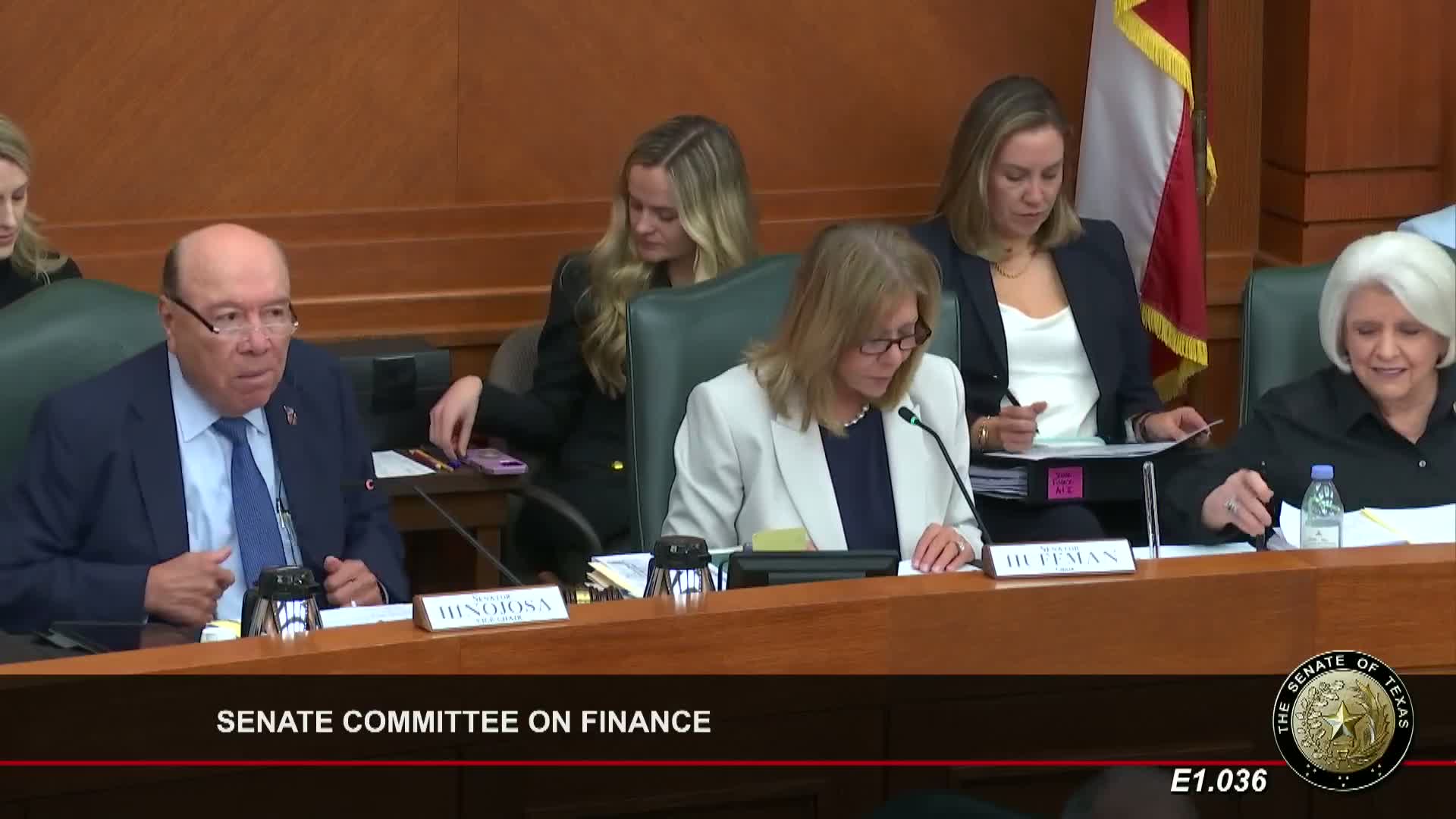
The Senate Finance Committee on Monday heard a Legislative Budget Board survey of state agency remote-work policies, prompting members to press for clearer statewide standards on when employees should work remotely and how agencies should measure service quality.
The LBB presentation by Julie Lindsay summarized responses the board collected in fall 2024: 96 executive and judicial agencies replied, and all but four reported allowing some form of remote work. Lindsay told the committee the data were self-reported and that the survey did not include institutions of higher education. "All but 4 of the agencies allow for some level of remote work," Lindsay said.
Committee members said the survey is a useful starting point but not enough to set policy. Senator Perry said the LBB study “is very skewed toward the agency’s perspective” and urged the panel to seek customer‑facing measures: "Did y'all inquire as far as actual customer service? I think the response would be an overwhelming, 'It ain't working,'" he said. Other senators echoed concerns about reduced office hours at local service offices and the risk that remote staffing can slow face‑to‑face customer access.
Committee members also raised cybersecurity and supervision issues. Senator Perry and others warned that extending state work into private residences can increase cyber risk: "When you extend the office into someone's bedroom ... we really open ourselves up for unnecessary and unwarranted possibles in the cyber wars," Perry said. Members pressed LBB and agency witnesses for more information about controls the agencies use to prevent off‑hours second jobs, monitor remote employees' productivity and secure state systems accessed from remote locations.
LBB's survey highlighted broad patterns but notable variety. Of 96 responding agencies, two said they were fully on‑site (the Texas School for the Deaf and the 12th Court of Appeals) while most reported some hybrid staffing. Regarding fiscal effects, 29 agencies reported positive fiscal impacts (reduced facility costs or turnover), two reported net negative fiscal impacts (costs for equipment and connectivity), and many reported no measurable impact. On recruitment and retention, 80 agencies saw positive effects and nine reported no impact. Responses on productivity were mixed: 46 agencies reported improved productivity, 40 reported no change.
Committee members asked LBB to dig deeper on specific measures—customer wait times, in‑person availability by office, the portion of staff working remotely who live within an hour of agency offices, and the presence and effectiveness of remote‑work monitoring policies. Several senators urged that agency heads seeking to make remote options permanent should be required to explain to appropriators how the arrangements affect service delivery and facility needs.
The committee did not take formal action on remote‑work policy but directed staff to gather more granular data. The chair said the committee will continue the discussion before it takes up budget decisions that affect agency facilities and staffing.