Get Full Government Meeting Transcripts, Videos, & Alerts Forever!
Get email alerts on the Large Loads Data Centers Crypto topic
No spam. Unsubscribe anytime.
Senators press ERCOT and PUC for visibility and limits on large loads, crypto and behind‑the‑meter arrangements
Summary
Committee members pressed regulators over rapid large-load interest — data centers and cryptocurrency mining — and how behind‑the‑meter contracts and new connection forms could reduce grid visibility. ERCOT and the PUC said registrations and new rules increase transparency but recommended statutory clarifications to define and monitor load types.
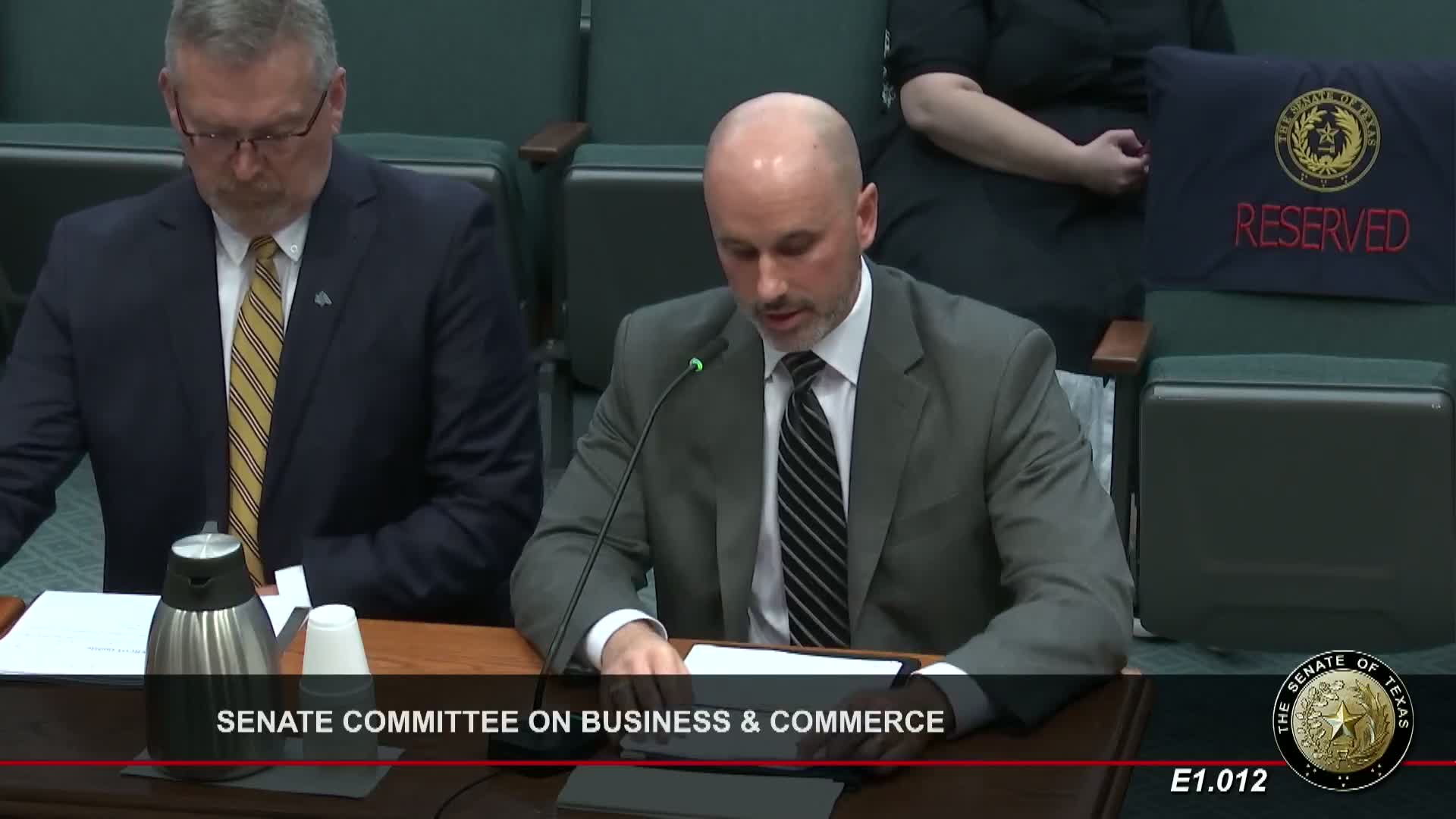
Senators questioned ERCOT and the Public Utility Commission of Texas about how large commercial loads and cryptocurrency mining facilities are being counted, monitored and connected to the grid.
Benjamin Barclay, chief executive and public counsel at the Office of Public Utility Counsel, highlighted concerns about cost allocation: “It follows that transmission cost allocation should be based on cost causation that reflects electricity usage by each class,” he said, pointing to large industrial growth in the Permian and recommending options such as voluntary demand-response programs and requiring proof of firm investment from large prospective loads.
Thomas Gleason and Woody Rickerson described current PUC rules requiring registration of large virtual currency mining facilities and the PUC’s interconnection allowances. Gleason said registrations were due on Feb. 1 and that so far 11 companies had registered representing 18 facilities and roughly 3,000 MW; he expected that amount to rise close to 4,000 MW by year‑end. Rickerson and Gleason both emphasized that ERCOT’s formal load forecast excludes only those loads the Transmission Service Providers deem realistic after a scrub of interest data.
Senators pressed on “behind‑the‑meter” arrangements where a large customer contracts with a colocated generator and the load is effectively removed from the grid’s metered peak for cost allocation purposes. ERCOT staff said the system treats all load as firm today and recommended a legislative definition or carve‑out to allow different treatment for such arrangements. Rickerson said: “All load is considered firm load. Your house, my house, and the data center are all firm load. And so having something that carves out a different definition for that type of load so that it can be treated differently is probably what's missing today.”
Committee members repeatedly urged mechanisms to ensure large facilities can commit to assist the grid in emergencies—e.g., switching to onsite backup generation so generating facilities can redirect power to the grid when needed. Regulators warned about side effects (for example emissions if backup is diesel) and urged federal coordination where environmental rules intersect emergency operations.
Why it matters: Large-load connections, when not visible or when treated differently in cost allocation, can shift costs to residential consumers and complicate reliability planning during peak emergencies. Senators signaled interest in legislation to tighten registration, require deposits or commitments from large prospective loads, and clarify cost allocation rules.
Ending: Regulators asked the Legislature to consider clarifying law to define load types, ensure ongoing registration and monitoring and to create incentives that align reliability and cost causation.