Get Full Government Meeting Transcripts, Videos, & Alerts Forever!
Get email alerts on the Transmission Planning 765kv topic
No spam. Unsubscribe anytime.
PUC and ERCOT outline Permian transmission options as Texas weighs 765 kV backbone
Summary
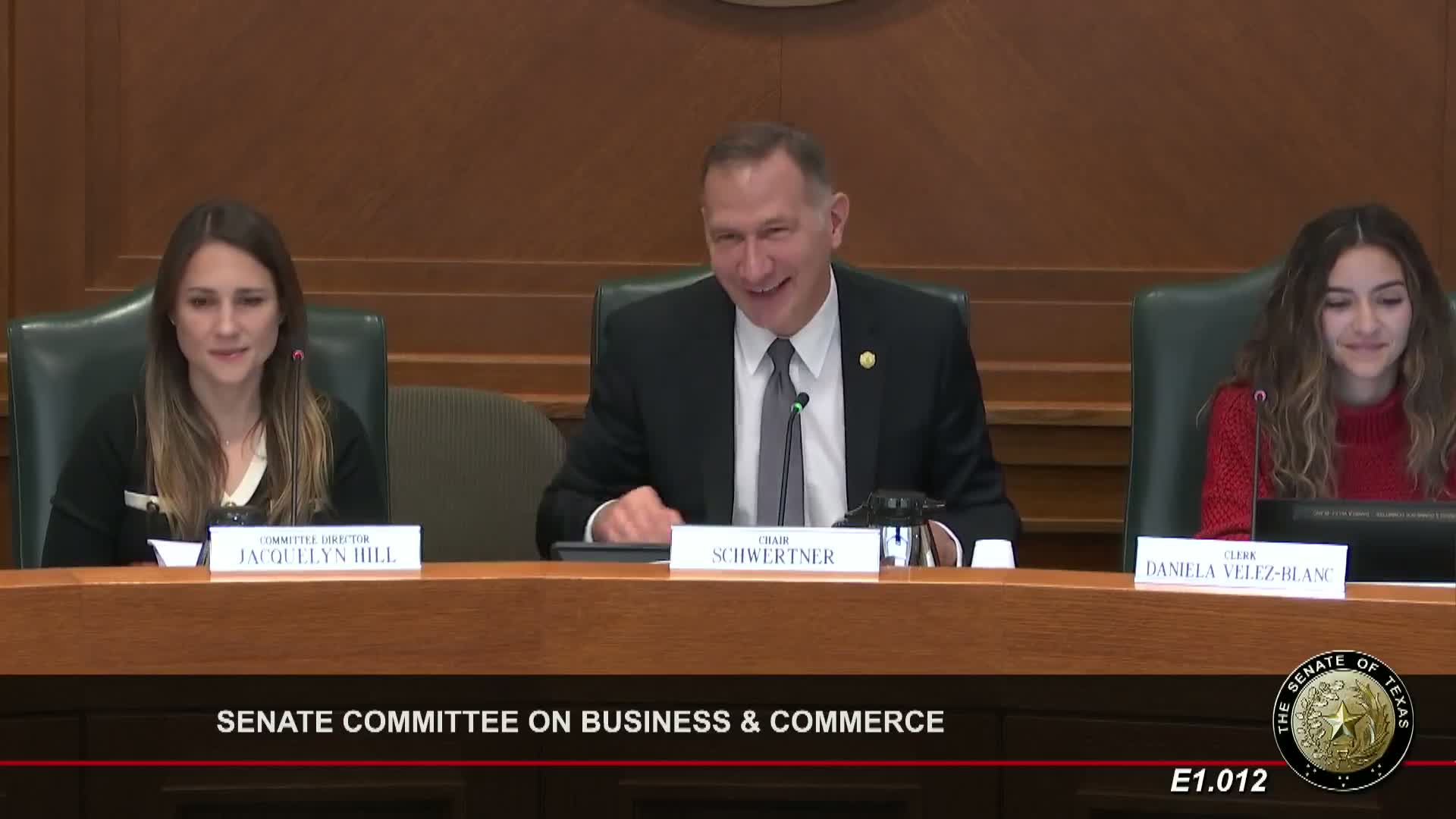
Senate Business and Commerce Committee Chair Charles Schwartner presided over a hearing where Thomas Gleason, chairman of the Public Utility Commission of Texas (PUC), and Woody Rickerson, senior vice president and chief operating officer of the Electric Reliability Council of Texas (ERCOT), detailed transmission planning for the Permian Basin and statewide backbone options.
Senate Business and Commerce Committee Chair Charles Schwartner presided over a hearing where Thomas Gleason, chairman of the Public Utility Commission of Texas (PUC), and Woody Rickerson, senior vice president and chief operating officer of the Electric Reliability Council of Texas (ERCOT), detailed transmission planning for the Permian Basin and statewide backbone options.
Gleason told the committee the PUC has been reviewing the regional transmission plan and that the agency will hold a stakeholder workshop on March 7 and deliberate in April. “If no decision is made, what was decided earlier in 2024 is if no decision to move to July is made, it will default to continuing with our March infrastructure,” Gleason said. He described the choice before the state as continuing to expand using 345 kV lines or moving to a 765 kV “backbone” to carry much larger transfers of power.
The debate centers on how quickly load is growing in West Texas—driven by oil-and-gas electrification, data centers and cryptocurrency operations—and how best to build enough transmission without repeated, costly retrofits. ERCOT’s regional transmission plan (RTP) compares a plan built largely with current 345 kV assets against a hybrid plan that includes 765 kV lines. Woody Rickerson said the 765 kV option offers greater transfer capability and flexibility to move power across long distances and would reduce the number of individual 345 kV lines needed to serve very large, gigawatt-scale loads.
The PUC and ERCOT told senators their cost estimates include contingencies for routing and right-of-way complexity—Gleason said the plan assumptions include a roughly 20% allowance to account for routing turns and similar field adjustments. Both agencies also said the unit-cost difference between the two planning approaches was not the sole determinant; the 765 kV option produces materially higher transfer capacity and could be more scalable if the large-load forecast materializes.
ERCOT officials told the panel the organization has cataloged more than 80,000 MW of interested large loads in its tracker of prospective projects, though not all of that interest becomes firm load in the official forecast. Rickerson said that the tracker increased to 83,000 MW from 63,000 MW in the prior year and that ERCOT’s formal load forecast will scrub and include only the portions that Transmission Service Providers consider realistic.
Gleason and Rickerson urged a deliberative process with stakeholders. “We will ultimately deliberate how to proceed forward in April,” Gleason said, adding that if the Legislature or stakeholders wish to weigh in the PUC welcomes that input.
Why it matters: transmission decisions determine where and how the grid can deliver power years from now. The choice affects costs for consumers, right-of-way needs, and whether Texas builds a higher-capacity spine that could serve future gigawatt-scale industrial and computing loads.
What’s next: the PUC hosts a workshop March 7 to gather stakeholder comments, will deliberate in April and—if no affirmative decision is reached to change course—will default to proceeding with the 345 kV approach in the near term.
Ending: Committee members asked for more transparency on cost allocation and potential bill impacts. Gleason and Rickerson said ERCOT and the PUC will continue stakeholder engagement and provide updated studies and cost scenarios to lawmakers ahead of any final decision.